JEE Challenger
More from Thermodynamics

Monatomic Ideal Gas Cyclic Process PT Diagram Matching List

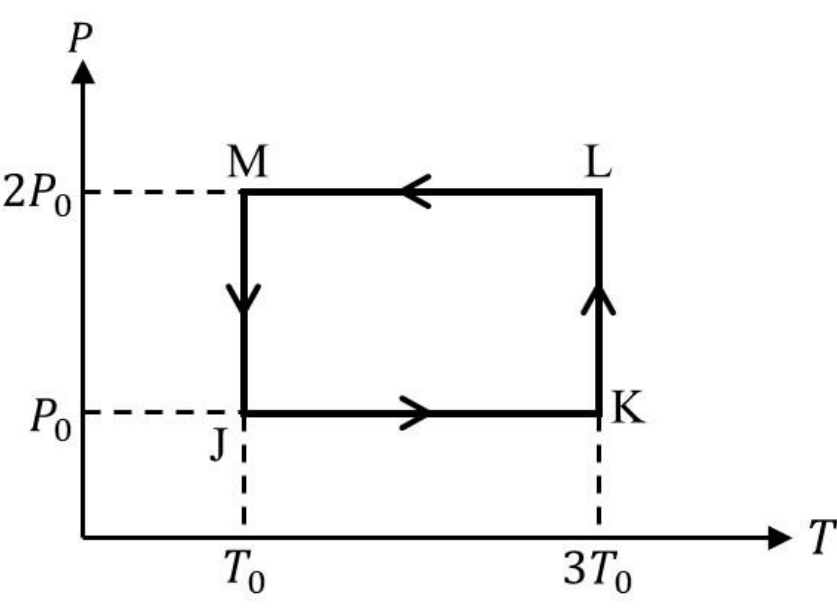
One mole of a monatomic ideal gas undergoes the cyclic process JKLMJ\text{J} \rightarrow \text{K} \rightarrow \text{L} \rightarrow \text{M} \rightarrow \text{J}, as shown in the P-T diagram.

Match the quantities mentioned in List-I with their values in List-II and choose the correct option.

[RR is the gas constant.]

List-IList-II(P) Work done in the complete cyclic process(1) RT04RT0ln2(Q) Change in the internal energy of the gas in the process JK(2) 0(R) Heat given to the gas in the process KL(3) 3RT0(S) Change in the internal energy of the gas in the process MJ(4) 2RT0ln2(5) 3RT0ln2\begin{array}{ll} \text{\textbf{List-I}} & \text{\textbf{List-II}} \\ \text{(P) Work done in the complete cyclic process} & \text{(1) } RT_0 - 4RT_0 \ln 2 \\ \text{(Q) Change in the internal energy of the gas in the process JK} & \text{(2) } 0 \\ \text{(R) Heat given to the gas in the process KL} & \text{(3) } 3RT_0 \\ \text{(S) Change in the internal energy of the gas in the process MJ} & \text{(4) } -2RT_0 \ln 2 \\ & \text{(5) } -3RT_0 \ln 2 \end{array}
Question Diagram 1

Options

A

P1;Q3;R5;S4\text{P} \rightarrow 1; \text{Q} \rightarrow 3; \text{R} \rightarrow 5; \text{S} \rightarrow 4

B

P4;Q3;R5;S2\text{P} \rightarrow 4; \text{Q} \rightarrow 3; \text{R} \rightarrow 5; \text{S} \rightarrow 2

Correct
C

P4;Q1;R2;S2\text{P} \rightarrow 4; \text{Q} \rightarrow 1; \text{R} \rightarrow 2; \text{S} \rightarrow 2

D

P2;Q5;R3;S4\text{P} \rightarrow 2; \text{Q} \rightarrow 5; \text{R} \rightarrow 3; \text{S} \rightarrow 4

Step-by-Step Solution

To solve the given problem, we analyze each step of the cyclic process JKLMJ\text{J} \rightarrow \text{K} \rightarrow \text{L} \rightarrow \text{M} \rightarrow \text{J} for n=1n = 1 mole of a monatomic ideal gas.

For a monatomic ideal gas, the molar heat capacity at constant volume is: CV=32RC_V = \frac{3}{2}R

From the given PTP-T diagram, the thermodynamic states are:

  • State J\text{J}: (P0,T0)(P_0, T_0)
  • State K\text{K}: (P0,3T0)(P_0, 3T_0)
  • State L\text{L}: (2P0,3T0)(2P_0, 3T_0)
  • State M\text{M}: (2P0,T0)(2P_0, T_0)

Step-by-Step Analysis of Each Process:

1. Process JK\text{J} \rightarrow \text{K} (Isobaric process at P=P0P = P_0):

  • Temperature changes from T0T_0 to 3T03T_0.
  • Work done (WJKW_{\text{JK}}): WJK=nR(TKTJ)=1R(3T0T0)=2RT0W_{\text{JK}} = nR(T_K - T_J) = 1 \cdot R \cdot (3T_0 - T_0) = 2RT_0
  • Change in internal energy (ΔUJK\Delta U_{\text{JK}}): ΔUJK=nCV(TKTJ)=1(32R)(3T0T0)=3RT0\Delta U_{\text{JK}} = n C_V (T_K - T_J) = 1 \cdot \left(\frac{3}{2}R\right)(3T_0 - T_0) = 3RT_0

This corresponds to (Q) \rightarrow (3).


2. Process KL\text{K} \rightarrow \text{L} (Isothermal process at T=3T0T = 3T_0):

  • Pressure changes from P0P_0 to 2P02P_0.
  • Change in internal energy (ΔUKL\Delta U_{\text{KL}}): ΔUKL=0\Delta U_{\text{KL}} = 0
  • Work done (WKLW_{\text{KL}}): WKL=nRTln(PKPL)=1R(3T0)ln(P02P0)=3RT0ln2W_{\text{KL}} = n R T \ln \left(\frac{P_K}{P_L}\right) = 1 \cdot R(3T_0) \ln \left(\frac{P_0}{2P_0}\right) = -3RT_0 \ln 2
  • By the First Law of Thermodynamics, the heat given to the gas (QKLQ_{\text{KL}}) is: QKL=ΔUKL+WKL=3RT0ln2Q_{\text{KL}} = \Delta U_{\text{KL}} + W_{\text{KL}} = -3RT_0 \ln 2

This corresponds to (R) \rightarrow (5).


3. Process LM\text{L} \rightarrow \text{M} (Isobaric process at P=2P0P = 2P_0):

  • Temperature changes from 3T03T_0 to T0T_0.
  • Work done (WLMW_{\text{LM}}): WLM=nR(TMTL)=1R(T03T0)=2RT0W_{\text{LM}} = nR(T_M - T_L) = 1 \cdot R \cdot (T_0 - 3T_0) = -2RT_0

4. Process MJ\text{M} \rightarrow \text{J} (Isothermal process at T=T0T = T_0):

  • Pressure changes from 2P02P_0 to P0P_0.
  • Change in internal energy (ΔUMJ\Delta U_{\text{MJ}}): ΔUMJ=0\Delta U_{\text{MJ}} = 0 (since TM=TJ=T0T_M = T_J = T_0)

This corresponds to (S) \rightarrow (2).

  • Work done (WMJW_{\text{MJ}}): WMJ=nRTln(PMPJ)=1RT0ln(2P0P0)=RT0ln2W_{\text{MJ}} = n R T \ln \left(\frac{P_M}{P_J}\right) = 1 \cdot R T_0 \ln \left(\frac{2P_0}{P_0}\right) = RT_0 \ln 2

Total Work Done in the Cyclic Process (P):

Wtotal=WJK+WKL+WLM+WMJW_{\text{total}} = W_{\text{JK}} + W_{\text{KL}} + W_{\text{LM}} + W_{\text{MJ}} Wtotal=2RT0+(3RT0ln2)+(2RT0)+(RT0ln2)=2RT0ln2W_{\text{total}} = 2RT_0 + (-3RT_0 \ln 2) + (-2RT_0) + (RT_0 \ln 2) = -2RT_0 \ln 2

This corresponds to (P) \rightarrow (4).


Final Matching Summary:

  • (P) Work done in complete cyclic process \rightarrow (4)
  • (Q) Change in internal energy in JK \rightarrow (3)
  • (R) Heat given to gas in KL \rightarrow (5)
  • (S) Change in internal energy in MJ \rightarrow (2)

P4;Q3;R5;S2\text{P} \rightarrow 4; \quad \text{Q} \rightarrow 3; \quad \text{R} \rightarrow 5; \quad \text{S} \rightarrow 2

Thus, the correct option is B.

Monatomic Ideal Gas Cyclic Process PT Diagram Matching List | Physics PYQ Solution - JEE Challenger