JEE Challenger
More from Hydrocarbons

Molar Mass of Major Product in Multistep Reaction of Alkyne

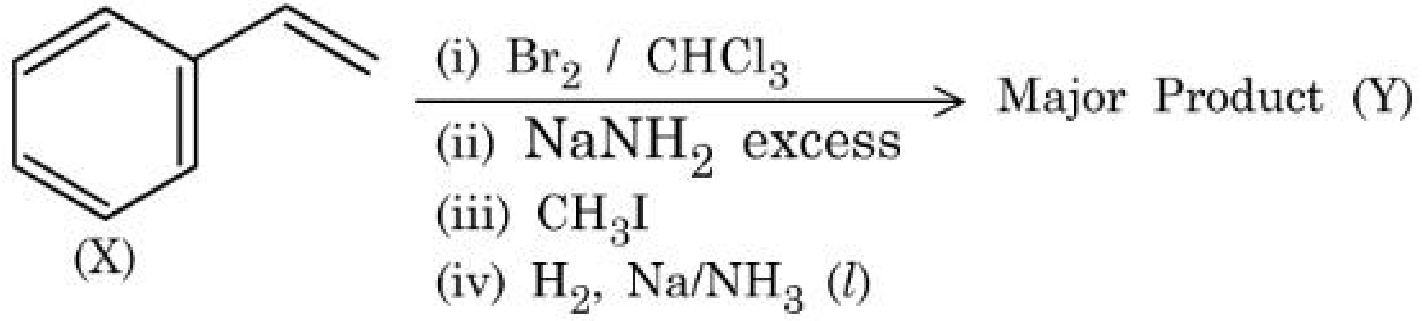
Compound (X) is subjected to the sequence of reactions as shown above. Molar mass of the major product (Y) formed is ________ g mol1\text{g mol}^{-1}.

(Given molar mass in g mol1\text{g mol}^{-1} C:12\text{C}: 12, H:1\text{H}: 1, O:16\text{O}: 16)

Question Diagram 1

Options

A

90

B

118

Correct
C

160

D

125

Step-by-Step Solution

To determine the molar mass of the major product (Y)(Y), we analyze each step of the reaction sequence starting from compound (X)(X), which is styrene (C6H5-CH=CH2\text{C}_6\text{H}_5\text{-CH=CH}_2):

  1. Step (i): Addition of Bromine (Br2/CHCl3\text{Br}_2 / \text{CHCl}_3) Styrene undergoes electrophilic addition of bromine across its alkene double bond to form 1,2-dibromo-1-phenylethane: C6H5-CH=CH2+Br2CHCl3C6H5-CH(Br)-CH2Br\text{C}_6\text{H}_5\text{-CH=CH}_2 + \text{Br}_2 \xrightarrow{\text{CHCl}_3} \text{C}_6\text{H}_5\text{-CH(Br)-CH}_2\text{Br}

  2. Step (ii): Double Dehydrohalogenation (NaNH2 excess\text{NaNH}_2 \text{ excess}) Treatment of the vicinal dibromide with excess sodium amide (NaNH2\text{NaNH}_2) causes two consecutive E2\text{E2} eliminations to yield phenylacetylene. Since excess NaNH2\text{NaNH}_2 is present, the acidic hydrogen of the terminal alkyne is deprotonated to form sodium phenylacetylide: C6H5-CH(Br)-CH2Brexcess NaNH2C6H5-CCNa+\text{C}_6\text{H}_5\text{-CH(Br)-CH}_2\text{Br} \xrightarrow{\text{excess NaNH}_2} \text{C}_6\text{H}_5\text{-C}\equiv\text{C}^- \text{Na}^+

  3. Step (iii): Alkylation (CH3I\text{CH}_3\text{I}) The acetylide ion acts as a strong nucleophile and reacts with iodomethane via an SN2\text{S}_\text{N}2 pathway to yield an internal alkyne, 1-phenylprop-1-yne: C6H5-CCNa++CH3IC6H5-CC-CH3+NaI\text{C}_6\text{H}_5\text{-C}\equiv\text{C}^- \text{Na}^+ + \text{CH}_3\text{I} \longrightarrow \text{C}_6\text{H}_5\text{-C}\equiv\text{C-CH}_3 + \text{NaI}

  4. Step (iv): Birch Reduction of Alkyne (Na/NH3(l)\text{Na/NH}_3 (l)) Reduction of internal alkynes using sodium in liquid ammonia selectively converts the alkyne into a trans-alkene. Thus, 1-phenylprop-1-yne is reduced to (E)-1-phenylprop-1-ene: C6H5-CC-CH3Na/NH3(l)C6H5-CH=CH-CH3Product (Y)\text{C}_6\text{H}_5\text{-C}\equiv\text{C-CH}_3 \xrightarrow{\text{Na/NH}_3(l)} \text{C}_6\text{H}_5\text{-CH=CH-CH}_3 \quad \text{Product }(Y)


Calculation of Molar Mass of Product (Y)(Y):

  • Molecular formula of (Y)(Y): C9H10\text{C}_9\text{H}_{10}

    • Benzene ring: C6H5\text{C}_6\text{H}_5
    • Propenyl group: CH=CHCH3-\text{CH}=\text{CH}-\text{CH}_3
  • Molar Mass: Molar Mass=(9×12)+(10×1)=108+10=118 g mol1\text{Molar Mass} = (9 \times 12) + (10 \times 1) = 108 + 10 = 118 \text{ g mol}^{-1}

Therefore, the molar mass of the major product (Y)(Y) is 118 g mol1118 \text{ g mol}^{-1}, which corresponds to Option B.

Molar Mass of Major Product in Multistep Reaction of Alkyne | Chemistry PYQ Solution - JEE Challenger