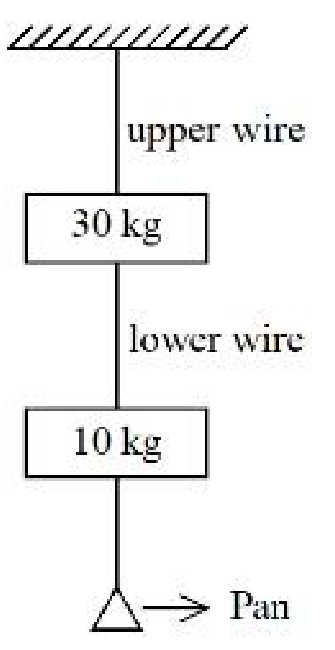
To find the maximum mass m that can be added to the pan without breaking either wire, we must determine the maximum tension each wire can tolerate before reaching its breaking stress.
1. Calculation of Maximum Tolerable Tension
The breaking stress for steel is given as:
σbreaking=12×108 N/m2
For the Upper Wire:
- Area of cross-section, A1=0.008 cm2=0.008×10⁻⁴ m2=8×10⁻⁷ m2
- Maximum tension allowed, T1,max:
T1,max=σbreaking×A1=(12×108 N/m2)×(8×10−7 m2)=960 N
For the Lower Wire:
- Area of cross-section, A2=0.004 cm2=0.004×10⁻⁴ m2=4×10⁻⁷ m2
- Maximum tension allowed, T2,max:
T2,max=σbreaking×A2=(12×108 N/m2)×(4×10−7 m2)=480 N
2. Tension Equations in Terms of Added Mass (m)
Let m be the mass added to the pan (with g=10 m/s2).
-
Lower Wire: Supports the 10 kg block and the added mass m in the pan.
T2=(10+m)g=(10+m)×10
-
Upper Wire: Supports the 30 kg block, the lower wire, the 10 kg block, and the added mass m in the pan.
T1=(30+10+m)g=(40+m)×10
3. Conditions to Prevent Wire Failure
Condition 1: Upper wire does not break
T1≤T1,max
(40+m)×10≤960
40+m≤96
m≤56 kg
Condition 2: Lower wire does not break
T2≤T2,max
(10+m)×10≤480
10+m≤48
m≤38 kg
Conclusion
To ensure that neither wire breaks, m must satisfy both constraints:
m=min(56 kg,38 kg)=38 kg
Thus, the maximum mass that can be added to the pan without breaking any wire is 38 kg.
Correct Answer: B