Maximum Height Increase of Center of Mass for Rolling Regular Polygons
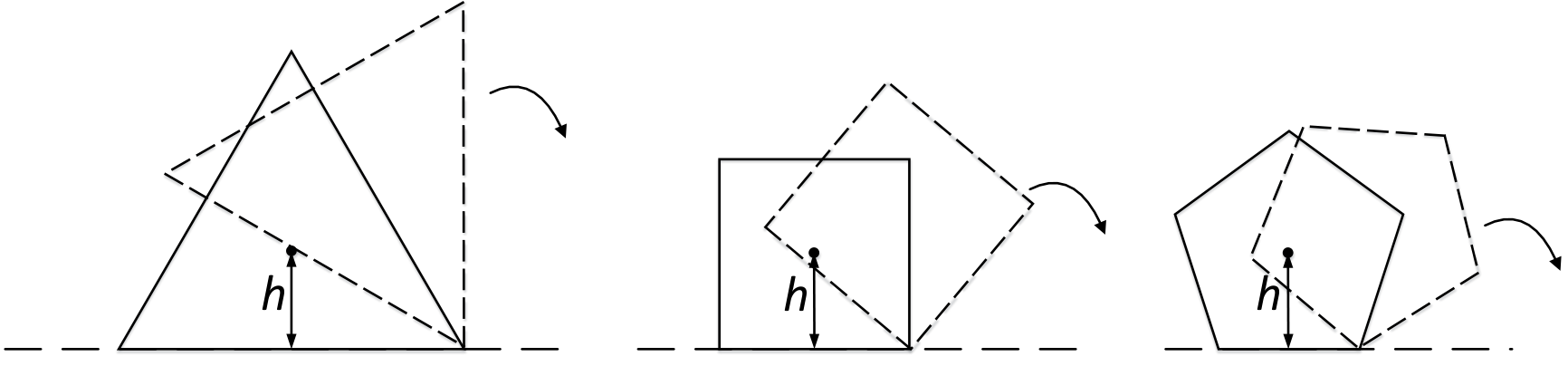
Consider regular polygons with the number of sides as depicted in the figure. Each polygon has its center of mass situated at a height above the flat ground. These polygons pivot and roll along a flat horizontal surface around their leading vertex without slipping or sliding. The maximum increase in height of the center of mass locus for each polygon depends on and according to:
Options
Step-by-Step Solution
To determine the maximum increase in height of the locus of the center of mass for a regular -sided polygon rolling along a flat horizontal surface, we analyze the geometry of the polygon during its rotation about a leading vertex.
-
Geometry of the Polygon in Flat Resting Position: When the polygon rests flat on one of its sides on the horizontal surface, its center of mass lies directly above the midpoint of that side at a vertical height .
A regular -sided polygon can be divided into congruent isosceles triangles, with vertices at the center of mass and the vertices of the polygon. The angle subtended by each side at the center of mass is:
The line segment from the center of mass to the midpoint of a side bisects this angle, forming a right-angled triangle with half-angle:
-
Distance from Center of Mass to a Vertex: Let be the distance from the center of mass of the polygon to any of its vertices (i.e., the circumradius of the polygon). From the right triangle formed by the center of mass, the midpoint of a side, and a vertex, we have:
Solving for gives:
-
Motion during Pivoting: When the polygon rolls without slipping, it pivots around its leading vertex. During this pivoting motion, the distance between the center of mass and the pivot vertex remains constant at . Thus, the center of mass traces out a circular arc of radius centered at the pivot vertex.
-
Maximum and Minimum Height of Center of Mass:
- The minimum height of the center of mass occurs when a side is fully in contact with the flat ground:
- The maximum height of the center of mass occurs when the line connecting the pivot vertex to the center of mass becomes vertical:
-
Maximum Height Increase : The maximum increase in the height of the center of mass above its minimum position is:
Factoring out :
Therefore, the correct option is B.