Maximum Height Change of Pivoted Disk Center After Collision
Comprehension Passage
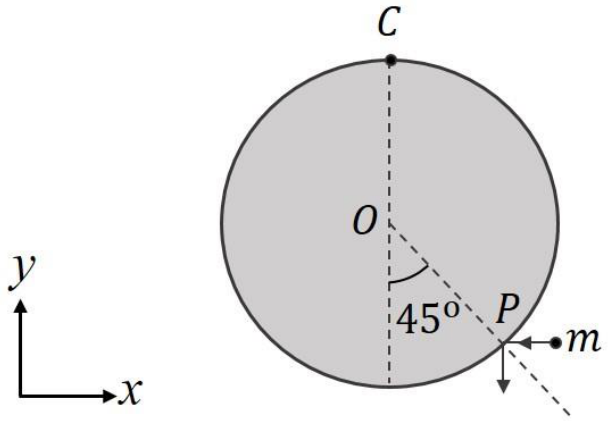
A uniform circular disk of radius 0.2 m and mass 1 kg is pivoted at its top point C such that it can rotate freely around C in the XY plane, as shown in the figure. Initially, when the disk is at rest, a particle of mass 20 g, travelling along negative x direction in the XY plane with speed 100 ms−1, hits the circumference of the disk at a point P. After collision the particle moves along negative y direction at a speed of 90 ms−1.
[Given: the acceleration due to gravity (g)=−10j^ ms−2]
After the collision the disk starts to rotate around point C in the XY plane. The maximum change in the height (in m) of its center O is:
To find the maximum change in the height of the disk's center O after the collision, we analyze the system using the conservation of angular momentum about the pivot point C during the collision, followed by the conservation of mechanical energy as the disk swings upward.
1. Geometric Setup and System Parameters
Given parameters:
Mass of the disk, M=1 kg
Radius of the disk, R=0.2 m
Mass of the particle, m=20 g=0.02 kg
Initial velocity of particle, v1=−100i^ m s−1
Final velocity of particle, v2=−90j^ m s−1
Acceleration due to gravity, g=10 m s−2
Let point C be the origin (0,0). The center O is at (0,−R).
From the given geometry, the point of impact P is at a radial distance R from O at an angle of 45∘ with the vertical line CO. Thus, the position vector of point P relative to C is:
rP/C=Rsin45∘i^−(R+Rcos45∘)j^=2Ri^−R(1+21)j^
2. Moment of Inertia of the Disk
By the parallel axis theorem, the moment of inertia of the disk about the pivot C is:
IC=Icm+MR2=21MR2+MR2=23MR2
Substituting the given values:
IC=23(1 kg)(0.2 m)2=0.06 kg m2
3. Conservation of Angular Momentum about Pivot C
Since the reaction force during the collision acts at pivot C, its torque about C is zero. Therefore, angular momentum about C is conserved:
Li=Lf
Final Angular Momentum (Lf):Lf=rP/C×(mv2)+ICωk^Lf=[2Ri^−R(1+21)j^]×(−mv2j^)+ICωk^=[−mv22R+ICω]k^
Equating the z-components:
−mv1R(1+21)=−mv22R+ICω
Rearranging for ICω:
ICω=mR[2v2−v1(1+21)]
Substituting the numerical values:
0.06ω=(0.02)(0.2)[290−100(1+21)]0.06ω=0.004(−100−210)=−0.004(100+52)ω=−0.060.004(100+52)=−320+2 rad s−1
The magnitude of the angular velocity is:
∣ω∣=320+2≈7.138 rad s−1
4. Conservation of Energy After Collision
Right after the collision, the kinetic energy of the disk is entirely rotational:
K=21ICω2K=21(0.06)(320+2)2=0.03×9400+402+2=300402+402 J
Using 2≈1.4142:
K≈300402+40(1.4142)=300458.568≈1.5286 J
As the disk swings up to its maximum height, this rotational kinetic energy is completely converted into gravitational potential energy of the disk's center of mass O:
ΔU=Mgh1.5286=(1 kg)(10 m s−2)hh=101.5286≈0.153 m
Thus, the maximum change in height of the disk's center O is approximately 0.15 m.
Maximum Height Change of Pivoted Disk Center After Collision | Physics PYQ Solution - JEE Challenger