Maximum Frequency Variation Received Between Oscillating Transmitter and Receiver
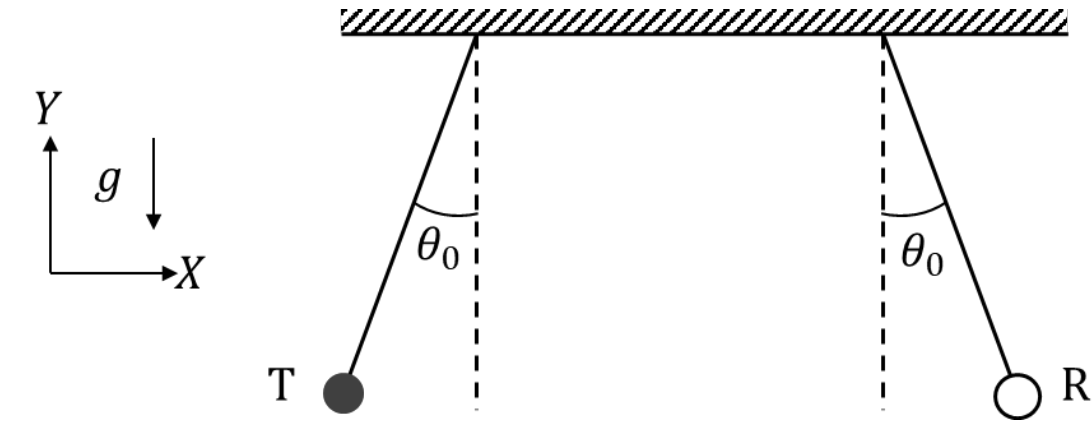
An audio transmitter (T) and a receiver (R) are hung vertically from two identical massless strings of length with their pivots well separated along the axis. They are pulled from the equilibrium position in opposite directions along the axis by a small angular amplitude and released simultaneously. If the natural frequency of the transmitter is and the speed of sound in air is , the maximum variation in the frequency (in Hz) as measured by the receiver (Take the acceleration due to gravity ) is ______
Topics & Concepts
Step-by-Step Solution
To find the maximum variation in the frequency as measured by the receiver, we first determine the maximum speeds of the transmitter () and the receiver ().
Step 1: Maximum Speed of the Pendulums
Both the transmitter and the receiver are identical simple pendulums suspended from strings of length . They are released from rest from an initial angular amplitude , where .
Using the principle of conservation of mechanical energy for either pendulum:
Solving for :
Given:
Step 2: Doppler Effect Calculations
Since both pendulums are released simultaneously in opposite directions from their respective equilibrium positions, they pass through their lowest points simultaneously:
- Moving towards each other: Both reach their maximum speed towards one another, yielding the maximum frequency .
- Moving away from each other: Half a period later, both reach their maximum speed directed away from one another, yielding the minimum frequency .
Given parameters:
- Natural frequency,
- Speed of sound in air,
Maximum Observed Frequency ():
Minimum Observed Frequency ():
Step 3: Maximum Variation in Frequency
The maximum variation in frequency () is the total range between the maximum and minimum measured frequencies:
Substituting the numerical values:
Using the approximation :
The maximum variation in the frequency measured by the receiver is 32.