Maximum Angular Deviation in Elastic Collision of Unequal Masses
In a scattering experiment, a particle of mass collides with another particle of mass , which is initially at rest. Assuming the collision to be perfectly elastic, the maximum angular deviation of the heavier particle, as shown in the figure, in radians is:
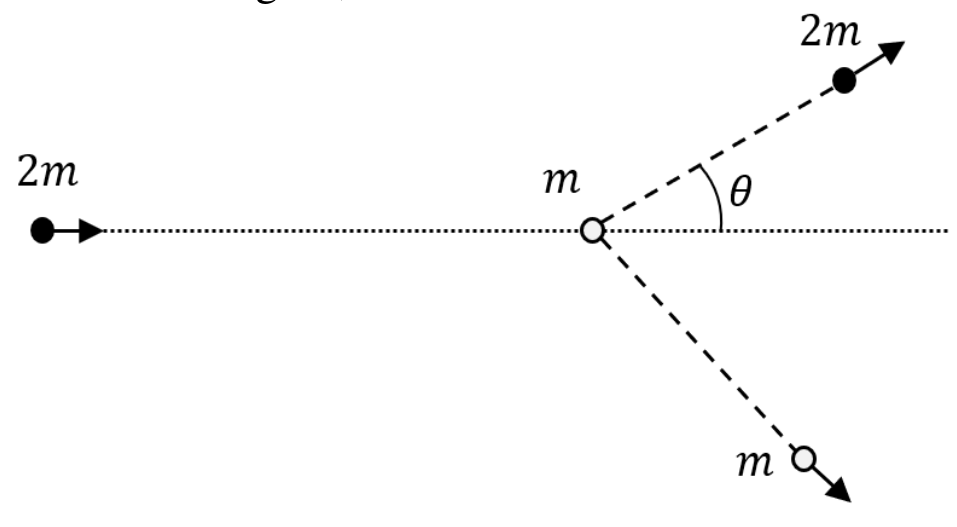
Options
Topics & Concepts
Step-by-Step Solution
To find the maximum angular deviation of the incident particle in the laboratory frame, we can analyze the collision using the Center of Mass (CM) frame.
1. Velocity in the Center of Mass (CM) Frame:
Let the incident particle of mass move with an initial velocity along the positive -axis, and the target particle of mass be at rest.
The velocity of the center of mass is given by:
In the CM frame, the initial velocity of the heavier particle is:
2. Post-Collision Velocity:
Since the collision is perfectly elastic, the magnitude of the velocity of the particle in the CM frame remains unchanged after scattering:
Let be the scattering angle of the heavier particle in the CM frame. The velocity of the particle in the laboratory frame is the vector sum of the CM velocity and the velocity relative to the CM:
The components of the laboratory velocity are:
3. Maximum Angular Deviation:
Geometrically, the vector is obtained by adding a vector of fixed magnitude (which can point in any direction ) to a fixed vector of magnitude .
Thus, the tip of lies on a circle of radius centered at a distance from the origin along the -axis.
Since , the origin lies strictly outside this circle. The maximum angular deviation in the laboratory frame occurs when the line representing the velocity vector is tangent to this circle.
At the point of tangency:
Therefore:
Hence, the correct option is (D).