JEE Challenger
More from Thermodynamics

Matching Thermodynamic Quantities for Ideal Gas in PV Diagram

Comprehension Passage

Consider a thermodynamic process performed on an ideal monatomic gas where infinitesimal heat absorbed by the gas is represented by TΔXT \Delta X, in which TT denotes the system's temperature and ΔX\Delta X represents an infinitesimal variation in a thermodynamic quantity XX. For one mole of a monatomic ideal gas, X=32Rln⁡(TTA)+Rln⁡(VVA)X = \frac{3}{2} R \ln \left(\frac{T}{T_A}\right) + R \ln \left(\frac{V}{V_A}\right), where RR is the universal gas constant, VV is the volume, and TA,VAT_A, V_A are constant parameters.

List-I details certain quantities in a process, whereas List-II provides potential values for these quantities.

List-I: (I) Work done by the system during process 1→2→31 \rightarrow 2 \rightarrow 3 (II) Internal energy change during process 1→2→31 \rightarrow 2 \rightarrow 3 (III) Heat absorbed by the system during process 1→2→31 \rightarrow 2 \rightarrow 3 (IV) Heat absorbed by the system during process 1→21 \rightarrow 2

List-II: (P) 13RT0ln⁡2\frac{1}{3} R T_0 \ln 2 (Q) 13RT0\frac{1}{3} R T_0 (R) RT0R T_0 (S) 43RT0\frac{4}{3} R T_0 (T) 13RT0(3+ln⁡2)\frac{1}{3} R T_0 (3 + \ln 2) (U) 56RT0\frac{5}{6} R T_0

If one mole of a monatomic ideal gas undergoes the process depicted in the given P−VP-V diagram with P0V0=13RT0P_0 V_0 = \frac{1}{3} R T_0, select the correct matching combination.
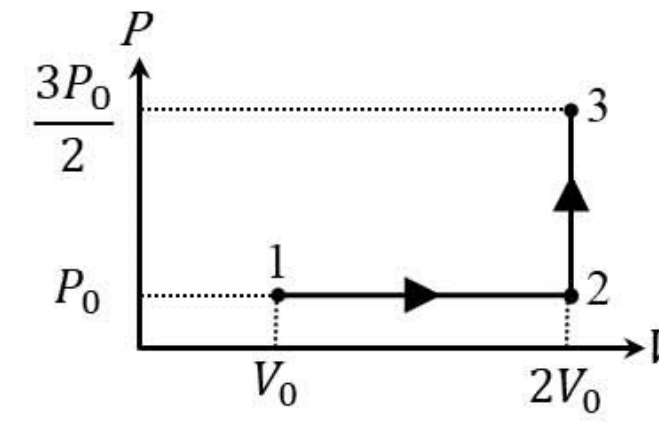
Question Diagram 1

Options

A

I→Q,II→R,III→P,IV→U\text{I} \rightarrow \text{Q}, \text{II} \rightarrow \text{R}, \text{III} \rightarrow \text{P}, \text{IV} \rightarrow \text{U}

B

I→Q,II→R,III→S,IV→U\text{I} \rightarrow \text{Q}, \text{II} \rightarrow \text{R}, \text{III} \rightarrow \text{S}, \text{IV} \rightarrow \text{U}

Correct
C

I→S,II→R,III→Q,IV→T\text{I} \rightarrow \text{S}, \text{II} \rightarrow \text{R}, \text{III} \rightarrow \text{Q}, \text{IV} \rightarrow \text{T}

D

I→Q,II→S,III→R,IV→U\text{I} \rightarrow \text{Q}, \text{II} \rightarrow \text{S}, \text{III} \rightarrow \text{R}, \text{IV} \rightarrow \text{U}

Step-by-Step Solution

To determine the correct matching combination, we analyze the states of 1 mole1\text{ mole} of the monatomic ideal gas (CV=32RC_V = \frac{3}{2}R, CP=52RC_P = \frac{5}{2}R) from the given P−VP-V diagram.

Given relation: P0V0=13RT0  ⟹  RT0=3P0V0P_0 V_0 = \frac{1}{3} R T_0 \implies R T_0 = 3 P_0 V_0

Step 1: Determine Temperature at Each State

Using the ideal gas equation PV=RTP V = R T (for n=1n = 1 mole):

  • State 1: P1=P0,V1=V0P_1 = P_0, \quad V_1 = V_0 T1=P1V1R=P0V0R=T03T_1 = \frac{P_1 V_1}{R} = \frac{P_0 V_0}{R} = \frac{T_0}{3}

  • State 2: P2=P0,V2=2V0P_2 = P_0, \quad V_2 = 2V_0 T2=P2V2R=2P0V0R=23T0T_2 = \frac{P_2 V_2}{R} = \frac{2P_0 V_0}{R} = \frac{2}{3} T_0

  • State 3: P3=32P0,V3=2V0P_3 = \frac{3}{2}P_0, \quad V_3 = 2V_0 T3=P3V3R=(32P0)(2V0)R=3P0V0R=T0T_3 = \frac{P_3 V_3}{R} = \frac{\left(\frac{3}{2}P_0\right)(2V_0)}{R} = \frac{3P_0 V_0}{R} = T_0


Step 2: Evaluate Quantities in List-I

(I) Work done by the system during process 1→2→31 \rightarrow 2 \rightarrow 3:

  • Process 1→21 \rightarrow 2 is an isobaric expansion at pressure P0P_0: W1→2=P0(V2−V1)=P0(2V0−V0)=P0V0=13RT0W_{1 \rightarrow 2} = P_0 (V_2 - V_1) = P_0 (2V_0 - V_0) = P_0 V_0 = \frac{1}{3} R T_0
  • Process 2→32 \rightarrow 3 is an isochoric process (V=2V0V = 2V_0): W2→3=0W_{2 \rightarrow 3} = 0

Thus, the total work done is: W1→2→3=W1→2+W2→3=13RT0W_{1 \rightarrow 2 \rightarrow 3} = W_{1 \rightarrow 2} + W_{2 \rightarrow 3} = \frac{1}{3} R T_0

I→Q\text{I} \rightarrow \text{Q}


(II) Change in internal energy during process 1→2→31 \rightarrow 2 \rightarrow 3:

Internal energy depends only on initial and final temperature: ΔU1→2→3=nCV(T3−T1)=(1)(32R)(T0−T03)=32R(23T0)=RT0\Delta U_{1 \rightarrow 2 \rightarrow 3} = n C_V (T_3 - T_1) = (1) \left(\frac{3}{2} R\right) \left(T_0 - \frac{T_0}{3}\right) = \frac{3}{2} R \left(\frac{2}{3} T_0\right) = R T_0

II→R\text{II} \rightarrow \text{R}


(III) Heat absorbed by the system during process 1→2→31 \rightarrow 2 \rightarrow 3:

By the First Law of Thermodynamics: Q1→2→3=ΔU1→2→3+W1→2→3=RT0+13RT0=43RT0Q_{1 \rightarrow 2 \rightarrow 3} = \Delta U_{1 \rightarrow 2 \rightarrow 3} + W_{1 \rightarrow 2 \rightarrow 3} = R T_0 + \frac{1}{3} R T_0 = \frac{4}{3} R T_0

III→S\text{III} \rightarrow \text{S}


(IV) Heat absorbed by the system during process 1→21 \rightarrow 2:

Since process 1→21 \rightarrow 2 is isobaric: Q1→2=nCP(T2−T1)=(1)(52R)(23T0−13T0)=52R(13T0)=56RT0Q_{1 \rightarrow 2} = n C_P (T_2 - T_1) = (1) \left(\frac{5}{2} R\right) \left(\frac{2}{3} T_0 - \frac{1}{3} T_0\right) = \frac{5}{2} R \left(\frac{1}{3} T_0\right) = \frac{5}{6} R T_0

IV→U\text{IV} \rightarrow \text{U}


Conclusion:

The correct matching combination is: I→Q,II→R,III→S,IV→U\text{I} \rightarrow \text{Q}, \quad \text{II} \rightarrow \text{R}, \quad \text{III} \rightarrow \text{S}, \quad \text{IV} \rightarrow \text{U}

This corresponds to Option B.