JEE Challenger
More from Thermodynamics

Matching Thermodynamic Processes in PV Diagram with Properties

A single mole of a monatomic ideal gas undergoes four thermodynamic processes as schematically illustrated in the PVPV-diagram below. Among these four processes, one is isobaric, one is isochoric, one is isothermal, and one is adiabatic. Pair each process listed in List-I with the appropriate statement from List-II.
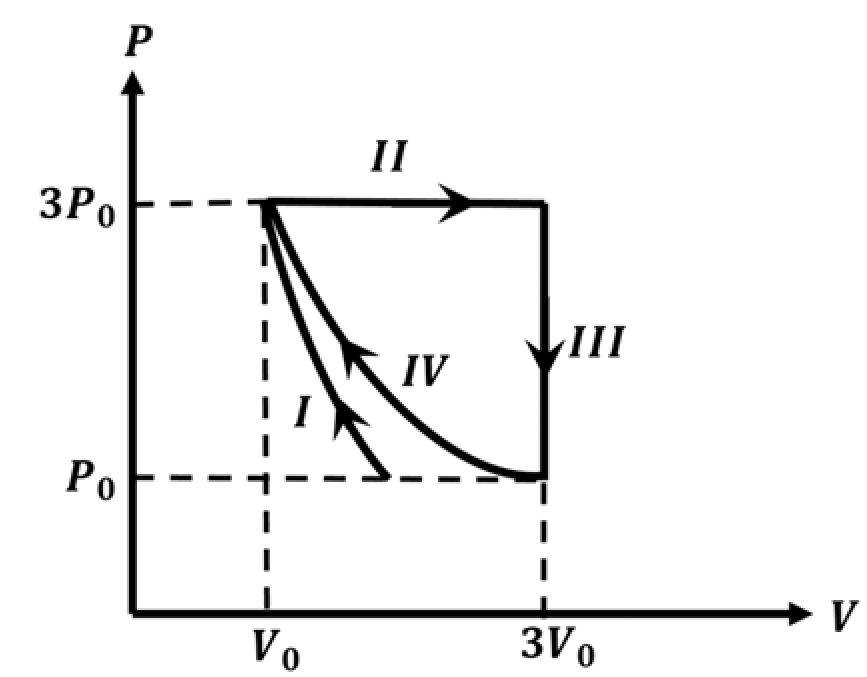
LIST–ILIST–IIP. In process I1. Work done by the gas is zeroQ. In process II2. Temperature of the gas remains unchangedR. In process III3. No heat is exchanged between the gas and its surroundingsS. In process IV4. Work done by the gas is 6P0V0\begin{array}{ll} \textbf{LIST--I} & \textbf{LIST--II} \\ \text{P. In process I} & \text{1. Work done by the gas is zero} \\ \text{Q. In process II} & \text{2. Temperature of the gas remains unchanged} \\ \text{R. In process III} & \text{3. No heat is exchanged between the gas and its surroundings} \\ \text{S. In process IV} & \text{4. Work done by the gas is } 6P_0V_0 \end{array}
Question Diagram 1

Options

A

P→4;Q→3;R→1;S→2\text{P} \rightarrow 4; \quad \text{Q} \rightarrow 3; \quad \text{R} \rightarrow 1; \quad \text{S} \rightarrow 2

B

P→1;Q→3;R→2;S→4\text{P} \rightarrow 1; \quad \text{Q} \rightarrow 3; \quad \text{R} \rightarrow 2; \quad \text{S} \rightarrow 4

C

P→3;Q→4;R→1;S→2\text{P} \rightarrow 3; \quad \text{Q} \rightarrow 4; \quad \text{R} \rightarrow 1; \quad \text{S} \rightarrow 2

Correct
D

P→3;Q→4;R→2;S→1\text{P} \rightarrow 3; \quad \text{Q} \rightarrow 4; \quad \text{R} \rightarrow 2; \quad \text{S} \rightarrow 1

Step-by-Step Solution

To determine the correct matching between List-I and List-II, we analyze the four thermodynamic processes shown in the PVPV-diagram:

  1. Process II (Horizontal line):

    • The pressure remains constant at P=3P0P = 3P_0 while the volume changes from V0V_0 to 3V03V_0. Thus, process II is isobaric.
    • The work done by the gas in process II is given by: WII=PΔV=3P0(3V0−V0)=6P0V0W_{\text{II}} = P \Delta V = 3P_0 (3V_0 - V_0) = 6P_0V_0
    • This matches statement 4 in List-II.
    • Therefore, Q →\rightarrow 4.
  2. Process III (Vertical line):

    • The volume remains constant at V=3V0V = 3V_0 while the pressure decreases from 3P03P_0 to P0P_0. Thus, process III is isochoric.
    • The work done by the gas in process III is: WIII=∫P dV=0W_{\text{III}} = \int P \, dV = 0
    • This matches statement 1 in List-II.
    • Therefore, R →\rightarrow 1.
  3. Process IV (Curve to (3V0,P0)(3V_0, P_0)):

    • At the initial state (V0,3P0)(V_0, 3P_0), the product of pressure and volume is: PiVi=(3P0)(V0)=3P0V0P_i V_i = (3P_0)(V_0) = 3P_0V_0
    • At the final state (3V0,P0)(3V_0, P_0), the product of pressure and volume is: PfVf=(P0)(3V0)=3P0V0P_f V_f = (P_0)(3V_0) = 3P_0V_0
    • Since PV=constantPV = \text{constant}, process IV follows an isothermal path.
    • In an isothermal process, the temperature of the gas remains unchanged throughout the process.
    • This matches statement 2 in List-II.
    • Therefore, S →\rightarrow 2.
  4. Process I (Steeper curve):

    • Since the slope of an adiabatic curve (PVγ=constantPV^\gamma = \text{constant}, with γ>1\gamma > 1) is steeper than that of an isothermal curve (PV=constantPV = \text{constant}), curve I represents the adiabatic process.
    • By definition, in an adiabatic process, no heat is exchanged between the gas and its surroundings (ΔQ=0\Delta Q = 0).
    • This matches statement 3 in List-II.
    • Therefore, P →\rightarrow 3.

Combining the results: P→3;Q→4;R→1;S→2\text{P} \rightarrow 3; \quad \text{Q} \rightarrow 4; \quad \text{R} \rightarrow 1; \quad \text{S} \rightarrow 2

This corresponds to Option (C).