Matching Reaction Sequences to Diol Products in Cyclic Alkenes and Ketones
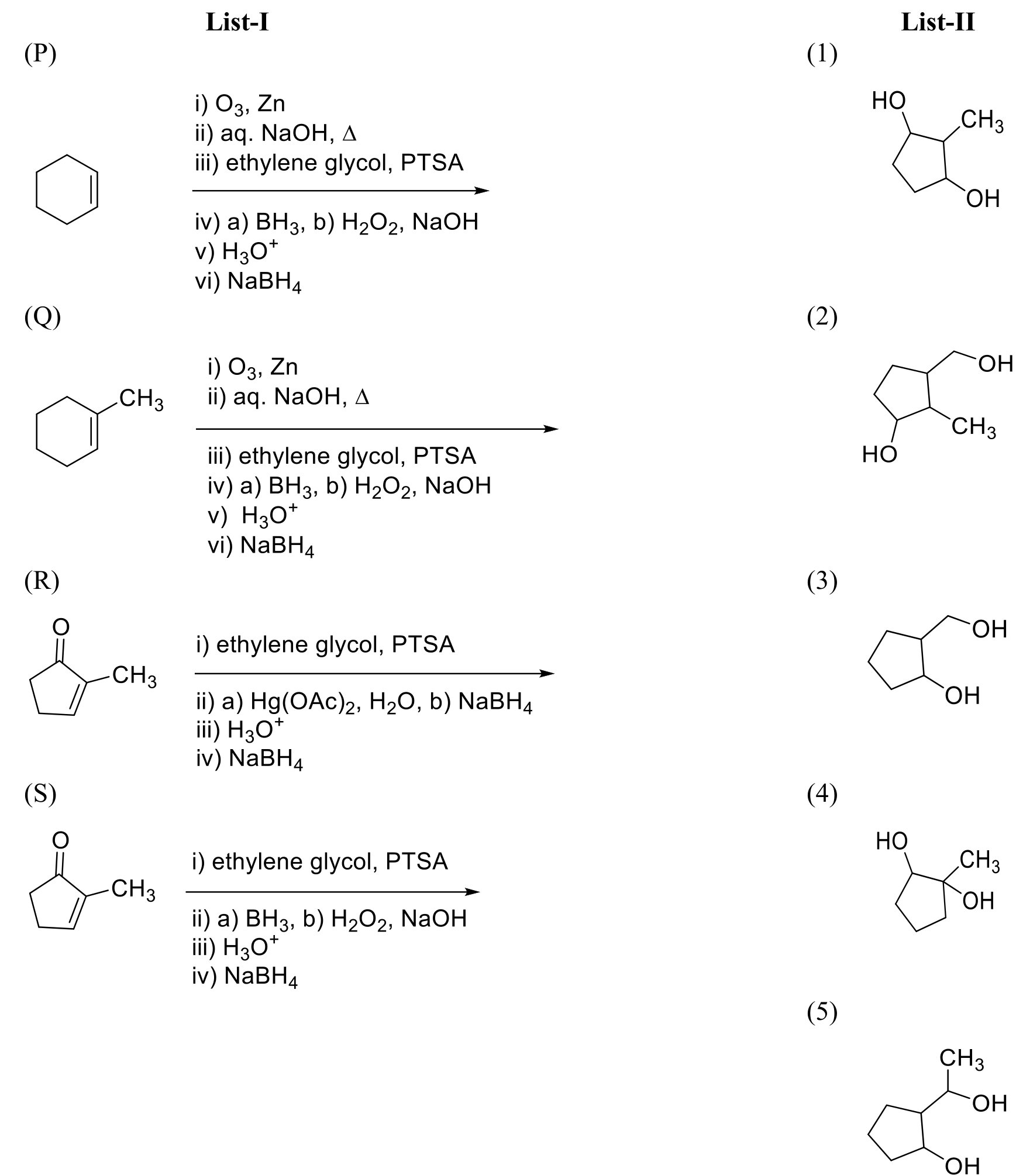
List-I contains various reaction sequences and List-II contains the possible products. Match each entry in List-I with the appropriate entry in List-II and choose the correct option.
Options
P-3, Q-5, R-4, S-1
P-3, Q-2, R-4, S-1
P-3, Q-5, R-1, S-4
P-5, Q-2, R-4, S-1
Step-by-Step Solution
To determine the correct matching between the reaction sequences in List-I and the final products in List-II, we analyze each sequence step-by-step:
Reaction (P)
-
(Reductive Ozonolysis):
Cleavage of the double bond in cyclohexene yields hexanedial:
-
(Intramolecular Aldol Condensation):
An enolate formed at attacks the carbonyl carbon at , forming a 5-membered ring. Upon dehydration, this yields cyclopent-1-ene-1-carbaldehyde. -
Ethylene glycol, PTSA (Acetal Protection):
Protects the aldehyde () group as a cyclic acetal (-dioxolane ring) while leaving the alkene double bond intact, giving 2-(cyclopent-1-en-1-yl)-1,3-dioxolane. -
a) , b) (Hydroboration-Oxidation):
Adds and across the double bond in an anti-Markovnikov manner. The group attaches to the less substituted carbon ( of the ring). -
(Deprotection):
Hydrolyzes the acetal back to the aldehyde group (). -
(Reduction):
Reduces the aldehyde group () to a primary alcohol ().
Product: , which corresponds to (3) in List-II.
Reaction (Q)
-
(Reductive Ozonolysis):
Cleavage of -methylcyclohex--ene yields -oxoheptanal:
-
(Intramolecular Aldol Condensation):
The enolate at (alpha to the ketone) attacks the more electrophilic aldehyde carbon (), forming a 5-membered ring. Dehydration gives -acetylcyclopent--ene:
-
Ethylene glycol, PTSA (Ketal Protection):
Protects the acetyl ketone () group as a cyclic ketal. -
a) , b) (Hydroboration-Oxidation):
Anti-Markovnikov addition of to the less substituted alkene carbon ( of the ring). -
(Deprotection):
Hydrolyzes the ketal back to the methyl ketone group (). -
(Reduction):
Reduces the ketone () to a secondary alcohol ().
Product: , which corresponds to (5) in List-II.
Reaction (R)
-
Ethylene glycol, PTSA (Ketal Protection):
Protects the carbonyl group of -methylcyclopent--en--one as a cyclic ketal, preserving the double bond. -
a) , b) (Oxymercuration-Demercuration):
Markovnikov addition of and without rearrangement. The group attaches to the more substituted carbon (, which bears the methyl group). -
(Deprotection):
Hydrolyzes the ketal back to the ketone at . -
(Reduction):
Reduces the ketone at to a secondary alcohol group ().
Product: -methylcyclopentane--diol, which corresponds to (4) in List-II.
Reaction (S)
-
Ethylene glycol, PTSA (Ketal Protection):
Protects the carbonyl group of -methylcyclopent--en--one as a cyclic ketal. -
a) , b) (Hydroboration-Oxidation):
Anti-Markovnikov addition across the double bond placing at the less substituted carbon () and at the methyl-bearing carbon (). -
(Deprotection):
Hydrolyzes the ketal back to the ketone at . -
(Reduction):
Reduces the ketone at to a secondary alcohol group ().
Product: -methylcyclopentane--diol, which corresponds to (1) in List-II.
Conclusion:
Matching each entry:
This set of matches corresponds to Option (A).