Matching Nucleophilic Substitution Reactions with Product Features
Match the reactions in List-I with the features of their products in List-II and choose the correct option.
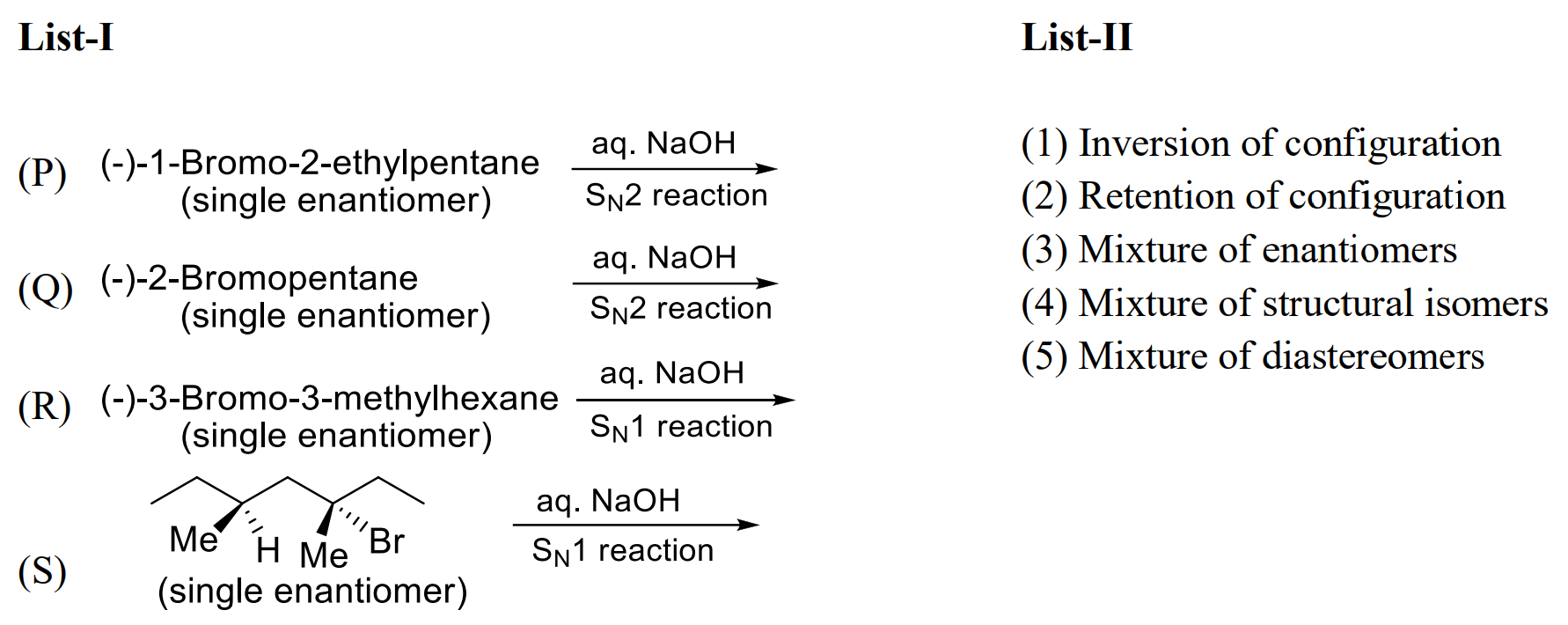
Options
A
B
Correct
C
D
Step-by-Step Solution
To determine the correct matching between List-I and List-II, we analyze each reaction individually based on its mechanism and stereochemical outcome:
-
Reaction (P):
- Reactant: -1-Bromo-2-ethylpentane (single enantiomer).
- Structure: .
- Analysis: The molecule has a chiral center at , whereas the leaving group () is attached to . Under conditions with aqueous , the nucleophile () attacks the primary carbon . Because no bonds at the chiral center are broken or formed during the reaction, the configuration at the chiral center remains completely unchanged.
- Feature of product: Retention of configuration (2).
- Therefore, .
-
Reaction (Q):
- Reactant: -2-Bromopentane (single enantiomer).
- Structure: .
- Analysis: The single chiral center () bears the leaving group (). The reaction undergoes a classic bimolecular nucleophilic substitution (), where the nucleophile attacks from the side opposite to the leaving group (backside attack). This leads to a Walden inversion at the chiral carbon.
- Feature of product: Inversion of configuration (1).
- Therefore, .
-
Reaction (R):
- Reactant: -3-Bromo-3-methylhexane (single enantiomer).
- Structure: .
- Analysis: The molecule contains a single tertiary chiral carbon at . Under conditions, heterolytic cleavage of the bond forms an achiral, trigonal planar carbocation intermediate: Nucleophilic attack by occurs with equal probability from either top or bottom face of the planar carbocation, producing a mixture of and enantiomers (racemic mixture).
- Feature of product: Mixture of enantiomers (3).
- Therefore, .
-
Reaction (S):
- Reactant: The substrate possesses two chiral centers, one of which carries the leaving group ().
- Analysis: Under conditions, ionization occurs at the chiral center bearing the group to form a planar carbocation. Subsequent attack by the nucleophile () generates both and configurations at this reactive chiral center. However, the second chiral center remains completely unreacted and retains its initial fixed configuration. Since the resulting products differ in configuration at one chiral center but have the identical configuration at the other, they are non-superimposable non-mirror images of each other (diastereomers).
- Feature of product: Mixture of diastereomers (5).
- Therefore, .
Combining all the individual matches:
This set of matches corresponds to Option B.