Matching Major Products of Oxime Reactions in List I to List II
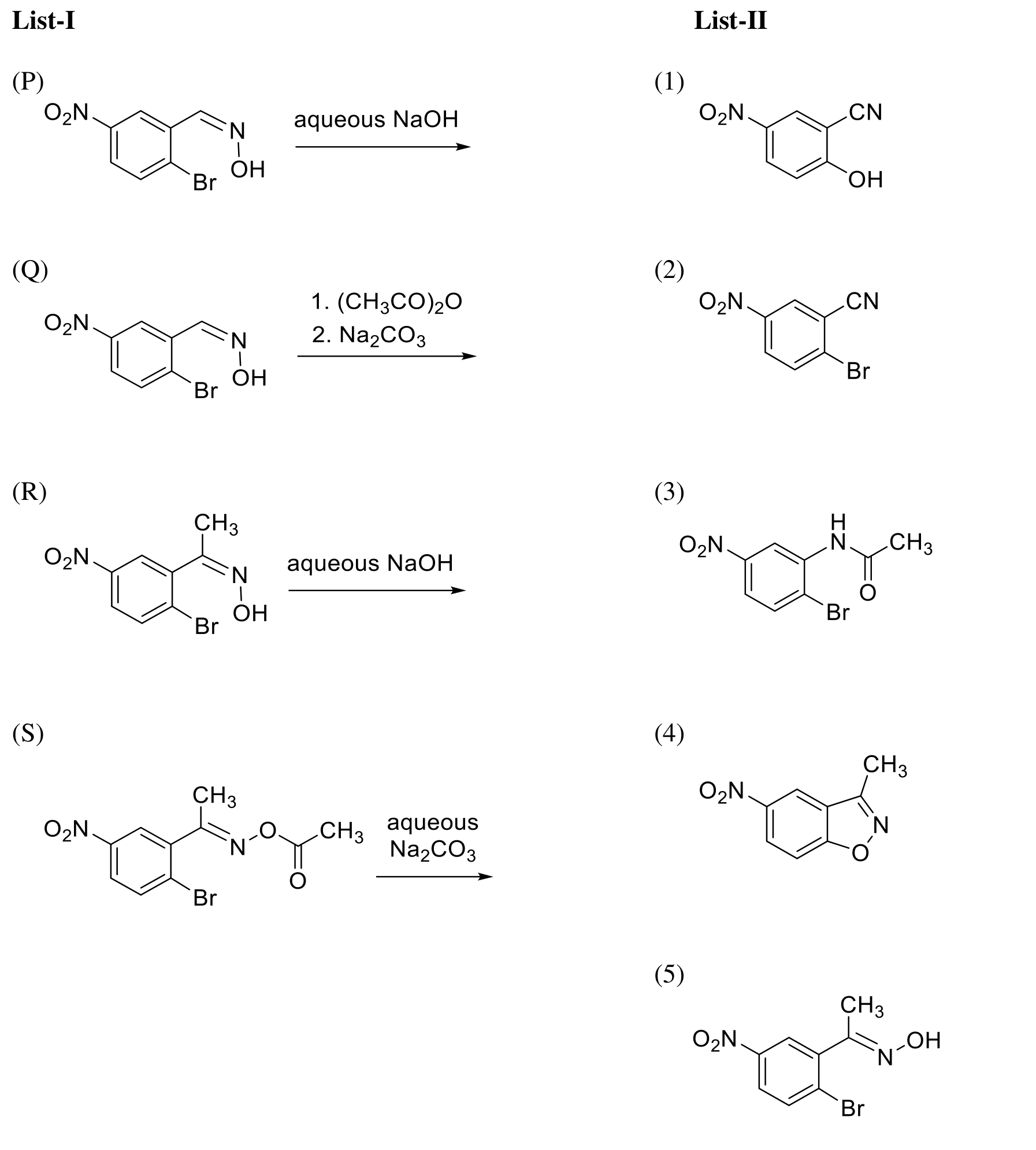
Match the major products obtained in the reactions given in List-I with the corresponding structures in List-II and choose the correct option.
Options
A
B
Correct
C
D
Step-by-Step Solution
To determine the correct matching between List-I and List-II, we analyze the reaction mechanisms for each transformation step-by-step:
-
Reaction (P):
- Substrate: -2-bromo-5-nitrobenzaldehyde oxime.
- Reagent: Aqueous .
- Mechanism:
- Aqueous deprotonates the hydroxyl group of the aldoxime to form an oximate anion:
- The oximate oxygen acts as an nucleophile and undergoes an intramolecular nucleophilic aromatic substitution () by attacking the ortho-position, displacing the bromide ion () which is strongly activated by the group. This forms a 5-nitro-1,2-benzisoxazole intermediate.
- Because 1,2-benzisoxazole contains a acidic proton at C-3, the strongly basic medium () abstracts this proton, triggering ring-opening elimination to yield the 2-hydroxy-5-nitrobenzonitrile.
- Matching:
-
Reaction (Q):
- Substrate: 2-bromo-5-nitrobenzaldehyde oxime.
- Reagents: 1. , 2. .
- Mechanism:
- Acetic anhydride acetylates the oxime hydroxyl group to form an -acetyl aldoxime intermediate:
- Subsequent treatment with a mild base () facilitates elimination of acetic acid to yield the 2-bromo-5-nitrobenzonitrile, leaving the aromatic ring bromine atom intact.
- Matching:
-
Reaction (R):
- Substrate: 1-(2-bromo-5-nitrophenyl)ethan-1-one oxime (a ketoxime).
- Reagent: Aqueous .
- Mechanism:
- Deprotonation by produces the ketoximate anion.
- Intramolecular displacement of the ortho-bromo substituent forms 3-methyl-5-nitro-1,2-benzisoxazole.
- Unlike the aldoxime in reaction (P), the C-3 position of this benzisoxazole ring bears a methyl group () instead of a hydrogen atom. Lacking an acidic C-3 hydrogen, base-catalyzed ring opening cannot occur, and the 3-methyl-5-nitro-1,2-benzisoxazole remains as the stable final product.
- Matching:
-
Reaction (S):
- Substrate: 1-(2-bromo-5-nitrophenyl)ethan-1-one -acetyl oxime.
- Reagent: Aqueous .
- Mechanism:
- Aqueous provides mild basic conditions that selectively hydrolyze the acetate ester bond () without causing nucleophilic displacement on the aromatic ring.
- Hydrolysis regenerates the parent ketoxime, 1-(2-bromo-5-nitrophenyl)ethan-1-one oxime.
- Matching:
Comparing the derived matches:
This set of matches corresponds to Option (B).