Matching Current Configurations with Resulting Magnetic Field Effects
Two wires each carrying a steady current are shown in four configurations in Column I. Some of the resulting effects are described in Column II. Match the statements in Column I with the statements in Column II and indicate your answer by darkening appropriate bubbles in the matrix given in the ORS.
Column I
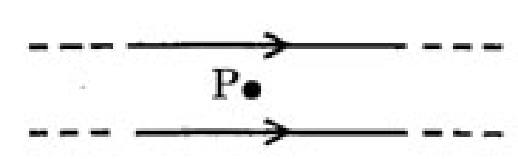
(A) Point P is situated midway between the wires.
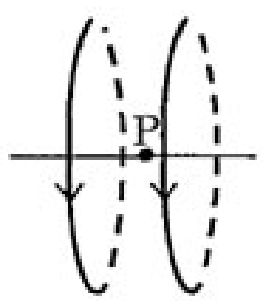
(B) Point P is situated at the mid-point of the line joining the centers of the circular wires, which have same radii.
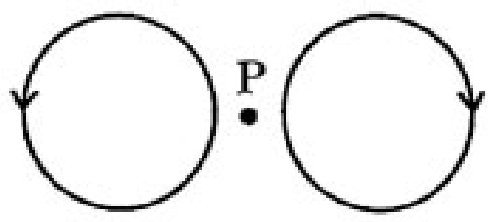
(C) Point P is situated at the mid-point of the line joining the centers of the circular wires, which have same radii.
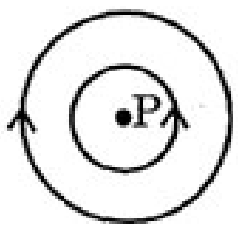
(D) Point P is situated at the common center of the wires.
Column II
(p) The magnetic fields () at P due to the currents in the wires are in the same direction.
(q) The magnetic fields () at P due to the currents in the wires are in opposite directions.
(r) There is no magnetic field at P.
(s) The wires repel each other.
Options
Step-by-Step Solution
Step-by-step Matching:
- Configuration (A): Two parallel straight wires carrying equal currents in the same direction, with point P situated midway between the wires.
- By the right-hand rule, the magnetic field at P due to the top wire points into the page (), and that due to the bottom wire points out of the page (). Thus, the fields are in opposite directions ().
- Since P is equidistant from both wires carrying equal currents, the magnitudes are equal (), so they cancel each other out completely: , meaning there is no magnetic field at P ().
- Parallel currents in the same direction attract each other, so they do not repel.
Hence, .
- Configuration (B): Two coaxial circular loops of same radii carrying currents in the same sense, with point P at the mid-point of the line joining their centers.
- By the right-hand rule, the magnetic fields produced along the common axis by both circular wires point in the same direction ().
Hence, .
- Configuration (C): Two coplanar circular loops of same radii, with point P at the mid-point of the line joining their centers.
- By the right-hand rule, the magnetic fields produced at P are in opposite directions ().
- By symmetry, the magnitudes are equal and opposite, so net magnetic field at P is zero ().
Hence, .
- Configuration (D): Two concentric coplanar circular loops carrying currents in opposite senses, with point P at the common center.
- The magnetic field due to one loop is perpendicular to the plane in one sense, while that due to the other loop is in the opposite sense. Thus, the magnetic fields at P are in opposite directions ().
- Because the radii of the two concentric wires differ (), the magnitudes do not cancel completely ().
- Portions of the concentric wires have opposite current directions, so they exert a repulsive magnetic force on each other ().
Hence, (or alone as per official IIT JEE key).
Matching:
Correct Answer: B