Match Relative Velocity Magnitudes for Different Particle Systems
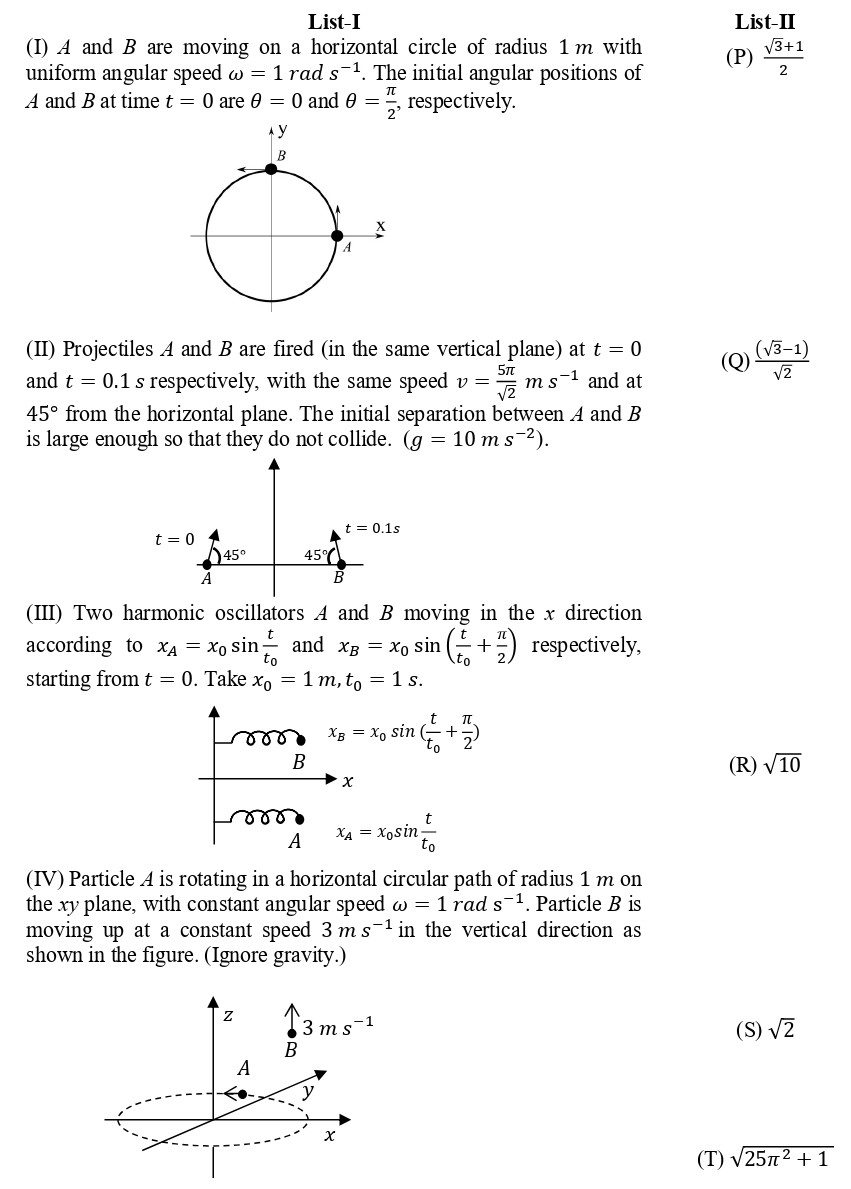
List I describes four systems, each with two particles A and B in relative motion as shown in figures. List II gives possible magnitudes of their relative velocities (in m s−1) at time t=3π s.
To determine the correct matching between List-I and List-II, we analyze each particle system individually at time t=3π s.
System (I)
Particle A and particle B undergo uniform circular motion in the xy-plane with radius R=1 m and angular velocity ω=1 rad s−1.
Initial angular positions at t=0:
θA(0)=0,θB(0)=2π
Angular positions at time t:
θA(t)=ωt,θB(t)=ωt+2π
The velocity vectors for A and B are given by:
vA=Rω(−sin(ωt)i^+cos(ωt)j^)vB=Rω(−sin(ωt+2π)i^+cos(ωt+2π)j^)=Rω(−cos(ωt)i^−sin(ωt)j^)
The relative velocity vector vA/B=vA−vB is:
vA/B=Rω[(cos(ωt)−sin(ωt))i^+(cos(ωt)+sin(ωt))j^]
The magnitude of relative velocity is:
∣vA/B∣=Rω(cos(ωt)−sin(ωt))2+(cos(ωt)+sin(ωt))2=Rω2
Substituting R=1 m and ω=1 rad s−1:
∣vA/B∣=2 m s−1
Thus, (I) → (S).
System (II)
Projectiles A and B are launched with speed v=25π m s−1 at an angle of 45∘ with the horizontal plane.
A is fired at t=0 s towards the right (+x direction):
uAx=vcos45∘=25π m s−1,uAy=vsin45∘=25π m s−1vA(t)=25πi^+(25π−gt)j^
B is fired at t=0.1 s towards the left (−x direction):
uBx=−vcos45∘=−25π m s−1,uBy=vsin45∘=25π m s−1vB(t)=−25πi^+(25π−g(t−0.1))j^
The relative velocity vector vA/B=vA−vB is:
vA/B=(25π−(−25π))i^+(−gt+g(t−0.1))j^=5πi^−0.1gj^
Given g=10 m s−2:
vA/B=5πi^−1j^
The magnitude of relative velocity is:
∣vA/B∣=(5π)2+(−1)2=25π2+1 m s−1
Thus, (II) → (T).
System (III)
Harmonic oscillators A and B move along the x-axis according to:
xA(t)=x0sin(t0t),xB(t)=x0sin(t0t+2π)
Given x0=1 m and t0=1 s:
xA(t)=sint,xB(t)=cost
Differentiating with respect to time to get velocities:
vA(t)=dtdxA=cost,vB(t)=dtdxB=−sint
Relative velocity vA/B:
vA/B=vA−vB=cost+sint
At time t=3π s:
vA/B=cos3π+sin3π=21+23=23+1 m s−1
Thus, (III) → (P).
System (IV)
Particle A moves in the xy-plane in a horizontal circle of radius R=1 m at constant angular speed ω=1 rad s−1. Its velocity vector lies in the xy-plane with speed:
vA=Rω=1⋅1=1 m s−1
Particle B moves upwards along the vertical z-axis at constant speed:
vB=3k^ m s−1
Since vA is in the xy-plane and vB is along the z-axis, they are mutually perpendicular (vA⊥vB). The magnitude of the relative velocity is:
∣vA/B∣=vA2+vB2=12+32=10 m s−1