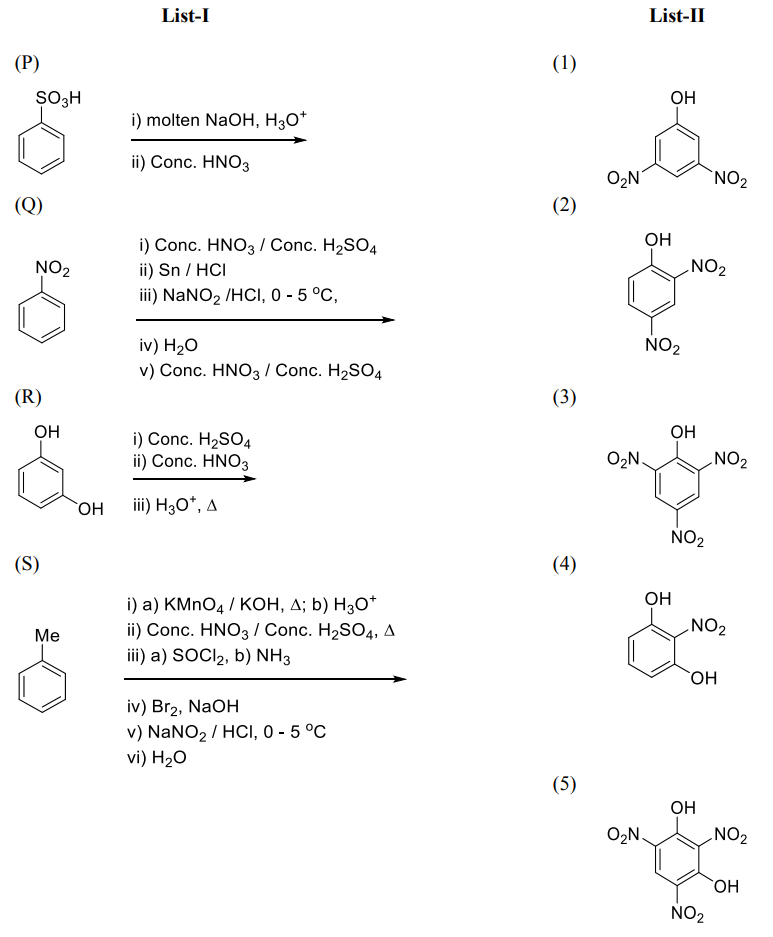
Match Reaction Sequences with Resulting Phenolic Compounds
List-I contains various reaction sequences and List-II contains different phenolic compounds.
Match each entry in List-I with the appropriate entry in List-II and choose the correct option.
To determine the correct matching between the reaction sequences in List-I and the resulting phenolic compounds in List-II, we analyze each reaction sequence step-by-step:
Reaction Sequence (P)
Step (i): Benzenesulfonic acid (C6H5SO3H) undergoes alkali fusion with molten NaOH followed by acidification with H3O+ to yield phenol (C6H5OH).
Step (ii): Nitration of phenol with Conc. HNO3 results in electrophilic aromatic substitution at all activated ortho and para positions (2, 4, and 6) to yield 2,4,6-trinitrophenol (Picric acid).
Step (i): Nitration of nitrobenzene (C6H5NO2) using Conc. HNO3/Conc. H2SO4 directs the incoming nitro group to the meta-position, giving 1,3-dinitrobenzene.
Step (ii): Reduction with Sn/HCl converts both nitro groups into amino groups, forming benzene-1,3-diamine (m-phenylenediamine).
Step (iii): Diazotization using NaNO2/HCl at 0−5∘C converts both amino groups into diazonium salts, yielding benzene-1,3-bis(diazonium) chloride.
Step (iv): Boiling with H2O hydrolyzes the diazonium groups to hydroxyl groups, yielding benzene-1,3-diol (Resorcinol).
Step (v): Nitration of resorcinol with Conc. HNO3/Conc. H2SO4 occurs at positions 2, 4, and 6, which are all strongly activated by both −OH groups, yielding 2,4,6-trinitrobenzene-1,3-diol (Styphnic acid).
Step (i): Sulfonation of resorcinol (benzene-1,3-diol) with Conc. H2SO4 occurs preferentially at positions 4 and 6 due to steric hindrance at position 2 (between the two −OH groups), yielding benzene-1,3-diol-4,6-disulfonic acid.
Step (ii): Nitration with Conc. HNO3 introduces a nitro group at the remaining vacant, activated position 2, forming 2-nitrobenzene-1,3-diol-4,6-disulfonic acid.
Step (iii): Heating with acid (H3O+,Δ) hydrolyzes and removes both sulfonic acid groups (desulfonation), selectively yielding 2-nitrobenzene-1,3-diol (2-nitroresorcinol).
Step (i): Oxidation of toluene (C6H5CH3) with alkaline KMnO4,Δ followed by acid workup (H3O+) yields benzoic acid.
Step (ii): Nitration of benzoic acid under vigorous conditions (Conc. HNO3/Conc. H2SO4,Δ) introduces two nitro groups at both meta-positions, yielding 3,5-dinitrobenzoic acid.
Step (iii): Reaction with SOCl2 followed by NH3 converts the acid group to an amide, producing 3,5-dinitrobenzamide.
Step (iv): Hofmann bromamide degradation using Br2/NaOH converts the amide group to a primary amine, yielding 3,5-dinitroaniline.
Step (v): Diazotization with NaNO2/HCl at 0−5∘C forms 3,5-dinitrobenzenediazonium chloride.
Step (vi): Hydrolysis by heating with H2O replaces the diazonium group with −OH, yielding 3,5-dinitrophenol.