Match Ozonolysis and Aldol Cyclization Products of Cycloalkenes
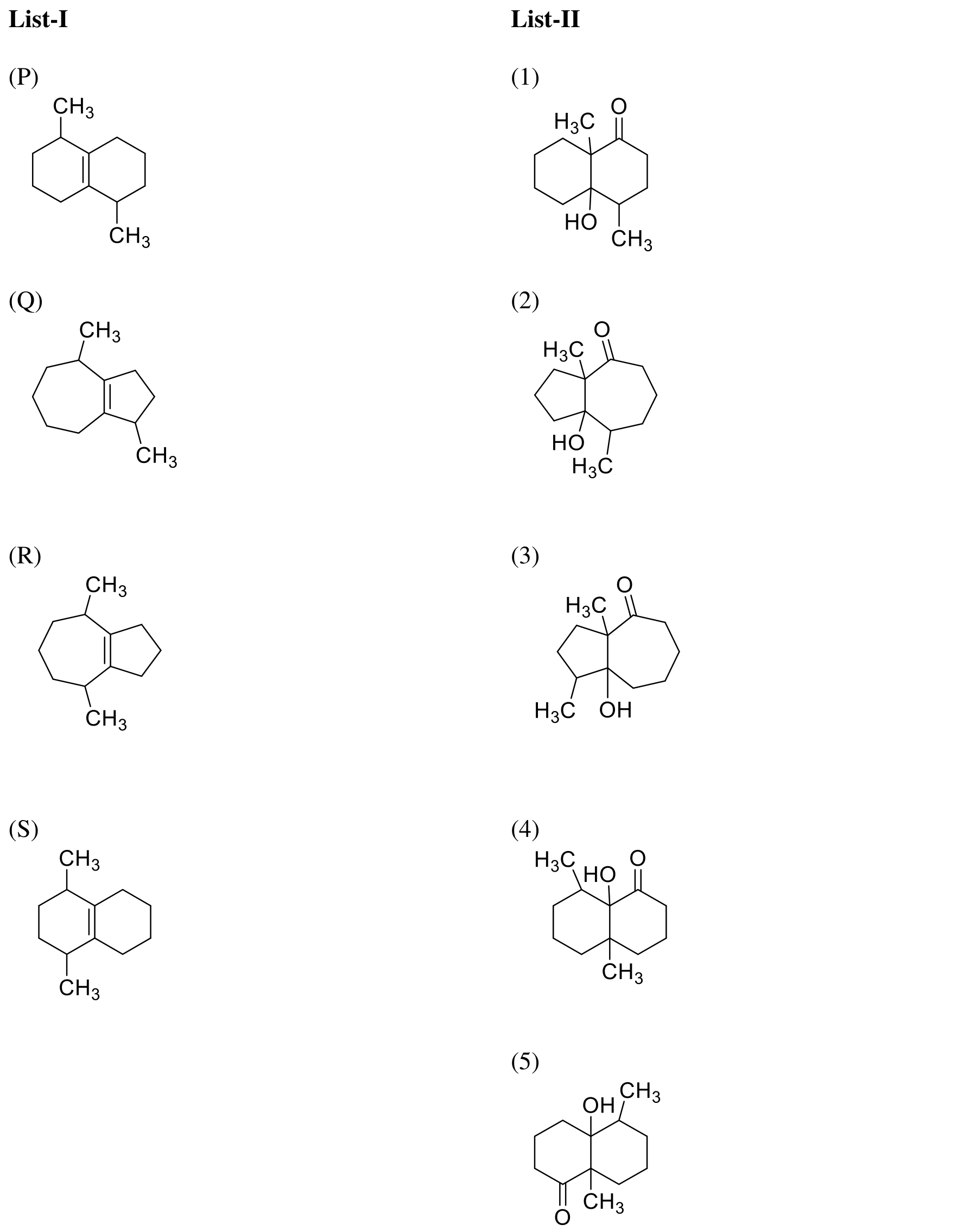
The List-II contains products obtained from the reaction of compounds in List-I with followed by cyclization (via more stable enolate) in the presence of aqueous . Match each entry in List-I with appropriate entry in List-II and choose the correct option.
Options
Step-by-Step Solution
To determine the correct matching between the starting bicyclic alkenes in List-I and their corresponding aldol cyclization products in List-II, we analyze the two-step reaction sequence for each compound:
1. General Reaction Mechanism
-
Ozonolysis (): Reductive ozonolysis cleaves the central tetrasubstituted double bond of the bicyclic system, yielding a single macrocyclic dicarbonyl compound (a cyclodecane-1,6-dione derivative).
-
Aldol Cyclization ():
- Enolate Formation: Deprotonation occurs selectively at the most substituted -carbon to generate the more stable (thermodynamic) enolate.
- Intramolecular Nucleophilic Attack: The enolate carbon attacks the second carbonyl carbon, forming a new bond and creating a bicyclic -hydroxy ketone.
2. Detailed Step-by-Step Analysis of Each Entry
Compound (P)
- Structure: Fused 6-membered and 6-membered rings, with one methyl group at an -position in the left ring and another methyl group at an -position in the right ring.
- Ozonolysis: Cleavage of the central double bond yields a 10-membered dicarbonyl: 2,7-dimethylcyclodecane-1,6-dione.
- Aldol Cyclization:
- Deprotonation occurs at the substituted -carbon () to form the more stable trisubstituted enolate.
- Nucleophilic attack of on the carbonyl at forms a 5-membered ring ().
- The remaining portion () forms a 7-membered ring.
- The product is a [5,7]-fused bicyclic system where one bridgehead carbon carries a methyl group, the other bridgehead carbon has a hydroxyl group (), and the adjacent carbon in the 7-membered ring retains the second methyl group.
- Match:
Compound (Q)
- Structure: Fused 7-membered and 5-membered rings, with one methyl group at an -position in the 7-membered ring and one methyl group at an -position in the 5-membered ring.
- Ozonolysis: Cleavage yields a 10-membered dicarbonyl system.
- Aldol Cyclization:
- Deprotonation at the substituted -carbon on the 7-membered ring side forms the more stable enolate.
- Attack of this enolate carbon on the carbonyl carbon of the 5-membered ring side forms a 6-membered ring.
- The remaining fragment cyclizes to form a second 6-membered ring.
- The product is a [6,6]-fused bicyclic system with a carbonyl group at the top position and a hydroxyl group at the bridgehead.
- Match:
Compound (R)
- Structure: Fused 7-membered and 5-membered rings, with both methyl groups located at the two -positions of the 7-membered ring.
- Ozonolysis: Cleavage yields a 10-membered dicarbonyl with two methyl substituents on the same side of the diketone.
- Aldol Cyclization:
- Enolate formation at the substituted -position followed by intramolecular aldol attack gives a [6,6]-fused bicyclic system.
- The hydroxyl group () and a methyl group are located on adjacent positions, giving structure (5).
- Match:
Compound (S)
- Structure: Fused 6-membered and 6-membered rings, with both methyl groups located at the two -positions of the left 6-membered ring.
- Ozonolysis: Cleavage gives 2,5-dimethylcyclodecane-1,6-dione.
- Aldol Cyclization:
- The more stable enolate forms at the methyl-substituted -carbon ().
- Intramolecular attack of on forms a 5-membered ring and a 7-membered ring ([5,7]-fused system).
- Here, the bottom bridgehead carbon carries both a methyl group and a hydroxyl group (), matching structure (3).
- Match:
3. Conclusion
Comparing the derived matches with the given options:
Thus, the correct option is C.