Match Organic Compounds with Specific Qualitative Chemical Identification Tests
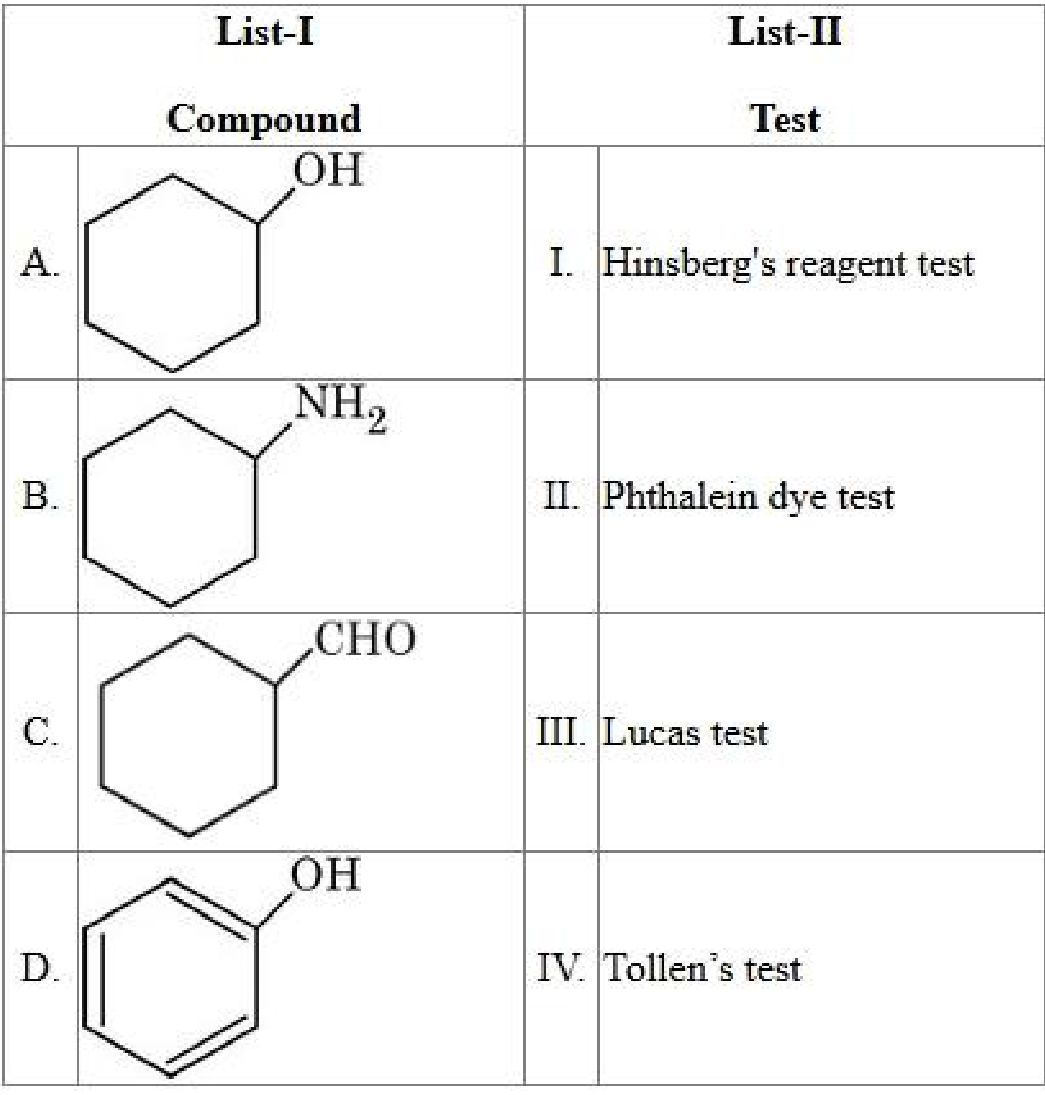
Match the LIST-I with LIST-II
Choose the correct answer from the options given below:
Options
ACorrect
A-III, B-I, C-IV, D-II
B
A-III, B-IV, C-I, D-II
C
A-I, B-III, C-II, D-IV
D
A-I, B-II, C-III, D-IV
Step-by-Step Solution
To determine the correct matching between the compounds in List-I and the qualitative chemical identification tests in List-II, we analyze each compound and its characteristic reaction:
-
Compound A (Cyclohexanol):
- Cyclohexanol is a secondary alcohol ( alcohol).
- Secondary alcohols react with Lucas reagent (a solution of anhydrous in concentrated ) to form alkyl chlorides, producing turbidity within 5 minutes.
- Therefore, A matches with III (Lucas test).
-
Compound B (Cyclohexylamine):
- Cyclohexylamine is a primary aliphatic amine ( amine).
- Primary amines react with Hinsberg's reagent (benzenesulfonyl chloride, ) to yield an -alkylbenzenesulfonamide containing an acidic hydrogen, which dissolves in aqueous .
- Therefore, B matches with I (Hinsberg's reagent test).
-
Compound C (Cyclohexanecarbaldehyde):
- Cyclohexanecarbaldehyde contains an aldehyde functional group ().
- Aldehydes readily reduce Tollen's reagent (ammoniacal silver nitrate, ) to metallic silver, forming a silver mirror on the inner walls of the test tube.
- Therefore, C matches with IV (Tollen's test).
-
Compound D (Phenol):
- Phenol reacts with phthalic anhydride when heated in the presence of concentrated to form phenolphthalein. Upon adding excess alkali (), a characteristic pink dye solution is produced.
- Therefore, D matches with II (Phthalein dye test).
Combining the correct matches:
This corresponds to Option A.