Match Organic Compounds with Chemical Tests and Observations
Match the compounds in List-I with the appropriate observations in List-II and choose the correct option.
Options
A
B
Correct
C
D
Topics & Concepts
Step-by-Step Solution
To determine the correct matching between the compounds in List-I and the observations in List-II, let us analyze each compound individually:
-
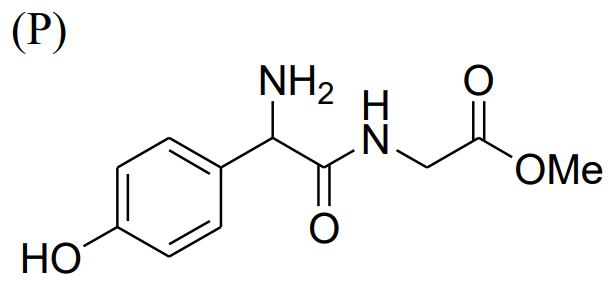
Compound (P):
- Structure: It is a peptide derivative containing a free primary -amino group () and a phenolic hydroxyl group ().
- Reactivity:
- Due to the presence of the free -amino group, it gives a positive ninhydrin test yielding a purple-colored complex (Ruhemann's purple).
- Due to the phenolic group, it reacts with neutral solution to form a characteristic violet-colored coordination complex.
- Therefore, .
-
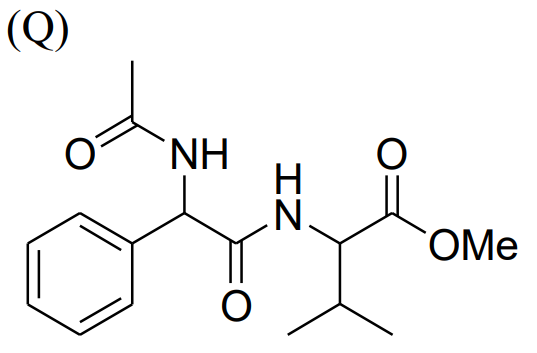
Compound (Q):
- Structure: It is an -acetylated dipeptide methyl ester with no free amino or phenolic group.
- Reactivity:
- Upon complete acid/base hydrolysis, the amide and ester linkages are cleaved to liberate free -amino acids (-phenylglycine and valine).
- These released amino acids give a positive ninhydrin test.
- Since the compound lacks a phenolic moiety, it does not give the phthalein dye test.
- Therefore, .
-
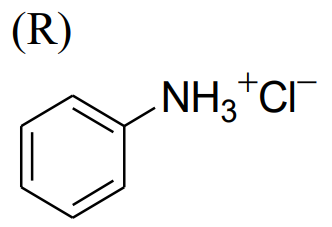
Compound (R):
- Structure: Anilinium chloride (), which in basic/neutral conditions releases aniline ().
- Reactivity:
- Aniline undergoes an azo-coupling reaction with benzenediazonium chloride (phenyldiazonium salt) at its para-position to form -aminoazobenzene, which is a well-known yellow dye.
- Therefore, .
-
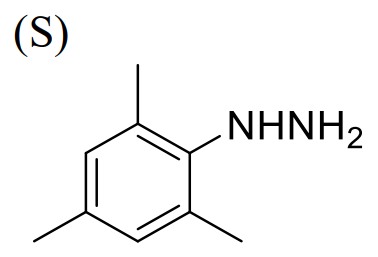
Compound (S):
- Structure: 2,4,6-trimethylphenylhydrazine (a substituted arylhydrazine derivative containing a functional group).
- Reactivity:
- Hydrazines react with the aldehyde/hemiacetal group of reducing sugars like D-glucose to form the corresponding hydrazone.
- Therefore, .
Matching all pairs:
Thus, the correct option is (B).