JEE Challenger
More from Alcohols, Phenols and Ethers

Match Organic Chemical Conversions with Suitable Reagent Sets

Match the given organic chemical transformations in List I with the corresponding reagent sets listed in List II, and select the correct option using the provided code below the lists:
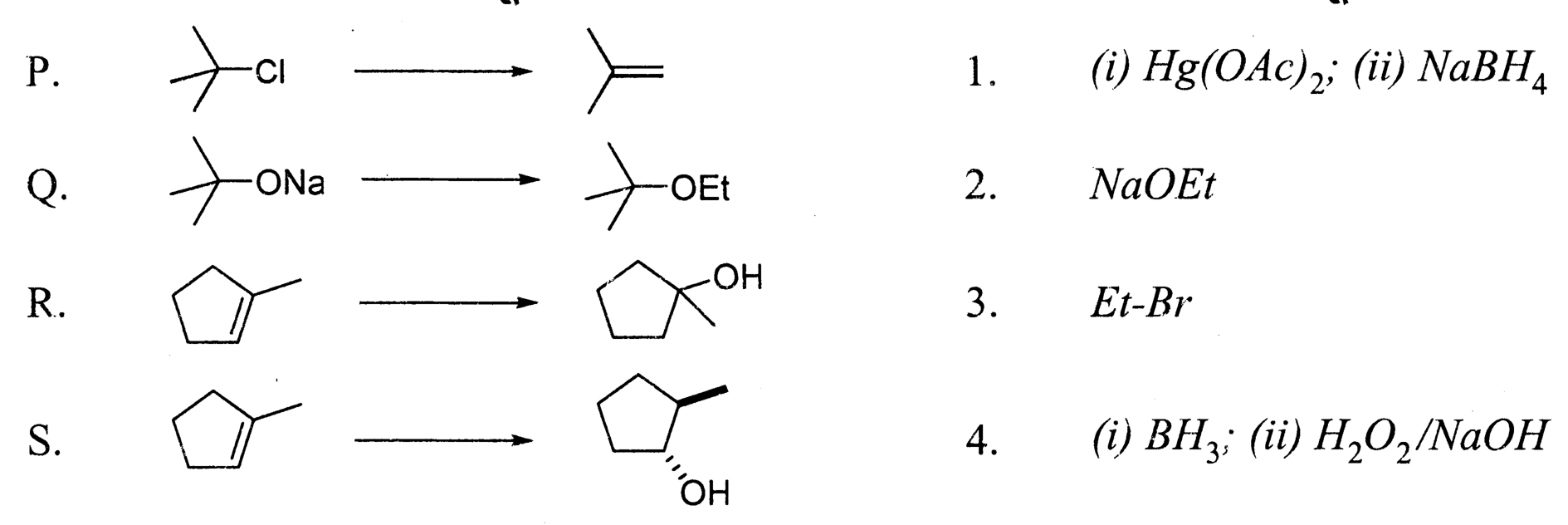
List IList IIP. Transformation of tertiary alkyl chloride to alkene1. (i) Hg(OAc)2; (ii) NaBH4Q. Transformation of alkoxide to ether2. NaOEtR. Formation of Markovnikov alcohol3. Et-BrS. Formation of anti-Markovnikov alcohol4. (i) BH3; (ii) H2O2/NaOH\begin{array}{ll} \text{List I} & \text{List II} \\ \text{P. Transformation of tertiary alkyl chloride to alkene} & 1.\text{ (i) } \text{Hg(OAc)}_2; \text{ (ii) } \text{NaBH}_4 \\ \text{Q. Transformation of alkoxide to ether} & 2.\text{ } \text{NaOEt} \\ \text{R. Formation of Markovnikov alcohol} & 3.\text{ } \text{Et-Br} \\ \text{S. Formation of anti-Markovnikov alcohol} & 4.\text{ (i) } \text{BH}_3; \text{ (ii) } \text{H}_2\text{O}_2/\text{NaOH} \end{array}
Question Diagram 1

Options

A

P →\rightarrow 2, Q →\rightarrow 3, R →\rightarrow 1, S →\rightarrow 4

Correct
B

P →\rightarrow 3, Q →\rightarrow 2, R →\rightarrow 1, S →\rightarrow 4

C

P →\rightarrow 2, Q →\rightarrow 3, R →\rightarrow 4, S →\rightarrow 1

D

P →\rightarrow 3, Q →\rightarrow 2, R →\rightarrow 4, S →\rightarrow 1

Step-by-Step Solution

To determine the correct matching between the chemical transformations in List I and the reagent sets in List II, let us analyze each reaction individually:

  1. Transformation P: Tertiary alkyl chloride ((CH3)3C-Cl)⟶Alkene ((CH3)2C=CH2)\text{Tertiary alkyl chloride } \big(\text{(CH}_3\text{)}_3\text{C-Cl}\big) \longrightarrow \text{Alkene } \big(\text{(CH}_3\text{)}_2\text{C=CH}_2\big) This transformation is an elimination reaction (E2E2) of a 3∘3^\circ alkyl halide to yield an alkene. This requires a strong base such as sodium ethoxide (NaOEt\text{NaOEt}). P→2\text{P} \rightarrow 2

  2. Transformation Q: Alkoxide ((CH3)3C-O−Na+)⟶Ether ((CH3)3C-O-Et)\text{Alkoxide } \big(\text{(CH}_3\text{)}_3\text{C-O}^-\text{Na}^+\big) \longrightarrow \text{Ether } \big(\text{(CH}_3\text{)}_3\text{C-O-Et}\big) This is the Williamson Ether Synthesis, where a nucleophilic alkoxide undergoes an SN2S_N2 reaction with a primary alkyl halide such as ethyl bromide (Et-Br\text{Et-Br}). Q→3\text{Q} \rightarrow 3

  3. Transformation R: 1-methylcyclopentene⟶1-methylcyclopentanol\text{1-methylcyclopentene} \longrightarrow \text{1-methylcyclopentanol} This reaction represents the addition of water across the double bond following Markovnikov's rule without carbocation rearrangement. The suitable reagent set for oxymercuration-demercuration is: (i) Hg(OAc)2,(ii) NaBH4\text{(i) } \text{Hg(OAc)}_2, \quad \text{(ii) } \text{NaBH}_4 R→1\text{R} \rightarrow 1

  4. Transformation S: 1-methylcyclopentene⟶trans-2-methylcyclopentanol\text{1-methylcyclopentene} \longrightarrow \textit{trans}\text{-2-methylcyclopentanol} This conversion represents an anti-Markovnikov addition of water with syn-stereospecificity to give the trans alcohol. The appropriate process for this transformation is Hydroboration-Oxidation, utilizing: (i) BH3,(ii) H2O2/NaOH\text{(i) } \text{BH}_3, \quad \text{(ii) } \text{H}_2\text{O}_2/\text{NaOH} S→4\text{S} \rightarrow 4

Comparing these matches with the given options: P→2,Q→3,R→1,S→4\text{P} \rightarrow 2, \quad \text{Q} \rightarrow 3, \quad \text{R} \rightarrow 1, \quad \text{S} \rightarrow 4

Thus, the correct option is A.