JEE Challenger
More from Electric Charges and Fields

Match Dipole Configurations with Resultant Electric Field at Midpoint

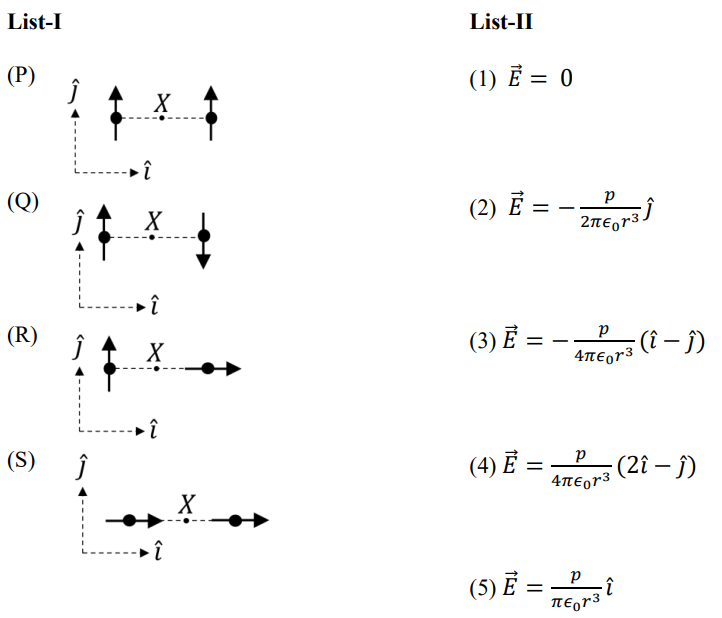
List-I shows four configurations, each consisting of a pair of ideal electric dipoles. Each dipole has a dipole moment of magnitude pp, oriented as marked by arrows in the figures. In all the configurations the dipoles are fixed such that they are at a distance 2r2r apart along the xx direction. The midpoint of the line joining the two dipoles is XX. The possible resultant electric fields E\vec{E} at XX are given in List-II.

Choose the option that describes the correct match between the entries in List-I to those in List-II.

Question Diagram 1

Options

A

P\rightarrow3, Q\rightarrow1, R\rightarrow2, S\rightarrow4

B

P\rightarrow4, Q\rightarrow5, R\rightarrow3, S\rightarrow1

C

P\rightarrow2, Q\rightarrow1, R\rightarrow4, S\rightarrow5

Correct
D

P\rightarrow2, Q\rightarrow1, R\rightarrow3, S\rightarrow5

Step-by-Step Solution

To find the correct matching between the dipole configurations in List-I and the resultant electric fields at midpoint XX in List-II, we use the general formula for the electric field due to an ideal electric dipole with dipole moment p\vec{p} at a position vector r\vec{r} relative to the dipole:

E(r)=14πϵ0r3[3(pr^)r^p]\vec{E}(\vec{r}) = \frac{1}{4\pi\epsilon_0 r^3} \left[ 3(\vec{p} \cdot \hat{r})\hat{r} - \vec{p} \right]

Let point XX be placed at the origin (0,0,0)(0,0,0).

  • The left dipole is located at position vector ri^-r\hat{i}, so the displacement vector from the left dipole to XX is r1=ri^\vec{r}_1 = r\hat{i} with unit vector r^1=i^\hat{r}_1 = \hat{i}.
  • The right dipole is located at position vector +ri^+r\hat{i}, so the displacement vector from the right dipole to XX is r2=ri^\vec{r}_2 = -r\hat{i} with unit vector r^2=i^\hat{r}_2 = -\hat{i}.

Configuration (P)

  • Left dipole: p1=pj^\vec{p}_1 = p\hat{j} E1=14πϵ0r3[3(pj^i^)i^pj^]=pj^4πϵ0r3\vec{E}_1 = \frac{1}{4\pi\epsilon_0 r^3}\left[ 3(p\hat{j} \cdot \hat{i})\hat{i} - p\hat{j} \right] = -\frac{p\hat{j}}{4\pi\epsilon_0 r^3}

  • Right dipole: p2=pj^\vec{p}_2 = p\hat{j} E2=14πϵ0r3[3(pj^(i^))(i^)pj^]=pj^4πϵ0r3\vec{E}_2 = \frac{1}{4\pi\epsilon_0 r^3}\left[ 3(p\hat{j} \cdot (-\hat{i}))(-\hat{i}) - p\hat{j} \right] = -\frac{p\hat{j}}{4\pi\epsilon_0 r^3}

  • Resultant Electric Field at XX: Enet=E1+E2=2pj^4πϵ0r3=p2πϵ0r3j^\vec{E}_{\text{net}} = \vec{E}_1 + \vec{E}_2 = -\frac{2p\hat{j}}{4\pi\epsilon_0 r^3} = -\frac{p}{2\pi\epsilon_0 r^3} \hat{j}

Thus, P2\text{P} \rightarrow 2.


Configuration (Q)

  • Left dipole: p1=pj^\vec{p}_1 = p\hat{j} E1=pj^4πϵ0r3\vec{E}_1 = -\frac{p\hat{j}}{4\pi\epsilon_0 r^3}

  • Right dipole: p2=pj^\vec{p}_2 = -p\hat{j} E2=14πϵ0r3[3(pj^(i^))(i^)(pj^)]=pj^4πϵ0r3\vec{E}_2 = \frac{1}{4\pi\epsilon_0 r^3}\left[ 3(-p\hat{j} \cdot (-\hat{i}))(-\hat{i}) - (-p\hat{j}) \right] = \frac{p\hat{j}}{4\pi\epsilon_0 r^3}

  • Resultant Electric Field at XX: Enet=E1+E2=0\vec{E}_{\text{net}} = \vec{E}_1 + \vec{E}_2 = 0

Thus, Q1\text{Q} \rightarrow 1.


Configuration (R)

  • Left dipole: p1=pj^\vec{p}_1 = p\hat{j} E1=pj^4πϵ0r3\vec{E}_1 = -\frac{p\hat{j}}{4\pi\epsilon_0 r^3}

  • Right dipole: p2=pi^\vec{p}_2 = p\hat{i} E2=14πϵ0r3[3(pi^(i^))(i^)pi^]=14πϵ0r3[3(p)(i^)pi^]=2pi^4πϵ0r3\vec{E}_2 = \frac{1}{4\pi\epsilon_0 r^3}\left[ 3(p\hat{i} \cdot (-\hat{i}))(-\hat{i}) - p\hat{i} \right] = \frac{1}{4\pi\epsilon_0 r^3}\left[ 3(-p)(-\hat{i}) - p\hat{i} \right] = \frac{2p\hat{i}}{4\pi\epsilon_0 r^3}

  • Resultant Electric Field at XX: Enet=E1+E2=p4πϵ0r3(2i^j^)\vec{E}_{\text{net}} = \vec{E}_1 + \vec{E}_2 = \frac{p}{4\pi\epsilon_0 r^3} (2\hat{i} - \hat{j})

Thus, R4\text{R} \rightarrow 4.


Configuration (S)

  • Left dipole: p1=pi^\vec{p}_1 = p\hat{i} E1=14πϵ0r3[3(pi^i^)i^pi^]=2pi^4πϵ0r3\vec{E}_1 = \frac{1}{4\pi\epsilon_0 r^3}\left[ 3(p\hat{i} \cdot \hat{i})\hat{i} - p\hat{i} \right] = \frac{2p\hat{i}}{4\pi\epsilon_0 r^3}

  • Right dipole: p2=pi^\vec{p}_2 = p\hat{i} E2=2pi^4πϵ0r3\vec{E}_2 = \frac{2p\hat{i}}{4\pi\epsilon_0 r^3}

  • Resultant Electric Field at XX: Enet=E1+E2=4pi^4πϵ0r3=pπϵ0r3i^\vec{E}_{\text{net}} = \vec{E}_1 + \vec{E}_2 = \frac{4p\hat{i}}{4\pi\epsilon_0 r^3} = \frac{p}{\pi\epsilon_0 r^3} \hat{i}

Thus, S5\text{S} \rightarrow 5.


Conclusion

The correct match is: P2,Q1,R4,S5\text{P} \rightarrow 2, \quad \text{Q} \rightarrow 1, \quad \text{R} \rightarrow 4, \quad \text{S} \rightarrow 5

This matches Option C.

Match Dipole Configurations with Resultant Electric Field at Midpoint | Physics PYQ Solution - JEE Challenger