JEE Challenger
More from Ray Optics and Optical Instruments

Match Combinations of Two Lenses with Position of Final Image

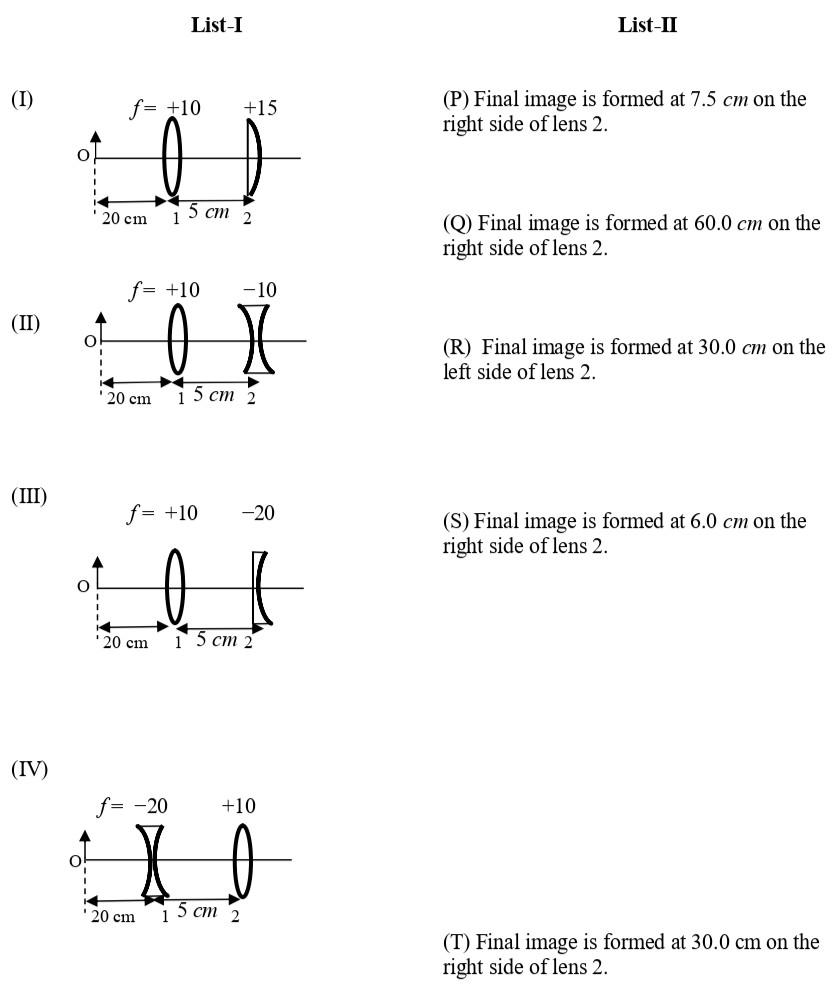
List I contains four combinations of two lenses (1 and 2) whose focal lengths (in cm\text{cm}) are indicated in the figures. In all cases, the object is placed 20 cm20\text{ cm} from the first lens on the left, and the distance between the two lenses is 5 cm5\text{ cm}. List II contains the positions of the final images.

Which one of the following options is correct?

Question Diagram 1

Options

A

(I)P;(II)R;(III)Q;(IV)T(\text{I}) \rightarrow P; (\text{II}) \rightarrow R; (\text{III}) \rightarrow Q; (\text{IV}) \rightarrow T

Correct
B

(I)Q;(II)P;(III)T;(IV)S(\text{I}) \rightarrow Q; (\text{II}) \rightarrow P; (\text{III}) \rightarrow T; (\text{IV}) \rightarrow S

C

(I)P;(II)T;(III)R;(IV)Q(\text{I}) \rightarrow P; (\text{II}) \rightarrow T; (\text{III}) \rightarrow R; (\text{IV}) \rightarrow Q

D

(I)T;(II)S;(III)Q;(IV)R(\text{I}) \rightarrow T; (\text{II}) \rightarrow S; (\text{III}) \rightarrow Q; (\text{IV}) \rightarrow R

Step-by-Step Solution

To determine the position of the final image formed by the two-lens combination in each case, we apply the thin lens formula sequentially for lens 1 (L1L_1) and lens 2 (L2L_2):

1v1u=1f\frac{1}{v} - \frac{1}{u} = \frac{1}{f}

The distance between the two lenses is d=5 cmd = 5\text{ cm}, and the object OO is placed at u1=20 cmu_1 = -20\text{ cm} from L1L_1.


Combination (I):

  • First Lens (L1L_1): f1=+10 cmf_1 = +10\text{ cm}, u1=20 cmu_1 = -20\text{ cm} 1v1120=110    1v1=110120=120    v1=+20 cm\frac{1}{v_1} - \frac{1}{-20} = \frac{1}{10} \implies \frac{1}{v_1} = \frac{1}{10} - \frac{1}{20} = \frac{1}{20} \implies v_1 = +20\text{ cm} The image I1I_1 formed by L1L_1 is at 20 cm20\text{ cm} to the right of L1L_1.

  • Second Lens (L2L_2): f2=+15 cmf_2 = +15\text{ cm} Since L2L_2 is 5 cm5\text{ cm} to the right of L1L_1, image I1I_1 serves as a virtual object for L2L_2 at u2=+(205)=+15 cmu_2 = +(20 - 5) = +15\text{ cm}. 1v2115=115    1v2=215    v2=+7.5 cm\frac{1}{v_2} - \frac{1}{15} = \frac{1}{15} \implies \frac{1}{v_2} = \frac{2}{15} \implies v_2 = +7.5\text{ cm} The final image is formed at 7.5 cm7.5\text{ cm} on the right side of lens 2.
    Match: (I)P\text{Match: } (\text{I}) \rightarrow P


Combination (II):

  • First Lens (L1L_1): f1=+10 cmf_1 = +10\text{ cm}, u1=20 cmu_1 = -20\text{ cm} v1=+20 cmv_1 = +20\text{ cm}

  • Second Lens (L2L_2): f2=10 cmf_2 = -10\text{ cm}, u2=+15 cmu_2 = +15\text{ cm} 1v2115=110    1v2=115110=130    v2=30.0 cm\frac{1}{v_2} - \frac{1}{15} = -\frac{1}{10} \implies \frac{1}{v_2} = \frac{1}{15} - \frac{1}{10} = -\frac{1}{30} \implies v_2 = -30.0\text{ cm} The final image is formed at 30.0 cm30.0\text{ cm} on the left side of lens 2.
    Match: (II)R\text{Match: } (\text{II}) \rightarrow R


Combination (III):

  • First Lens (L1L_1): f1=+10 cmf_1 = +10\text{ cm}, u1=20 cmu_1 = -20\text{ cm} v1=+20 cmv_1 = +20\text{ cm}

  • Second Lens (L2L_2): f2=20 cmf_2 = -20\text{ cm}, u2=+15 cmu_2 = +15\text{ cm} 1v2115=120    1v2=115120=160    v2=+60.0 cm\frac{1}{v_2} - \frac{1}{15} = -\frac{1}{20} \implies \frac{1}{v_2} = \frac{1}{15} - \frac{1}{20} = \frac{1}{60} \implies v_2 = +60.0\text{ cm} The final image is formed at 60.0 cm60.0\text{ cm} on the right side of lens 2.
    Match: (III)Q\text{Match: } (\text{III}) \rightarrow Q


Combination (IV):

  • First Lens (L1L_1): f1=20 cmf_1 = -20\text{ cm}, u1=20 cmu_1 = -20\text{ cm} 1v1120=120    1v1=120120=110    v1=10 cm\frac{1}{v_1} - \frac{1}{-20} = -\frac{1}{20} \implies \frac{1}{v_1} = -\frac{1}{20} - \frac{1}{20} = -\frac{1}{10} \implies v_1 = -10\text{ cm} The image I1I_1 is formed 10 cm10\text{ cm} to the left of L1L_1.

  • Second Lens (L2L_2): f2=+10 cmf_2 = +10\text{ cm} The position of I1I_1 relative to L2L_2 is u2=(10+5)=15 cmu_2 = -(10 + 5) = -15\text{ cm}. 1v2115=110    1v2=110115=130    v2=+30.0 cm\frac{1}{v_2} - \frac{1}{-15} = \frac{1}{10} \implies \frac{1}{v_2} = \frac{1}{10} - \frac{1}{15} = \frac{1}{30} \implies v_2 = +30.0\text{ cm} The final image is formed at 30.0 cm30.0\text{ cm} on the right side of lens 2.
    Match: (IV)T\text{Match: } (\text{IV}) \rightarrow T


Conclusion:

The correct matching is: (I)P;(II)R;(III)Q;(IV)T(\text{I}) \rightarrow P; \quad (\text{II}) \rightarrow R; \quad (\text{III}) \rightarrow Q; \quad (\text{IV}) \rightarrow T

This corresponds to Option A.

Match Combinations of Two Lenses with Position of Final Image | Physics PYQ Solution - JEE Challenger