Major Product in Reaction of Amino Acid Derivative with Nitrous Acid
Determine the major organic product resulting from the given reaction sequence:
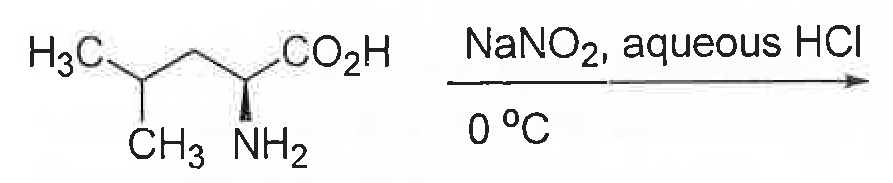
Options
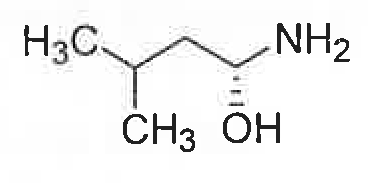
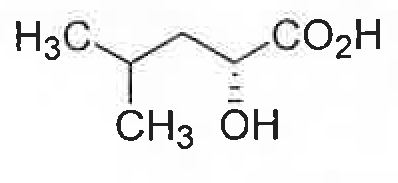
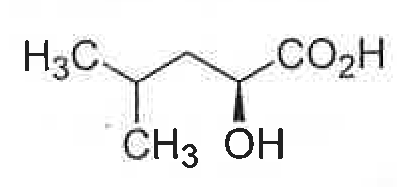
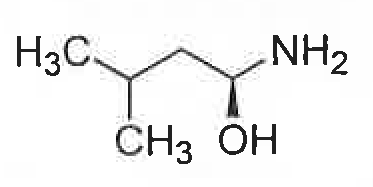
Step-by-Step Solution
To determine the major organic product of the reaction, let us analyze the reaction step-by-step:
1. Nature of the Reaction
The reactant is an -amino acid derivative (specifically, -2-amino-4-methylpentanoic acid, a leucine derivative) containing a primary aliphatic amino group () at the -carbon. Treating a primary amine with nitrous acid (, generated in situ from and aqueous at ) leads to diazotization.
2. Reaction Mechanism and Stereochemistry
-
Diazotization: The primary amino group () at the -position reacts with to form an unstable diazonium ion:
-
Neighboring Group Participation (NGP): The reaction of -amino acids with nitrous acid proceeds with retention of configuration at the -chiral center via a double inversion mechanism due to Neighboring Group Participation (NGP) by the carboxyl group ():
- First Inversion: The carbonyl oxygen of the carboxylic acid group acts as an internal nucleophile and attacks the -carbon from the back side, expelling gas as a leaving group. This forms a transient 3-membered -lactone intermediate with inversion of configuration.
- Second Inversion: A water molecule () from the aqueous solvent subsequently attacks the -carbon of the -lactone intermediate from the back side to open the ring. This second nucleophilic substitution () results in a second inversion of configuration.
-
Net Result (Double Inversion = Retention): The two successive inversions ( steps) yield a net retention of configuration at the -carbon. Thus, the incoming hydroxyl group () occupies the exact same spatial position (wedge) previously occupied by the group.
3. Conclusion
- The stereocenter at C-4 bearing the methyl group (, on a wedge) remains unaffected throughout the reaction.
- The stereocenter at C-2 retains its configuration, so the newly formed hydroxyl group () is on a wedge.
Therefore, the major product is the -hydroxy acid represented in Option (C).
Correct Answer: (C)