Major Product in Nucleophilic Substitution of Substituted Fluorobenzene
The major product of the following reaction
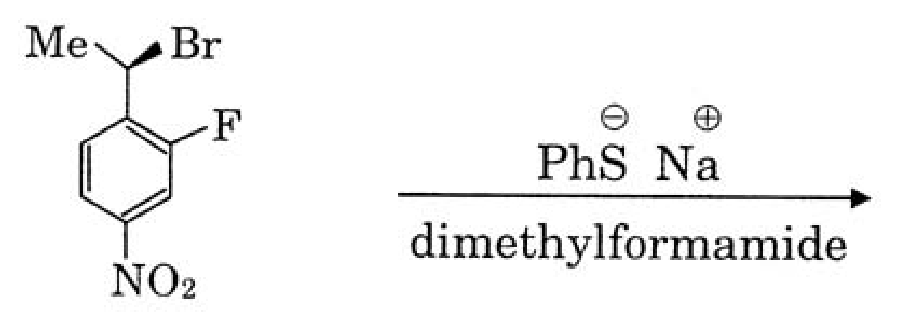
is
Options
A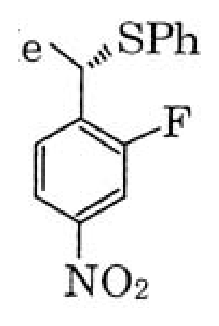 Correct
B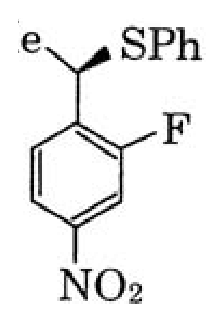
C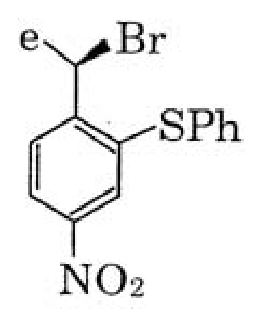
D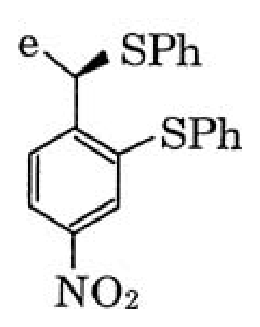
Step-by-Step Solution
To determine the major product of the reaction, let us analyze the reactive sites of the substrate and the nature of the reagent:
-
Substrate Analysis:
- Benzylic position: The molecule contains a secondary benzylic carbon bearing a bromine atom (). Bromide () is an excellent leaving group, and the benzylic position is exceptionally reactive toward nucleophilic substitution () due to the resonance stabilization of the transition state by the adjacent phenyl ring.
- Aromatic ring: The ring contains a fluorine atom () at the position meta to the strongly electron-withdrawing nitro group (). Because the nitro group is meta to the fluorine atom, the Meisenheimer intermediate cannot be efficiently stabilized by resonance through the nitro group. Consequently, nucleophilic aromatic substitution () on the aryl fluoride is not favored under these conditions.
-
Reagent and Reaction Conditions:
- Sodium thiophenolate () provides the thiolate anion (), which is a powerful, soft nucleophile.
- Dimethylformamide () is a polar aprotic solvent that favors bimolecular nucleophilic substitution () by leaving the nucleophile unhindered by hydrogen bonding.
-
Stereochemical Outcome:
- The reaction proceeds via an mechanism at the chiral benzylic center.
- The nucleophile () attacks the benzylic carbon from the backside relative to the departing bromide leaving group.
- Since the original configuration has the group on a wedge (pointing toward the viewer), the attack results in complete inversion of configuration, placing the incoming group on a dash (pointing away from the viewer).
- The fluorine atom on the aromatic ring remains intact.
This stereochemical inversion yields the product represented in (A).
Correct Answer: (A)