Major Product Determination in Alkyne Reduction Reaction
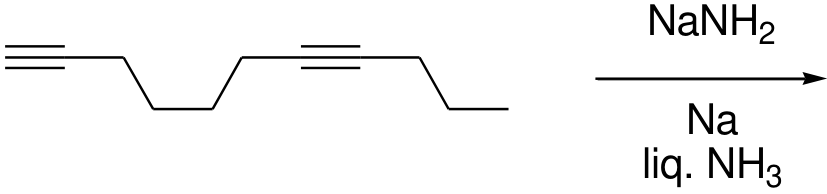
Identify the primary product formed in the following chemical transformation:
Options
A
B Correct
C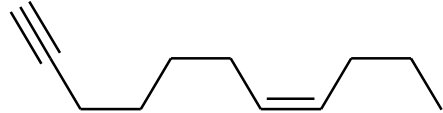
D
Topics & Concepts
Step-by-Step Solution
To determine the major product formed in the given reaction, we analyze the reaction of a compound containing both a terminal alkyne and an internal alkyne with followed by .
Step 1: Deprotonation by
- The starting material contains two types of triple bonds:
- A terminal alkyne (), which has an acidic hydrogen ().
- An internal alkyne (), which lacks acidic acetylenic protons.
- is a strong base that selectively deprotonates the terminal alkyne to form an alkynide (acetylide) anion:
Step 2: Dissolving Metal Reduction ()
- Internal Alkyne Reduction: Sodium in liquid ammonia () reduces internal alkynes via a single-electron transfer (SET) mechanism. This anti-addition reduction selectively yields the stereospecific -alkene (trans-alkene).
- Protection of Terminal Alkyne: The terminal alkyne is present in its conjugate base form, the alkynide anion (). Due to the strong electrostatic repulsion from the existing negative charge, the alkynide anion cannot accept an electron from sodium to form a radical anion. Consequently, the terminal alkyne group is protected against Birch reduction and remains completely unreacted.
Step 3: Protonation (Workup)
- Upon workup (or from proton exchange with ), the terminal alkynide anion is protonated back to regenerate the terminal triple bond ():
Final Product Structure
- Terminal group: Intact terminal alkyne ().
- Internal group: Converted selectively to a trans-alkene (double bond in -configuration).
Comparing this result with the given options, Option (B) correctly shows the molecule with an unreacted terminal alkyne and a trans-internal double bond.
Correct Answer: (B)