Magnetic Field Due to Two Concentric Circular Loops
Two concentric circular loops, one having a radius and the second having radius , are situated in the -plane with their common center at the origin as shown in the diagram. The smaller loop carries an anti-clockwise current , and the larger loop carries a clockwise current , such that . The vector represents the net magnetic field at a position in the -plane. Which of the following options is/are correct?
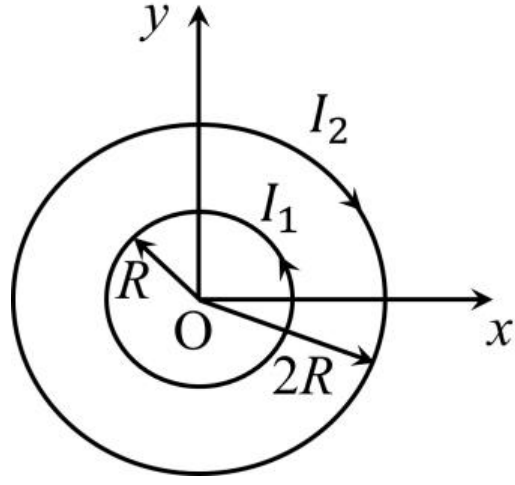
Options
is oriented perpendicular to the -plane at every point in the plane
depends on and purely via the radial coordinate
The magnitude remains non-zero for every point satisfying
is directed normally outwards from the -plane at all points lying between the two loops
Topics & Concepts
Step-by-Step Solution
To determine the correct options, let us analyze the magnetic field produced by the two concentric circular loops placed in the -plane with their common center at the origin .
1. Direction of Magnetic Field (Option A)
By the Biot-Savart Law, the magnetic field at a position vector in the -plane due to a current element at is given by:
Since both the loops and the position vector lie entirely in the -plane:
The cross product has components only along the -axis (). Integrating over both loops gives:
Thus, is oriented perpendicular to the -plane at every point in the plane.
Option A is CORRECT.
2. Radial Symmetry (Option B)
Both loops are circular and centered at the origin . The current distribution possesses continuous rotational symmetry about the -axis.
Consequently, the magnitude and direction of the magnetic field depend solely on the distance from the origin:
Option B is CORRECT.
3. Magnetic Field inside the Smaller Loop () (Option C)
Let the unit vector perpendicular to the -plane pointing outwards be .
- The smaller loop carries an anti-clockwise current , producing a magnetic field in the direction inside .
- The larger loop carries a clockwise current , producing a magnetic field in the direction inside .
At the center , the net magnetic field is:
Given that , we have , which implies:
As , the point approaches the wire of the smaller loop carrying current . The contribution from diverges to along , while the contribution from remains finite:
Since is a continuous function of on the interval , by the Intermediate Value Theorem, there must exist at least one radial distance where:
Therefore, does NOT remain non-zero for all points satisfying .
Option C is INCORRECT.
4. Magnetic Field between the Loops () (Option D)
For any point in the region :
- The point lies outside the inner loop of radius . The anti-clockwise current produces a magnetic field directed into the plane () in the region outside its radius ().
- The point lies inside the outer loop of radius . The clockwise current produces a magnetic field directed into the plane () in the region inside its radius ().
Since both magnetic field contributions are directed into the plane (), the net field points normally inwards (into the plane), not outwards.
Option D is INCORRECT.
Conclusion
The correct options are A and B.