JEE Challenger
More from Moving Charges and Magnetism

Magnetic Field Distribution in Hollow Cylinder with Uniform Current Density

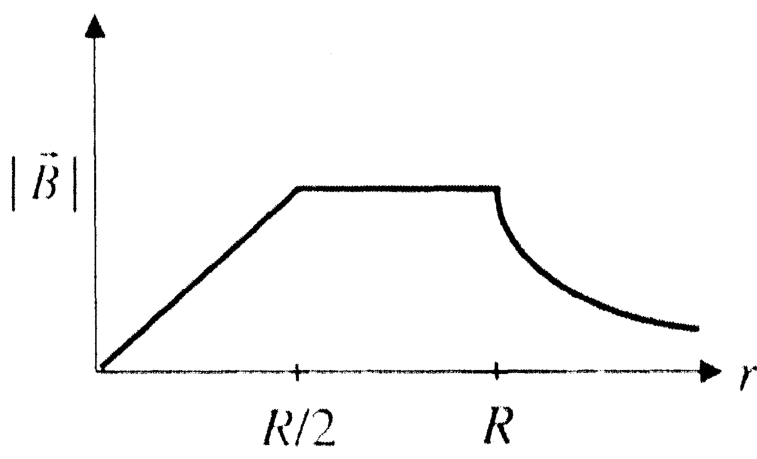
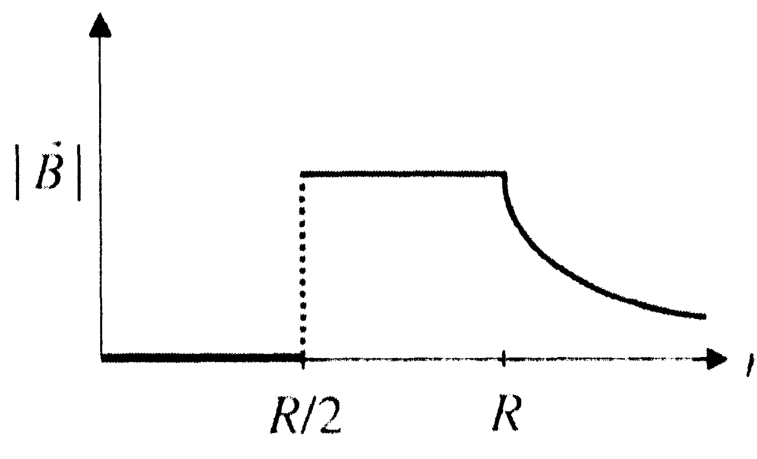
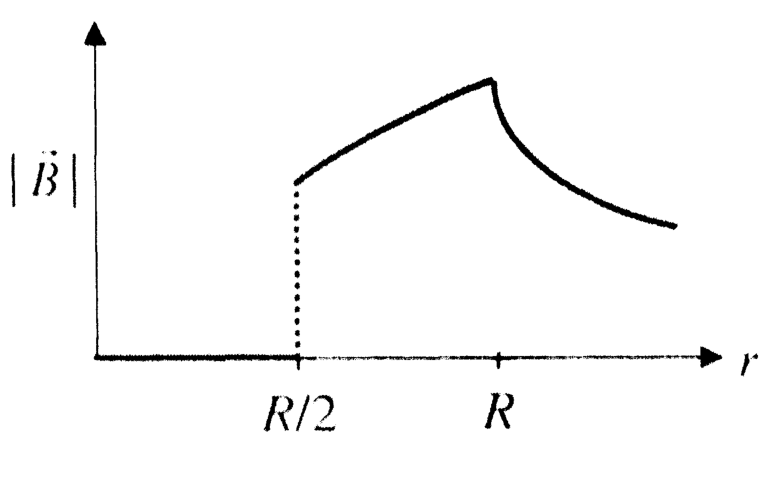
Consider an infinitely long, hollow cylindrical conductor having inner radius R/2R/2 and outer radius RR, carrying a uniform current density along its longitudinal axis. Which of the following graphs accurately depicts the magnetic field magnitude ∣B⃗∣|\vec{B}| as a function of distance rr from the central axis?

Options

A
Option A
B
Option B
C
Option C
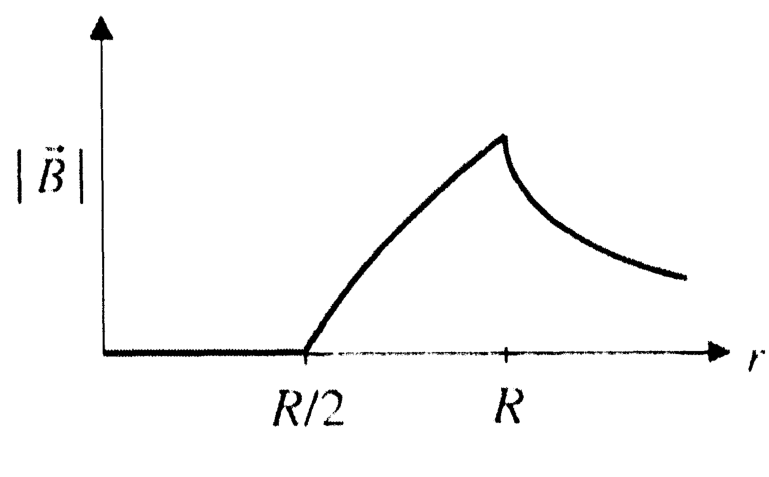
D
Option D
Correct

Step-by-Step Solution

To find the magnitude of the magnetic field ∣B⃗∣|\vec{B}| as a function of the radial distance rr from the central axis of an infinitely long, hollow cylindrical conductor with inner radius R/2R/2 and outer radius RR, we apply Ampère's Circuital Law:

∮B⃗⋅dl⃗=μ0Ienclosed\oint \vec{B} \cdot d\vec{l} = \mu_0 I_{\text{enclosed}}

By cylindrical symmetry, the magnetic field lines form concentric circles centered on the axis, and the field magnitude B(r)B(r) depends only on rr. Choosing a circular Amperian loop of radius rr centered on the cylinder's axis gives:

B(r)⋅(2πr)=μ0Ienclosed(r)  ⟹  B(r)=μ0Ienclosed(r)2πrB(r) \cdot (2\pi r) = \mu_0 I_{\text{enclosed}}(r) \implies B(r) = \frac{\mu_0 I_{\text{enclosed}}(r)}{2\pi r}

We analyze the field in three distinct regions:

1. Region I: 0≤r<R20 \le r < \frac{R}{2} (Hollow Inner Core)

Since there is no current-carrying conductor inside this region: Ienclosed(r)=0I_{\text{enclosed}}(r) = 0 B(r)=0B(r) = 0

2. Region II: R2≤r≤R\frac{R}{2} \le r \le R (Inside the Conductor Wall)

Let JJ be the uniform current density. The enclosed cross-sectional area carrying current within radius rr is: Aenclosed(r)=πr2−π(R2)2=π(r2−R24)A_{\text{enclosed}}(r) = \pi r^2 - \pi \left(\frac{R}{2}\right)^2 = \pi \left(r^2 - \frac{R^2}{4}\right)

Thus, the enclosed current is: Ienclosed(r)=J⋅π(r2−R24)I_{\text{enclosed}}(r) = J \cdot \pi \left(r^2 - \frac{R^2}{4}\right)

Substituting Ienclosed(r)I_{\text{enclosed}}(r) into Ampère's Law: B(r)=μ0Jπ(r2−R24)2πr=μ0J2(r−R24r)B(r) = \frac{\mu_0 J \pi \left(r^2 - \frac{R^2}{4}\right)}{2\pi r} = \frac{\mu_0 J}{2} \left(r - \frac{R^2}{4r}\right)

Evaluating B(r)B(r) at key points and checking its slope:

  • At r=R2r = \frac{R}{2}: B(R2)=μ0J2(R2−R24(R/2))=0B\left(\frac{R}{2}\right) = \frac{\mu_0 J}{2} \left(\frac{R}{2} - \frac{R^2}{4(R/2)}\right) = 0
  • Derivative with respect to rr: dBdr=μ0J2(1+R24r2)>0\frac{dB}{dr} = \frac{\mu_0 J}{2} \left(1 + \frac{R^2}{4r^2}\right) > 0 This indicates that B(r)B(r) is continuous at r=R/2r = R/2 and increases monotonically up to r=Rr = R.
  • At r=Rr = R: B(R)=μ0J2(R−R4)=3μ0JR8B(R) = \frac{\mu_0 J}{2} \left(R - \frac{R}{4}\right) = \frac{3 \mu_0 J R}{8}

3. Region III: r>Rr > R (Outside the Conductor)

For any r>Rr > R, the Amperian loop encloses the total current Itotal=J⋅3πR24I_{\text{total}} = J \cdot \frac{3\pi R^2}{4}: Ienclosed(r)=ItotalI_{\text{enclosed}}(r) = I_{\text{total}} B(r)=μ0Itotal2πr∝1rB(r) = \frac{\mu_0 I_{\text{total}}}{2\pi r} \propto \frac{1}{r}

The magnetic field decreases hyperbolically (1/r1/r) for r>Rr > R.

Conclusion

  • B(r)=0B(r) = 0 for 0≤r<R20 \le r < \frac{R}{2}
  • B(r)B(r) starts from 00 at r=R2r = \frac{R}{2} and increases non-linearly to a maximum value at r=Rr = R
  • B(r)∝1rB(r) \propto \frac{1}{r} for r>Rr > R

This behavior corresponds precisely to the graph shown in Option (D).