Magnetic Field at the Center of Spiral Wire
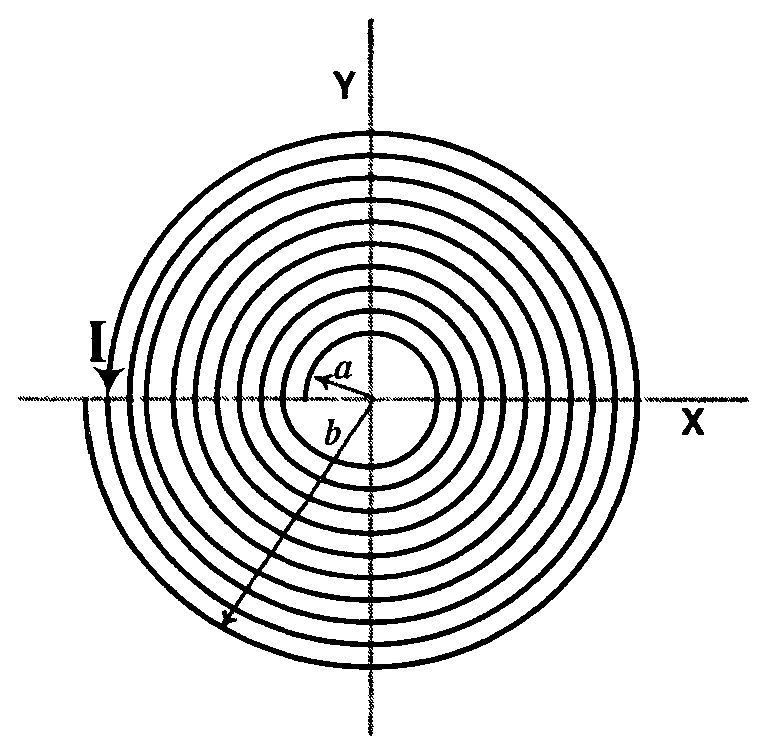
A long insulated copper wire is closely wound as a spiral of '' turns. The spiral has inner radius '' and outer radius ''. The spiral lies in the X-Y plane and a steady current '' flows through the wire. The Z-component of the magnetic field at the center of the spiral is
Options
Topics & Concepts
Step-by-Step Solution
To find the Z-component of the magnetic field at the center of the spiral wire, we can divide the spiral into elemental concentric circular loops.
1. Turn Density:
The total number of turns is uniformly distributed over the radial width from inner radius to outer radius . Thus, the number of turns per unit radial distance is:
2. Elemental Circular Loop:
Consider a thin circular ring element of radius and thickness , where .
The number of turns in this elemental width is given by:
3. Magnetic Field Due to the Element:
The magnetic field at the center produced by a circular loop of radius carrying current with turns is directed along the Z-axis (normal to the X-Y plane) and is given by Biot-Savart law as:
Substituting the expression for :
4. Total Magnetic Field:
To find the total magnetic field at the center, we integrate from to :
Evaluating the integral:
Substituting this back into the expression for :
This corresponds to Option (A).