JEE Challenger
More from Magnetism and Matter

Magnetic Field at Midway Point Between Two Bar Magnets

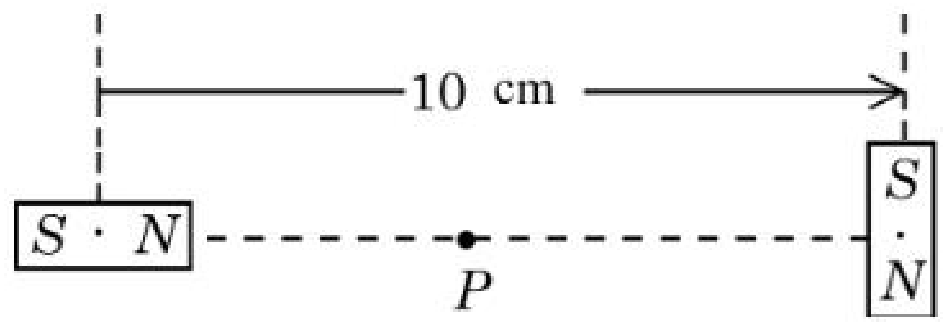
Two identical small bar magnets each of dipole moment 35 J/T3\sqrt{5}\text{ J/T} are placed at a center to center separation of 10 cm10\text{ cm}, with their axes perpendicular to each other as shown in figure. The value of magnetic field at the point P midway between the magnets is α×103 T\alpha \times 10^{-3}\text{ T}. The value of α\alpha is _____.

(μ0=4π×107 Tm/A\mu_0 = 4\pi \times 10^{-7}\text{ Tm/A})

Question Diagram 1
Official Numerical Answer12

Topics & Concepts

Step-by-Step Solution

To find the magnetic field at the point PP midway between the two identical small bar magnets, we consider the contribution of each magnet separately.

1. Given Data:

  • Dipole moment of each magnet, M=35 J/TM = 3\sqrt{5} \text{ J/T}
  • Center-to-center separation between magnets, d=10 cm=0.1 md = 10 \text{ cm} = 0.1 \text{ m}
  • Distance from point PP to the center of each magnet, r=d2=5 cm=0.05 m=5×10² mr = \frac{d}{2} = 5 \text{ cm} = 0.05 \text{ m} = 5 \times 10^{-2} \text{ m}
  • Permeability constant, μ04π=107 Tm/A\frac{\mu_0}{4\pi} = 10^{-7} \text{ T}\cdot\text{m/A}

2. Magnetic Field due to the First Magnet (B1\vec{B}_1): Point PP lies on the axial line (end-on position) of the horizontal magnet (first magnet).

position: B1=μ04π2Mr3B_1 = \frac{\mu_0}{4\pi} \frac{2M}{r^3}

Substituting the given values: B1=107×2×35(5×10²)3B_1 = 10^{-7} \times \frac{2 \times 3\sqrt{5}}{(5 \times 10^{-2})^3} B1=107×65125×106=651.25×10³ T=4.85×103 TB_1 = 10^{-7} \times \frac{6\sqrt{5}}{125 \times 10^{-6}} = \frac{6\sqrt{5}}{1.25} \times 10^{-3} \text{ T} = 4.8\sqrt{5} \times 10^{-3} \text{ T}

The direction of B1\vec{B}_1 is along the axis of the magnet (horizontally to the right).


3. Magnetic Field due to the Second Magnet (B2\vec{B}_2): Point PP lies on the equatorial line (broadside-on position) of the vertical magnet (second magnet).

The magnitude of the magnetic field at an equatorial point is given by: B2=μ04πMr3=B12B_2 = \frac{\mu_0}{4\pi} \frac{M}{r^3} = \frac{B_1}{2}

Substituting the value of B1B_1: B2=4.85×1032=2.45×103 TB_2 = \frac{4.8\sqrt{5} \times 10^{-3}}{2} = 2.4\sqrt{5} \times 10^{-3} \text{ T}

The direction of B2\vec{B}_2 is perpendicular to the line joining the centers (vertically upwards).


4. Net Magnetic Field at Point PP: Since the axes of the two magnets are perpendicular to each other, B1\vec{B}_1 and B2\vec{B}_2 are mutually perpendicular (θ=90\theta = 90^\circ).

The resultant magnetic field BB at point PP is: B=B12+B22B = \sqrt{B_1^2 + B_2^2} B=(4.85×10³)2+(2.45×10³)2B = \sqrt{(4.8\sqrt{5} \times 10^{-3})^2 + (2.4\sqrt{5} \times 10^{-3})^2} B=2.45×103×22+12B = 2.4\sqrt{5} \times 10^{-3} \times \sqrt{2^2 + 1^2} B=2.45×5×103 TB = 2.4\sqrt{5} \times \sqrt{5} \times 10^{-3} \text{ T} B=2.4×5×103 T=12×103 TB = 2.4 \times 5 \times 10^{-3} \text{ T} = 12 \times 10^{-3} \text{ T}

Comparing this result with the given form B=α×103 TB = \alpha \times 10^{-3} \text{ T}: α=12\alpha = 12

Magnetic Field at Midway Point Between Two Bar Magnets | Physics PYQ Solution - JEE Challenger