Levitation of Conducting Ring Above AC Powered Coil
STATEMENT-1
A vertical iron rod has a coil of wire wound over it at the bottom end. An alternating current flows in the coil. The rod goes through a conducting ring as shown in the figure. The ring can float at a certain height above the coil.
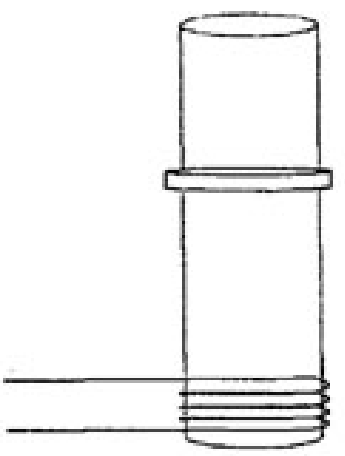
because
STATEMENT-2
In the above situation, a current is induced in the ring which interacts with the horizontal component of the magnetic field to produce an average force in the upward direction.
Options
Statement-1 is True, Statement-2 is True; Statement-2 is a correct explanation for Statement-1
Statement-1 is True, Statement-2 is True; Statement-2 is NOT a correct explanation for Statement-1
Statement-1 is True, Statement-2 is False
Statement-1 is False, Statement-2 is True
Topics & Concepts
Step-by-Step Solution
To determine the correctness of the statements, let us analyze the electromagnetic interaction between the AC-powered coil, the iron rod, and the conducting ring (the classic Thomson's jumping ring experiment):
-
Magnetic Field Distribution:
When an alternating current passes through the coil, it produces an alternating magnetic field channeled through the iron rod. Above the coil, the magnetic field lines diverge as they exit the rod. In cylindrical coordinates , this divergence implies that the magnetic field has both:- A vertical (axial) component:
- A horizontal (radial) component:
-
Induced Current in the Ring:
The time-varying magnetic flux through the conducting ring induces an electromotive force (EMF) according to Faraday's Law:
The conducting ring has a finite electrical resistance and a self-inductance . Due to this inductance, the induced current lags behind the induced EMF by a phase angle :
where with . -
Interaction and Magnetic Force:
The magnetic Lorentz force on an element of the ring carrying current is given by:
Expanding the cross product:
- The radial force components cancel symmetrically around the ring or produce a net radial pinch.
- The vertical force on the entire ring of radius is:
Taking the time average of the vertical force over a cycle:
Using the identity :
Therefore:
Since , the phase angle , making . This ensures a non-zero, time-averaged magnetic force directed upward ().
-
Levitation:
As the ring moves higher above the coil, the magnetic field strength decreases, which decreases . At a certain height, the upward magnetic force balances the downward gravitational force ():
Hence, the ring can stably float (levitate) at this height.
Therefore:
- Statement-1 is True.
- Statement-2 is True.
- Statement-2 is the correct explanation for Statement-1.
Correct Option: (A)