Laplace Correction Process for Speed of Sound in Ideal Gas
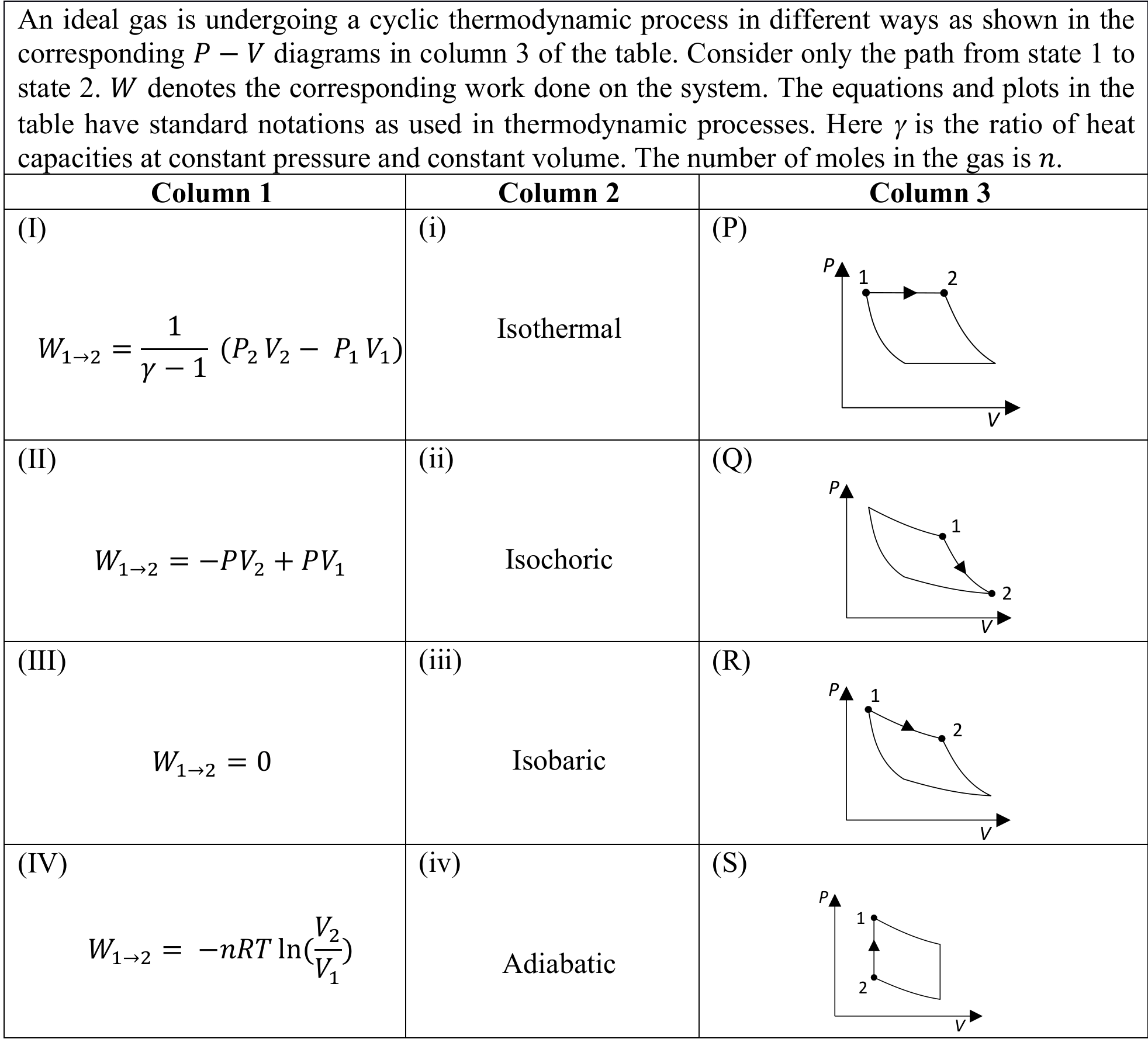
Answer questions 16, 17, and 18 by correctly matching the information given across the three columns in the following table.
An ideal gas undergoes a thermodynamic cyclic process along different paths as depicted in the corresponding diagrams in Column 3. Consider only the path from state 1 to state 2. Here, denotes the work done on the system. Standard notations are used for equations and plots in thermodynamics, where represents the ratio of specific heat capacities () and is the amount of gas in moles.
Which of the options correctly identifies the thermodynamic process that Laplace introduced as a correction for determining the speed of sound propagation in an ideal gas?
Options
(I) (ii) (Q)
(IV) (ii) (R)
(III) (iv) (R)
(I) (iv) (Q)
Topics & Concepts
Step-by-Step Solution
To determine the correct combination of options, we analyze the thermodynamic concepts and the given table as follows:
1. Laplace's Correction for the Speed of Sound
Newton initially assumed that sound propagation through a gas occurs under isothermal conditions because the temperature of the gas was assumed to remain constant. However, Laplace corrected this by pointing out that sound waves involve extremely rapid compressions and rarefactions. As a result, there is no time for heat exchange between adjacent regions (). Therefore, the process is adiabatic.
From Column 2, an adiabatic process corresponds to (iv).
2. Work Done on the System in an Adiabatic Process
For an ideal gas undergoing an adiabatic process () from state 1 to state 2, the work done by the gas is given by:
As defined in the problem, represents the work done on the system ():
This matches entry (I) in Column 1.
3. Matching with Diagram
From the given options:
- (I) represents the correct expression for work done on the system during an adiabatic process.
- (iv) represents the Adiabatic process.
- (Q) represents the corresponding adiabatic curve on the diagram.
Hence, the correct matching combination is (I) (iv) (Q), which corresponds to option D.