JEE Challenger
More from Moving Charges and Magnetism

Ion Trajectory and Detection in Perpendicular Magnetic Field

A positive, singly ionized atom of mass number AMA_{\text{M}} is accelerated from rest by the voltage 192 V192\text{ V}. Thereafter, it enters a rectangular region of width ww with magnetic field B0=0.1k^ Tesla\vec{B}_0 = 0.1\hat{k}\text{ Tesla}, as shown in the figure. The ion finally hits a detector at the distance xx below its starting trajectory.

[Given: Mass of neutron/proton =(5/3)×1027 kg= (5/3) \times 10^{-27}\text{ kg}, charge of the electron =1.6×10¹⁹ C= 1.6 \times 10^{-19}\text{ C}.]

Which of the following option(s) is(are) correct?
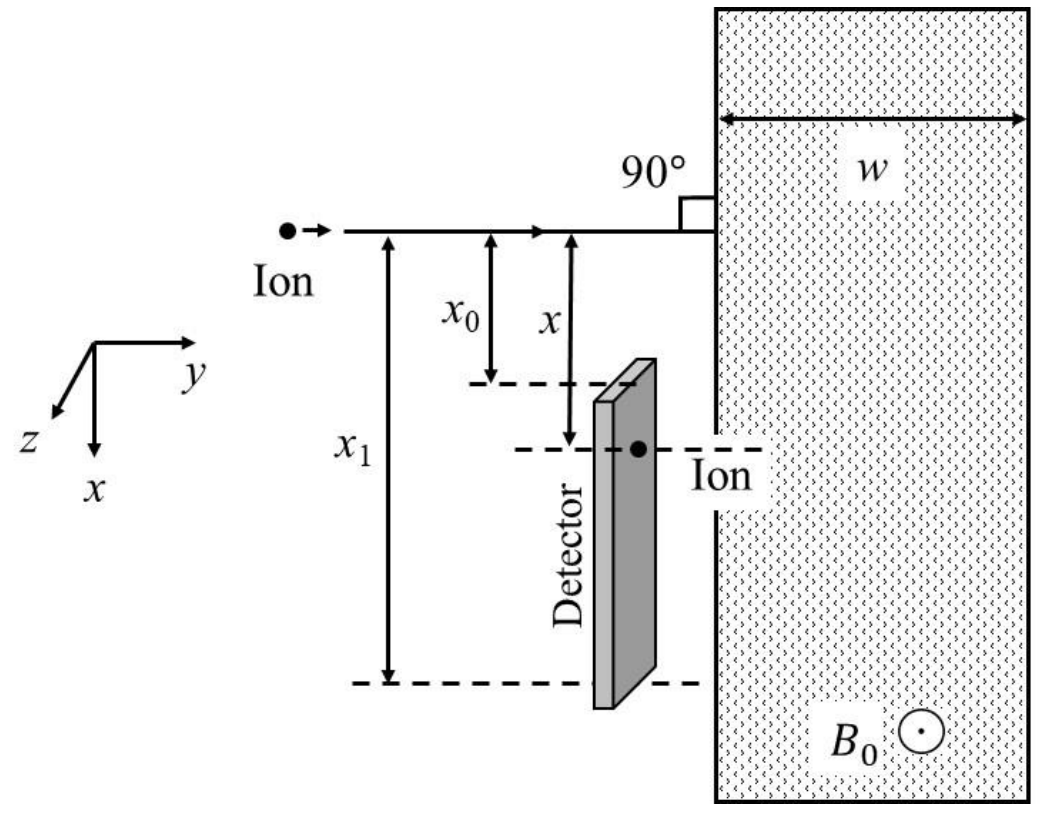
Question Diagram 1

Options

A

The value of xx for H+H^+ ion is 4 cm4\text{ cm}.

Correct
B

The value of xx for an ion with AM=144A_{\text{M}} = 144 is 48 cm48\text{ cm}.

Correct
C

For detecting ions with 1AM1961 \leq A_{\text{M}} \leq 196, the minimum height (x1x0)(x_1 - x_0) of the detector is 55 cm55\text{ cm}.

D

The minimum width ww of the region of the magnetic field for detecting ions with AM=196A_{\text{M}} = 196 is 56 cm56\text{ cm}.

Step-by-Step Solution

To determine the correct statements, let us analyze the trajectory of the ion step-by-step:

1. Velocity of the Ion

The ion has mass m=AMm0m = A_{\text{M}} m_0, where m0=53×1027 kgm_0 = \frac{5}{3} \times 10^{-27}\text{ kg}, and charge q=1.6×10¹⁹ Cq = 1.6 \times 10^{-19}\text{ C}. It is accelerated from rest through a potential difference of V=192 VV = 192\text{ V}.

Using the work-energy theorem: qV=12mv2    v=2qVmqV = \frac{1}{2}mv^2 \implies v = \sqrt{\frac{2qV}{m}}

2. Radius of the Circular Trajectory

The ion enters the magnetic field B0=B0k^\vec{B}_0 = B_0 \hat{k} perpendicularly with velocity v=vj^\vec{v} = v\hat{j}. The magnetic force acting on it is: F=q(v×B0)=q(vj^×B0k^)=qvB0i^\vec{F} = q(\vec{v} \times \vec{B}_0) = q(v\hat{j} \times B_0\hat{k}) = q v B_0 \hat{i} This force is directed downwards along the +x+x-direction, causing the ion to trace a circular path in the xyxy-plane of radius RR: R=mvqB0=2mqVqB0=1B02mVqR = \frac{mv}{qB_0} = \frac{\sqrt{2mqV}}{qB_0} = \frac{1}{B_0}\sqrt{\frac{2mV}{q}}

Substitute the given values into the expression for RR: R=10.12×(AM×53×1027)×1921.6×1019R = \frac{1}{0.1}\sqrt{\frac{2 \times \left(A_{\text{M}} \times \frac{5}{3} \times 10^{-27}\right) \times 192}{1.6 \times 10^{-19}}}

R=10×640×108AM1.6=10×400×108AMR = 10 \times \sqrt{\frac{640 \times 10^{-8} A_{\text{M}}}{1.6}} = 10 \times \sqrt{400 \times 10^{-8} A_{\text{M}}}

R=10×(20×104AM)=2×10²AM m=2AM cmR = 10 \times \left(20 \times 10^{-4}\sqrt{A_{\text{M}}}\right) = 2 \times 10^{-2}\sqrt{A_{\text{M}}}\text{ m} = 2\sqrt{A_{\text{M}}}\text{ cm}

3. Trajectory and Exit Distance xx

The ion performs a half-circle inside the magnetic field region and emerges from the same boundary to hit the detector.

  • The penetration depth of the ion into the magnetic field is equal to the radius: wmin=R=2AM cmw_{\min} = R = 2\sqrt{A_{\text{M}}}\text{ cm}
  • The vertical distance xx below the starting trajectory where the ion emerges and hits the detector is the diameter of the circular path: x=2R=4AM cmx = 2R = 4\sqrt{A_{\text{M}}}\text{ cm}

4. Evaluating the Options

  • Option (A): For a H+\text{H}^+ ion, AM=1A_{\text{M}} = 1: x=41 cm=4 cmx = 4\sqrt{1}\text{ cm} = 4\text{ cm} (Option A is correct)

  • Option (B): For an ion with AM=144A_{\text{M}} = 144: x=4144 cm=4×12 cm=48 cmx = 4\sqrt{144}\text{ cm} = 4 \times 12\text{ cm} = 48\text{ cm} (Option B is correct)

  • Option (C): For ions with 1AM1961 \leq A_{\text{M}} \leq 196: xmin=41 cm=4 cmx_{\min} = 4\sqrt{1}\text{ cm} = 4\text{ cm} xmax=4196 cm=4×14 cm=56 cmx_{\max} = 4\sqrt{196}\text{ cm} = 4 \times 14\text{ cm} = 56\text{ cm} The minimum height of the detector is: (x1x0)min=xmaxxmin=56 cm4 cm=52 cm55 cm(x_1 - x_0)_{\min} = x_{\max} - x_{\min} = 56\text{ cm} - 4\text{ cm} = 52\text{ cm} \neq 55\text{ cm} (Option C is incorrect)

  • Option (D): For detecting ions with AM=196A_{\text{M}} = 196, the minimum required width of the magnetic field region is: wmin=R=2196 cm=28 cm56 cmw_{\min} = R = 2\sqrt{196}\text{ cm} = 28\text{ cm} \neq 56\text{ cm} (Option D is incorrect)


Correct Answer:

(A), (B)

Ion Trajectory and Detection in Perpendicular Magnetic Field | Physics PYQ Solution - JEE Challenger