Instantaneous Axis of Rotation for Rigid Body Disc System
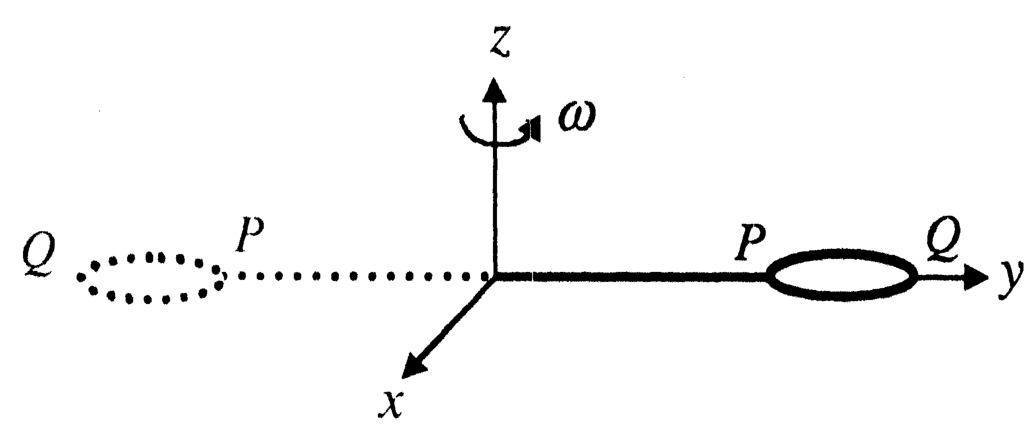
A rigid body's general motion can be analyzed as a combination of: (i) motion of its center of mass around an axis, and (ii) motion about an instantaneous axis through the center of mass. These axes are not required to be stationary. As an example, consider a thin uniform disc welded horizontally at its rim to a light stick, as illustrated. When this disc-stick combination rotates around the origin on a frictionless horizontal plane at angular velocity , its motion at any moment is equivalent to (i) rotation of the disc's center of mass around the -axis, and (ii) rotation of the disc about an instantaneous vertical axis through its center of mass (evident from the shift in orientation of points and ). Both motions occur with identical angular speed .
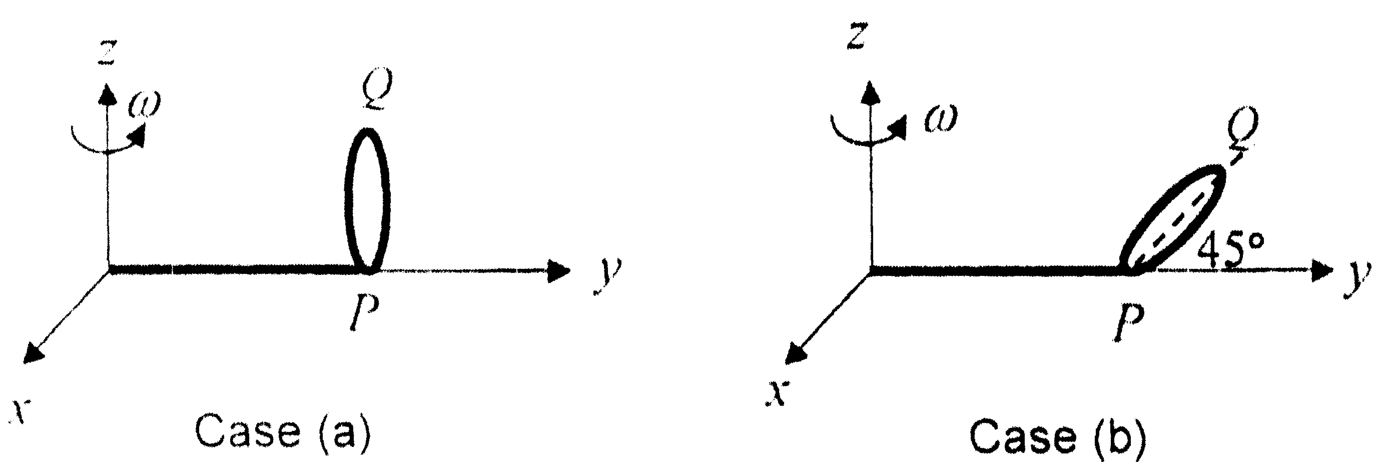
Next, consider two analogous configurations shown in the figure: Case (a) where the disc's face is vertical and parallel to the - plane; Case (b) where the disc's face forms a angle with the - plane with its horizontal diameter parallel to the -axis. In both scenarios, the disc is attached at point , and the assemblies rotate at constant angular velocity about the -axis.
Which of the given statements regarding the instantaneous axis passing through the centre of mass is correct?
Options
It is vertical for both the cases (a) and (b).
It is vertical for case (a); and is at to the - plane and lies in the plane of the disc for case (b).
It is horizontal for case (a); and is at to the - plane and is normal to the plane of the disc for case (b).
It is vertical for case (a); and is at to the - plane and is normal to the plane of the disc for case (b).
Step-by-Step Solution
To determine the direction of the instantaneous axis of rotation passing through the center of mass of the disc, we utilize the fundamental principles of rigid body kinematics.
Step 1: Kinematics of Rigid Body Rotation
When a rigid body system rotates about a fixed axis (in this case, the vertical -axis) with an angular speed , the angular velocity vector of the entire system is given by:
Step 2: Uniqueness of Angular Velocity Vector
A fundamental property of rigid body motion is that the angular velocity vector is a unique, intrinsic characteristic of the body's instantaneous motion. It is independent of the choice of reference point or origin.
Specifically, the velocity of any point on the disc relative to its center of mass is given by:
where is identical to the overall angular velocity of the rigid system.
Step 3: Direction of the Instantaneous Axis of Rotation
The instantaneous axis of rotation passing through the center of mass is defined as the line passing through the center of mass parallel to the angular velocity vector .
Since the system rotates exclusively about the -axis in both scenarios:
- For Case (a): The rotation of the rigid assembly occurs about the -axis with angular velocity . Thus, the instantaneous axis through the center of mass is parallel to (vertical).
- For Case (b): Regardless of the orientation of the disc's plane ( angle with the - plane), the entire rigid body still rotates strictly about the -axis. Thus, its angular velocity vector remains , making the instantaneous axis through the center of mass parallel to (vertical).
Conclusion
The instantaneous axis of rotation passing through the center of mass is vertical for both Case (a) and Case (b).
Correct Option: A