Induced EMF in Rotating Square Loop in Time Dependent Magnetic Field
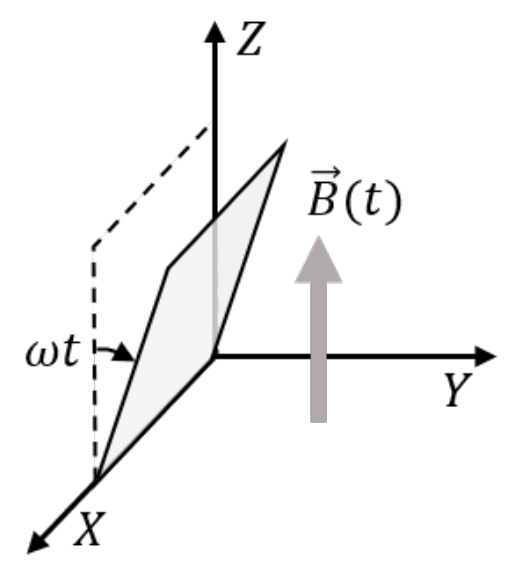
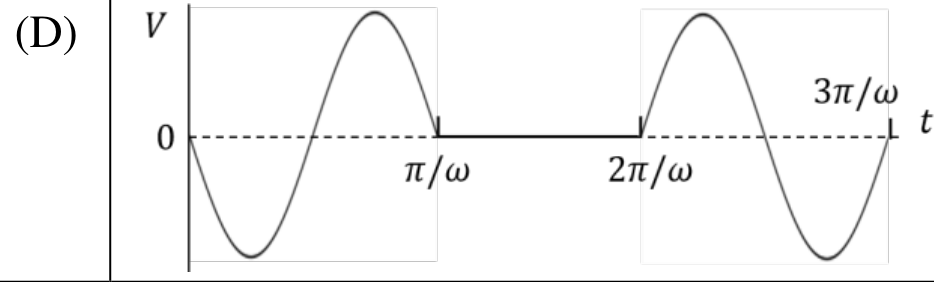
A conducting square loop initially lies in the plane with its lower edge hinged along the -axis. Only in the region , there is a time dependent magnetic field pointing along the -direction, , where is a constant. The magnetic field is zero everywhere else. At time , the loop starts rotating with constant angular speed about the axis in the clockwise direction as viewed from the axis (as shown in the figure). Ignoring self-inductance of the loop and gravity, which of the following plots correctly represents the induced e.m.f. () in the loop as a function of time:
Options
Topics & Concepts
Step-by-Step Solution
To determine the induced electromotive force (e.m.f.) in the loop, we analyze the magnetic flux through the loop as a function of time.
1. Orientation and Region of the Loop
- The square loop of side (and area ) has its bottom edge along the -axis and initially lies in the -plane.
- At , it begins rotating with a constant angular speed clockwise as viewed from the positive -axis.
- The position vector of the plane of the loop at time is at an angle with the -axis, tilting towards the -axis.
- The unit normal vector to the surface of the loop is given by:
- The magnetic field is non-zero only in the region , and is zero for .
2. Flux Calculation for Different Time Intervals
Interval 1: During this half of the rotation period, the loop is completely within the region , where the magnetic field exists. The magnetic flux through the loop is:
According to Faraday's law of electromagnetic induction, the induced e.m.f. is:
Thus, for :
- At :
- At :
- At :
- At :
- At :
This corresponds to one complete cosine cycle with a positive starting value.
Interval 2: During this half of the rotation, the loop moves through the region , where the magnetic field is zero (). Consequently:
3. Conclusion
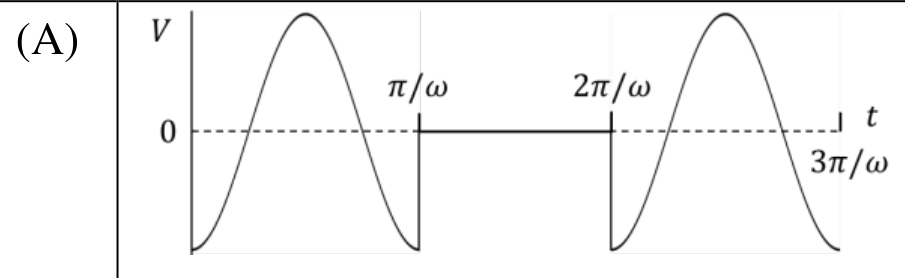
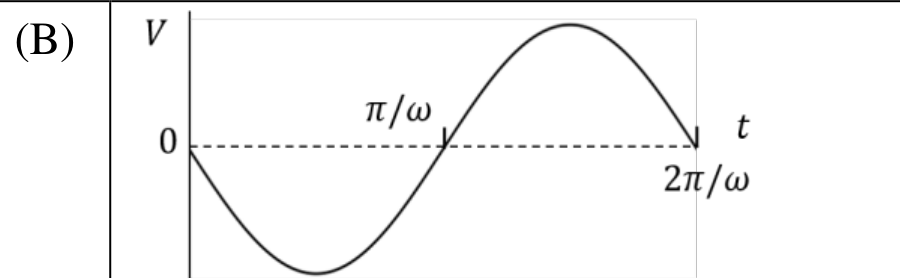
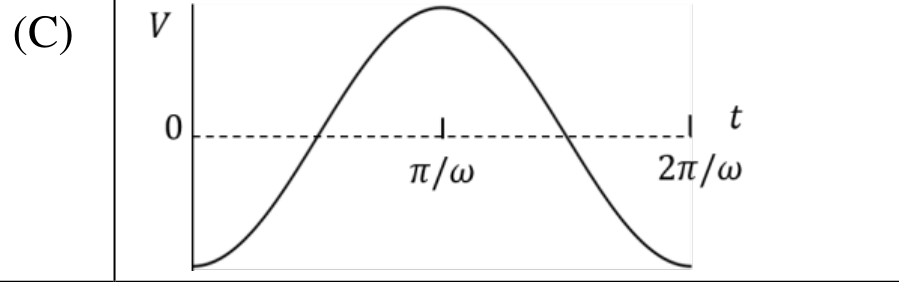
The induced e.m.f. is a full cosine wave oscillation starting at a positive peak in the interval , and remains strictly zero in the interval , repeating periodically every .
This behavior is correctly depicted in graph (A).
Correct Answer: (A)