Impulse Imparted to Uniform Rod Connected to String
A thin uniform rod of length and certain mass is kept on a frictionless horizontal table with a massless string of length fixed to one end (top view is shown in the figure). The other end of the string is pivoted to a point O. If a horizontal impulse is imparted to the rod at a distance from the mid-point of the rod (see figure), then the rod and string revolve together around the point O, with the rod remaining aligned with the string. In such a case, the value of is ______.
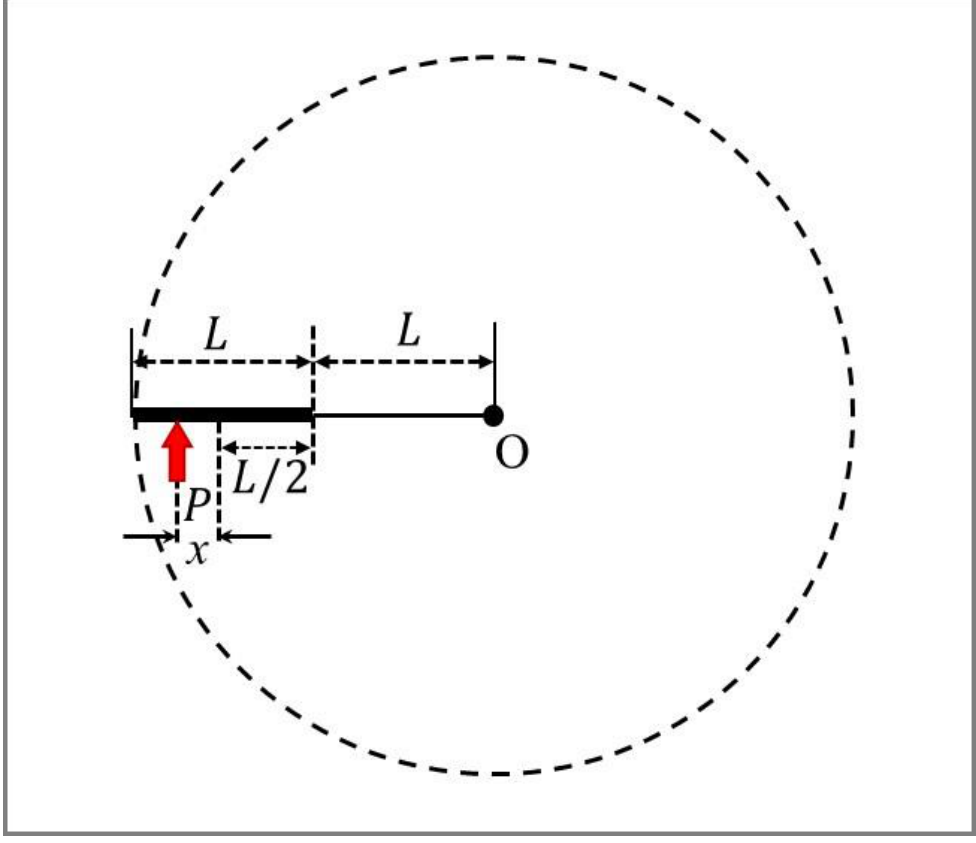
Step-by-Step Solution
To find the value of , we analyze the motion of the system (rod + massless string) immediately after the horizontal impulse is applied.
1. System Geometry and Parameters
- Mass of the rod =
- Length of the rod =
- Length of the string =
- Distance from the pivot to the inner end of the rod =
- Distance from the pivot to the center of mass () of the rod:
- Position of the point of application of impulse from the pivot :
2. Moment of Inertia about the Pivot
Using the parallel-axis theorem, the moment of inertia of the rod about point is:
3. Impulse and Linear Momentum
Since the string is massless and flexible, it can only exert tension along its length (radially towards point ). It cannot exert any transverse (perpendicular) force or impulse on the rod.
Therefore, the net transverse impulse on the rod is simply . By the impulse-momentum theorem for the center of mass in the transverse direction:
Given that the rod and string revolve together around point as a single rigid body with angular velocity , the velocity of the center of mass is related to by:
Equating the two expressions for :
4. Angular Momentum Conservation about
The angular impulse imparted about the pivot is:
The angular momentum of the system after the impulse is:
Equating the angular impulse to the angular momentum:
Dividing both sides by :
Comparing with , we get: