Image Formation in Plano Convex Beaker Filled with Liquid
A glass beaker has a solid, plano-convex base of refractive index , as shown in the figure. The radius of curvature of the convex surface (SPU) is , while the planar surface (STU) acts as a mirror. This beaker is filled with a liquid of refractive index up to the level QPR. If the image of a point object O at a height of (OT in the figure) is formed onto itself, then, which of the following option(s) is(are) correct?
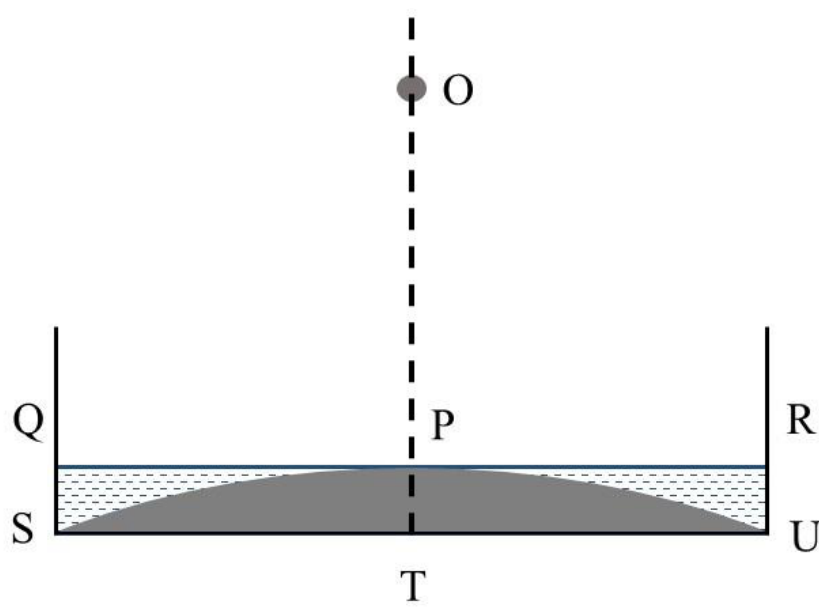
Options
For , .
For , .
For , .
For , .
Step-by-Step Solution
To determine the condition under which the image of the point object is formed onto itself, we trace paraxial light rays originating from through the optical system:
-
Refraction at the flat liquid surface ():
- Refractive index of air:
- Refractive index of liquid:
- Object distance from the apex :
Using the refraction formula for a plane surface ():
This forms a virtual image at a distance of above .
-
Refraction at the convex glass surface ():
- Refractive index of liquid:
- Refractive index of glass base:
- Radius of curvature of : (since the center of curvature lies inside the glass, along the direction of incident light)
- Object distance for this surface:
For the image to be formed onto itself, light rays entering the glass base must fall normally on the planar mirror surface . This means the rays inside the glass must be parallel to the central optical axis (), which corresponds to an image distance .
Using the spherical surface refraction formula:
Substituting the values:
-
Evaluating the options:
-
For Option A (): (Option A is correct)
-
For Option B (): (Option B is correct)
-
For Option C (): (Option C is incorrect)
-
For Option D (): (Option D is incorrect)
-
Correct Option(s): A and B