Image Formation by Oil Lens on Water Surface
Water (with refractive index ) in a tank is deep. Oil of refractive index lies on water making a convex surface of radius of curvature '' as shown. Consider oil to act as a thin lens. An object 'S' is placed above water surface. The location of its image is at '' above the bottom of the tank. Then '' is
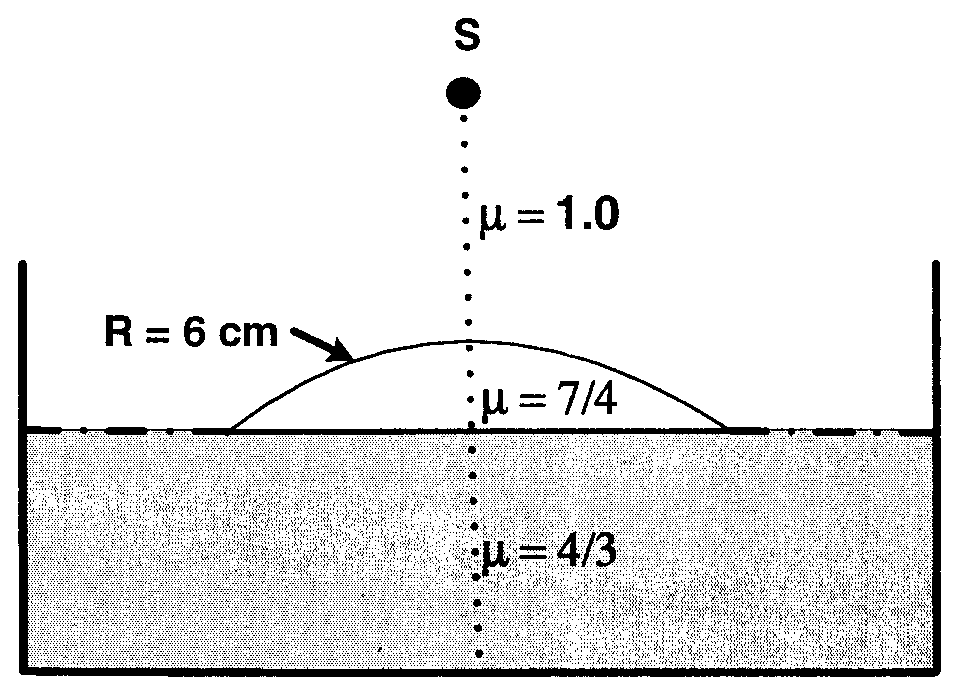
Step-by-Step Solution
To find the position of the image formed by the system, we consider the refraction of light through the two interfaces forming the thin oil lens:
-
Refraction at the first (air-oil) spherical surface:
- Refractive index of air:
- Refractive index of oil:
- Object distance:
- Radius of curvature of the convex surface: (center of curvature lies in the medium of transmission, i.e., downwards)
Using the spherical surface refraction formula:
Substituting the given values:
-
Refraction at the second (oil-water) plane surface:
- The oil lens is considered thin, so the refraction at the flat interface occurs at effectively the same location as the water surface.
- The image formed by the first surface acts as a virtual object for the plane oil-water interface.
- Object distance for the second surface:
- Refractive index of oil:
- Refractive index of water:
- Radius of curvature of the plane surface:
Using the refraction formula for a plane surface:
Solving for :
Therefore, the final image is formed at a distance of below the water surface.
-
Position of the image from the bottom of the tank:
- The depth of the water in the tank is .
- The image is formed at a depth of below the surface.
- The distance of the image from the bottom of the tank is:
Thus, the value of is .