JEE Challenger
More from Ray Optics and Optical Instruments

Image Coincidence in System of Two Concave Mirrors and Convex Lens

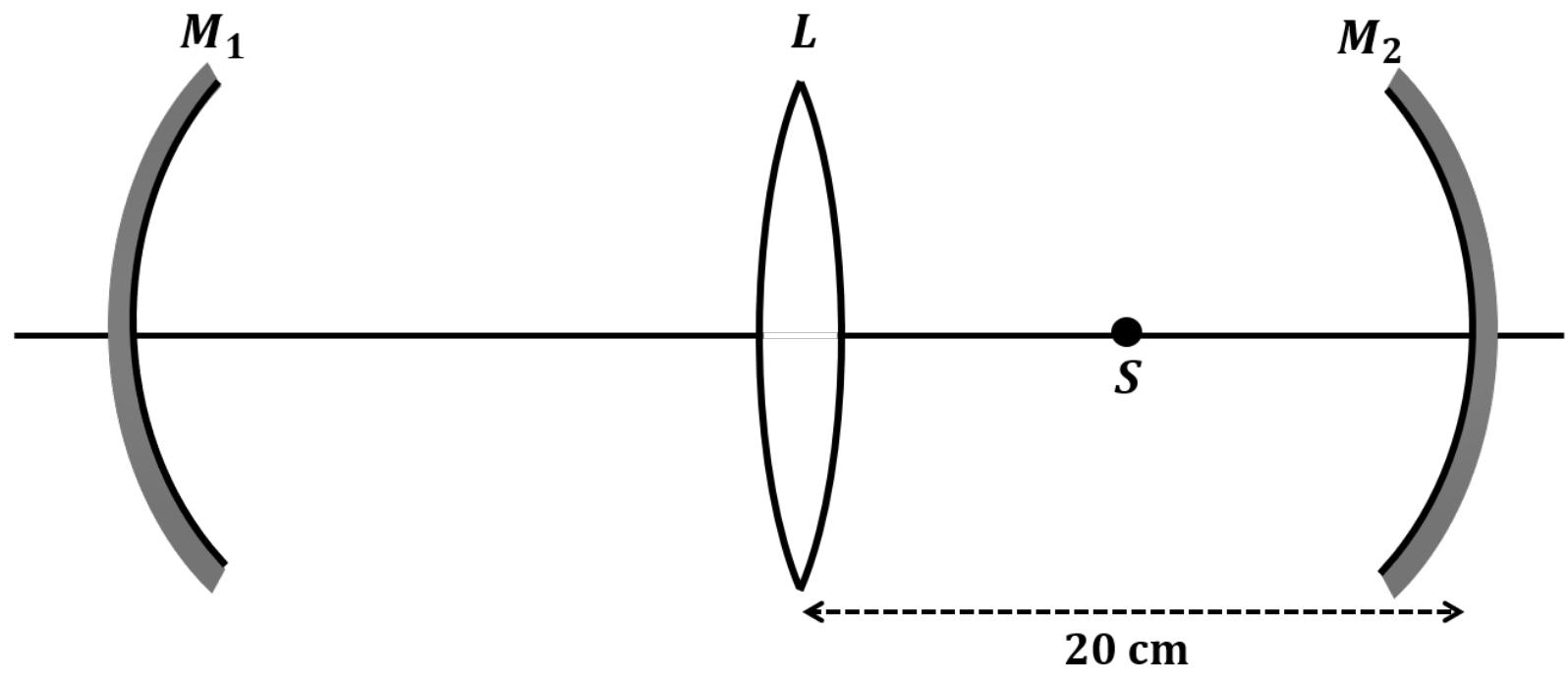
An optical arrangement consists of two concave mirrors M1\text{M}_1 and M2\text{M}_2, and a convex lens L\text{L} with a common principal axis, as shown in the figure. The focal length of L\text{L} is 10 cm10\text{ cm}. The radii of curvature of M1\text{M}_1 and M2\text{M}_2 are 20 cm20\text{ cm} and 24 cm24\text{ cm}, respectively. The distance between L\text{L} and M2\text{M}_2 is 20 cm20\text{ cm}. A point object S\text{S} is placed at the mid-point between L\text{L} and M2\text{M}_2 on the axis. When the distance between L\text{L} and M1\text{M}_1 is n/7 cmn/7\text{ cm}, one of the images coincides with S\text{S}. The value of nn is _______.

Question Diagram 1
Official Numerical Answer220

Step-by-Step Solution

To find the value of nn, let us trace the path of the rays starting from the point object SS:

  1. Reflection at Concave Mirror M2M_2: The point object SS is placed at the midpoint between the lens LL and mirror M2M_2.

    • Distance between LL and M2=20 cmM_2 = 20\text{ cm}
    • Object distance for M2M_2: u2=10 cmu_2 = -10\text{ cm}
    • Focal length of M2M_2: f2=R22=242=12 cmf_2 = -\frac{R_2}{2} = -\frac{24}{2} = -12\text{ cm}

    Using the mirror formula: 1v2+1u2=1f2\frac{1}{v_2} + \frac{1}{u_2} = \frac{1}{f_2} 1v2110=112\frac{1}{v_2} - \frac{1}{10} = -\frac{1}{12} 1v2=110112=6560=160    v2=+60 cm\frac{1}{v_2} = \frac{1}{10} - \frac{1}{12} = \frac{6 - 5}{60} = \frac{1}{60} \implies v_2 = +60\text{ cm}

    Thus, mirror M2M_2 forms a virtual image I1I_1 at a distance of 60 cm60\text{ cm} behind it (to the right of M2M_2).

  2. Refraction through Lens LL: The reflected rays from M2M_2 travel towards the lens LL. The virtual image I1I_1 acts as an object for lens LL.

    • Distance of I1I_1 from LL: uL=(20 cm+60 cm)=80 cmu_L = -(20\text{ cm} + 60\text{ cm}) = -80\text{ cm}
    • Focal length of the lens: fL=+10 cmf_L = +10\text{ cm}

    Using the lens formula: 1vL1uL=1fL\frac{1}{v_L} - \frac{1}{u_L} = \frac{1}{f_L} 1vL180=110\frac{1}{v_L} - \frac{1}{-80} = \frac{1}{10} 1vL=110180=780    vL=807 cm\frac{1}{v_L} = \frac{1}{10} - \frac{1}{80} = \frac{7}{80} \implies v_L = \frac{80}{7}\text{ cm}

    The rays after refraction through LL converge at a distance of 807 cm\frac{80}{7}\text{ cm} to the left of the lens.

  3. Reflection at Concave Mirror M1M_1 and Retracing Path: For the final image to coincide with the source SS, the rays must strike mirror M1M_1 normally and retrace their entire path back to SS. This occurs when the converging rays from lens LL meet at the center of curvature C1C_1 of mirror M1M_1.

    • Radius of curvature of M1M_1: R1=20 cmR_1 = 20\text{ cm}
    • Distance between lens LL and mirror M1M_1: d=vL+R1=807+20=80+1407=2207 cmd = v_L + R_1 = \frac{80}{7} + 20 = \frac{80 + 140}{7} = \frac{220}{7}\text{ cm}

Given that the distance between LL and M1M_1 is n7 cm\frac{n}{7}\text{ cm}, we have: n7=2207    n=220\frac{n}{7} = \frac{220}{7} \implies n = 220