Identify Reaction Not Yielding Major Product Via Rearrangement
The major product of which of the following reaction is not obtained by rearrangement reaction ?
Options
A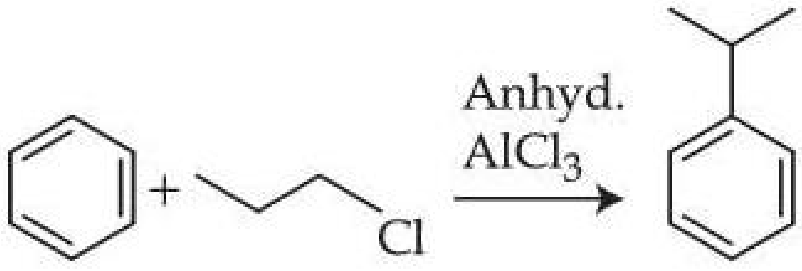
B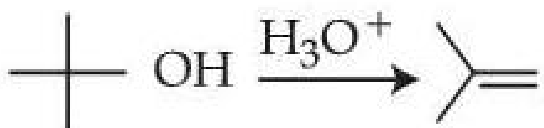 Correct
C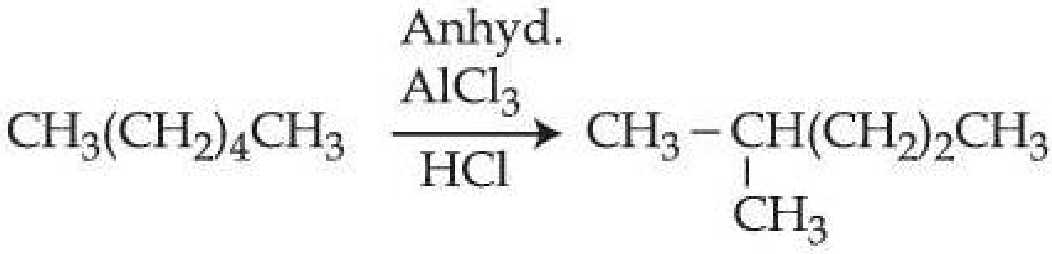
D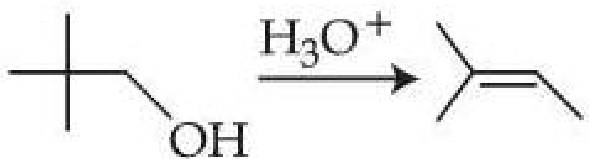
Step-by-Step Solution
To determine which reaction does not form its major product via a rearrangement reaction, we analyze the reaction mechanism for each option:
-
Option A: Friedel-Crafts alkylation of benzene with -chloropropane in the presence of anhydrous :
- The primary carbocation intermediate generated initially undergoes a -hydride shift to form the more stable secondary carbocation .
- Electrophilic aromatic substitution by this rearranged carbocation yields isopropylbenzene (cumene) as the major product.
- Involves rearrangement.
-
Option B: Acid-catalyzed dehydration of 2-methylpropan-2-ol (-butanol):
- Protonation of the alcohol followed by the loss of a water molecule directly forms a stable carbocation intermediate:
- Loss of a proton () from this stable carbocation forms 2-methylpropene without requiring any structural or hydride rearrangement.
- Does NOT involve rearrangement.
-
Option C: Isomerization of -hexane using anhydrous and :
- The conversion of straight-chain -hexane into branched 2-methylpentane involves carbocation generation followed by alkyl/hydride skeletal rearrangements.
- Involves rearrangement.
-
Option D: Acid-catalyzed dehydration of 3,3-dimethylbutan-2-ol:
- Loss of water generates a carbocation, .
- A -methyl shift takes place to convert it into a more stable carbocation, .
- Subsequent deprotonation yields 2,3-dimethylbut-2-ene as the major product.
- Involves rearrangement.
Thus, the reaction in Option B does not proceed through a rearrangement.
Correct Answer: Option B