Identify Most Acidic Hydrogen in Depicted Hydrocarbon Structures
Consider the depicted hydrogen () in the hydrocarbons given below. The most acidic hydrogen () is
Options
A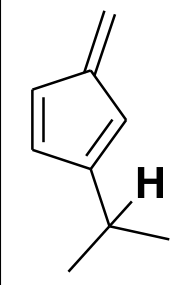
B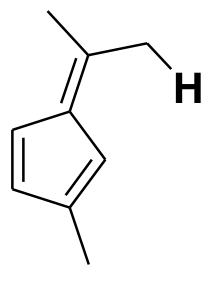 Correct
C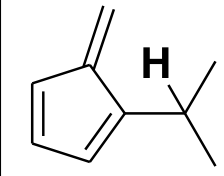
D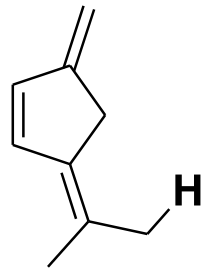
Topics & Concepts
Step-by-Step Solution
To determine the most acidic hydrogen () among the given hydrocarbon structures, we evaluate the relative stability of the conjugate base (carbanion) formed upon the removal of . The acidity of a compound increases with the increased stability of its conjugate base.
-
Analysis of Structure (B):
- In structure (B), the highlighted hydrogen () is located on the methyl group attached to the exocyclic double bond of the 5-membered ring.
- Upon deprotonation (loss of ), a carbanion is formed adjacent to the exocyclic double bond:
- In the resonance contributor where the negative charge resides on the ring carbon, the 5-membered ring contains two endocyclic double bonds along with the negative charge on the ring carbon.
- This creates a fully conjugated cyclic system containing -electrons (-electrons from the two double bonds and -electrons from the lone pair of the carbanion).
- According to Hückel's rule ( -electrons, where ), this cyclopentadienyl anion core is aromatic, imparting exceptional stability to the conjugate base.
-
Analysis of Structures (A), (C), and (D):
- In structures (A) and (C), deprotonation yields carbanions where resonance delocalization does not lead to a fully aromatic -electron cyclopentadienyl ring.
- In structure (D), the ring contains a saturated -hybridized carbon atom within the ring framework, which prevents complete cyclic delocalization and precludes the formation of an aromatic conjugate base.
Since the conjugate base of (B) achieves aromatic stabilization, the corresponding hydrogen () is the most acidic.
Correct Answer: (B)