Identify Incorrect Statements Regarding Amine Reactions and Properties
Identify the incorrect statements.
Choose the correct answer from the options given below:
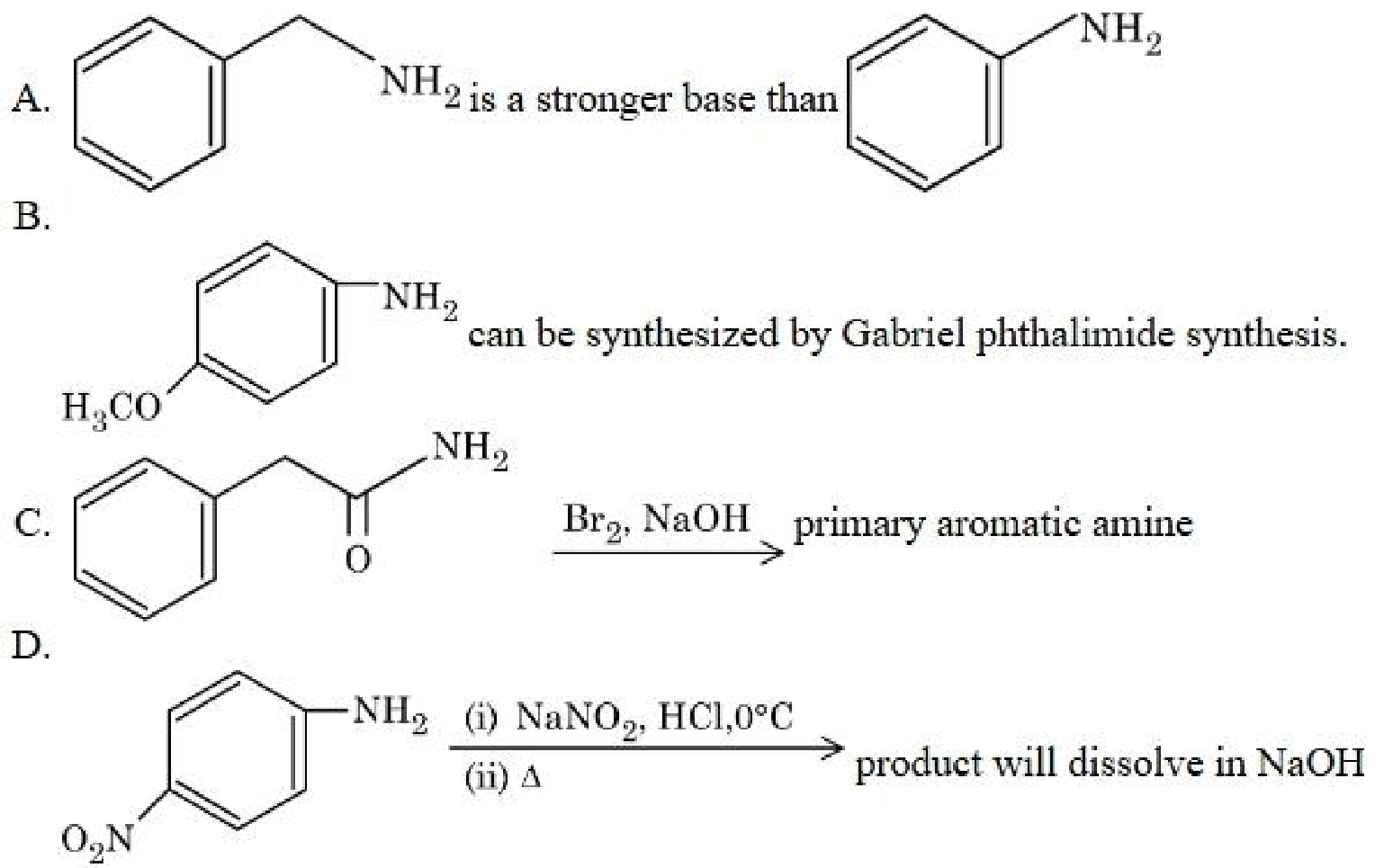
Options
A
A and D Only
B
A and C Only
CCorrect
B and C Only
D
A and B Only
Topics & Concepts
Step-by-Step Solution
To determine which of the given statements are incorrect, let us analyze each statement individually:
-
Statement A:
- The first structure is 2-phenylethan-1-amine (), which is an aliphatic primary amine.
- The second structure is aniline (), which is an aromatic primary amine.
- In aniline, the unshared electron pair on the nitrogen atom is in conjugation with the benzene ring and is delocalized through resonance, making it less available for protonation.
- In 2-phenylethan-1-amine, the nitrogen atom is separated from the aromatic ring by -hybridized carbon atoms, so its lone pair is not delocalized into the ring.
- Therefore, 2-phenylethan-1-amine is a stronger base than aniline.
- Thus, Statement A is correct.
-
Statement B:
- The structure shown is 4-methoxyaniline (-anisidine), which is a primary aromatic amine.
- Gabriel phthalimide synthesis involves an nucleophilic substitution reaction between potassium phthalimide and an alkyl halide.
- Aryl halides do not undergo nucleophilic substitution with potassium phthalimide under ordinary conditions because the bond has partial double-bond character due to resonance with the benzene ring.
- Hence, primary aromatic amines cannot be synthesized by Gabriel phthalimide synthesis.
- Thus, Statement B is incorrect.
-
Statement C:
- The reactant is 2-phenylacetamide ().
- Treating an amide with and undergoes the Hoffmann bromamide degradation reaction, reducing the chain length by one carbon atom:
- The product formed is benzylamine ().
- In benzylamine, the group is attached to an -hybridized aliphatic carbon atom, making it a primary aliphatic amine, not an aromatic amine.
- Thus, Statement C is incorrect.
-
Statement D:
- The reactant is 4-nitroaniline ().
- Step (i): Diazotization with at yields -nitrobenzenediazonium chloride:
- Step (ii): Heating () in aqueous medium hydrolyzes the diazonium salt to form 4-nitrophenol:
- -Nitrophenol is acidic in nature () and readily reacts with aqueous to form a water-soluble sodium salt (sodium 4-nitrophenolate):
- Hence, the product dissolves in .
- Thus, Statement D is correct.
Conclusion: The incorrect statements are B and C Only.
Correct Answer: Option C (B and C Only)