Identify Incorrect Orbital Combination for Helium Ion
Answer Q.31, Q.32 and Q.33 by appropriately matching the information provided in the three columns of the table below.
The wave function, , is a mathematical expression depending upon spherical polar coordinates of the electron, characterized by quantum numbers , , and . Here denotes the radial distance from the nucleus, represents colatitude, and is the azimuth. In the given formulas, represents the atomic number and is the Bohr radius.
For the ion, determine the only INCORRECT combination:
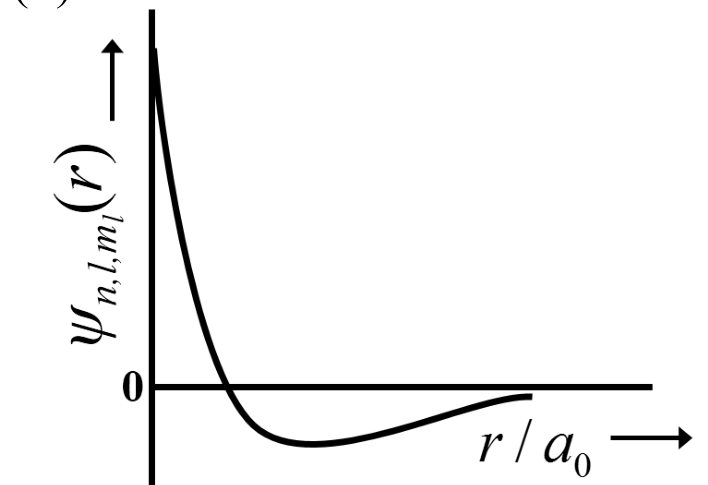
Options
(I) (i) (R)
(II) (ii) (Q)
(I) (iii) (R)
(I) (i) (S)
Topics & Concepts
Step-by-Step Solution
To determine the INCORRECT combination for the ion, let us analyze the relationships between the entries in Column 1, Column 2, and Column 3 for each given option.
1. Analysis of the Wave Functions and Properties
-
1s Orbital :
-
The wave function for a orbital () of a hydrogen-like species (, ) is given by: This directly matches (i) in Column 2:
-
The probability density reaches its absolute maximum at (at the nucleus). This matches (R) in Column 3.
-
-
Orbital :
- The wave function for a orbital () is given by: This corresponds to (iii) in Column 2.
-
2s Orbital :
- Number of radial nodes = . This corresponds to (ii) in Column 2.
- For any s-orbital (), the probability density at the nucleus () is non-zero and proportional to . This corresponds to (Q) in Column 3.
-
Excitation Energy Statement :
- For a single-electron species like , the energy required to excite an electron between energy levels and is given by:
- For transition :
- For transition :
- The ratio of energies is: Hence, statement (S) is correct for .
2. Evaluation of the Options
-
Option A: (I) (i) (R)
- (I) is 1s orbital (i) is its correct wave function (R) correctly states maximum probability density at the nucleus.
- Result: CORRECT combination.
-
Option B: (II) (ii) (Q)
- (II) is 2s orbital (ii) correctly gives one radial node (Q) correctly gives probability density at the nucleus .
- Result: CORRECT combination.
-
Option C: (I) (iii) (R)
- (I) represents the 1s orbital, whereas (iii) is the wave function expression for the orbital.
- A 1s orbital cannot be represented by wave function (iii).
- Result: INCORRECT combination.
-
Option D: (I) (i) (S)
- (I) is 1s orbital (i) is its correct wave function (S) is a true energy transition relationship for .
- Result: CORRECT combination.
Conclusion
The only INCORRECT combination is (C).