Identify Hydrocarbon P from Ozonolysis and Haloform Reaction
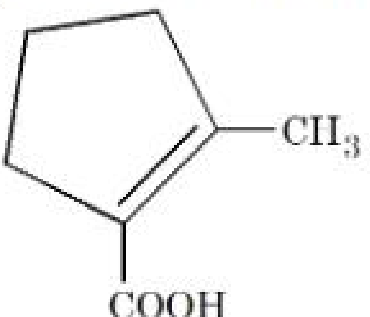
"P" is a hydrocarbon of molecular formula:- . On ozonolysis, "P" forms "Q". "Q" on treatment with alkali under reflux condition produces "R", which on treatment with gives a yellow precipitate. Acidification of the solution gives "S". The structure of "S" is given below:-
The correct structure of "P" is
Options
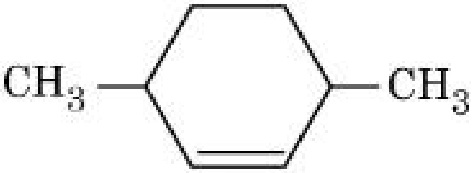
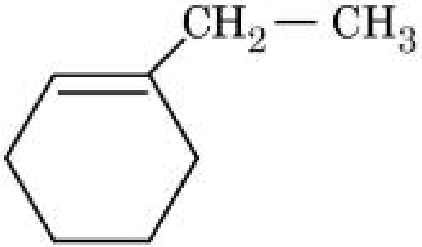
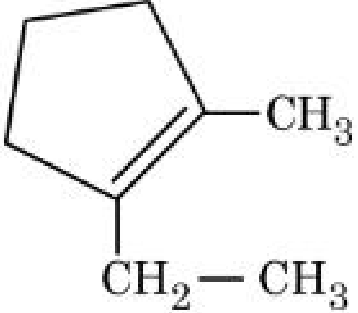
Step-by-Step Solution
To determine the correct structure of the hydrocarbon P (), we can analyze the reaction sequence in a step-by-step manner starting from the final product S and working backwards:
1. Structure of Compound S
The given structure of compound S is 2-methylcyclopent-1-ene-1-carboxylic acid, which contains a five-membered ring with:
- A double bond between and .
- A carboxylic acid group () at .
- A methyl group () at .
2. Haloform Reaction to form S from R
Compound S is formed by treating compound R with (haloform reaction) followed by acidification: Since the haloform reaction specifically oxidizes methyl ketones () to carboxylic acids (), compound R must contain an acetyl group () at of the cyclopentene ring. Thus, R is 1-(2-methylcyclopent-1-en-1-yl)ethan-1-one.
3. Intramolecular Aldol Condensation to form R from Q
Compound R is formed by treating compound Q with alkali under reflux conditions. This is an intramolecular aldol condensation reaction:
- Ring closure of a 1,6-dicarbonyl compound forms a stable 5-membered ring.
- Reversing the aldol condensation (cleaving the double bond and adding the elements of water back across the carbonyl and adjacent position) reveals the diketone Q:
4. Ozonolysis of P to form Q
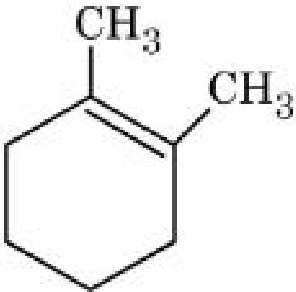
Ozonolysis of hydrocarbon P () yields the diketone Q (octane-2,7-dione). Joining the two carbonyl carbons of Q together with a double bond gives the structure of hydrocarbon P:
Thus, the starting hydrocarbon P is 1,2-dimethylcyclohexene.
Comparing with the given options:
- Option D represents 1,2-dimethylcyclohexene.
Correct Answer: D