Identify Final Product S in Sequential Reaction of Ethyl Ester
Comprehension Passage
Reaction of compound P with excess in followed by addition of yields Q. Treating compound Q with at forms R. Reacting R with in the presence of anhydrous in , followed by treatment with , produces compound S. [Here, in compound P represents an ethyl group]
Determine the structure corresponding to product S:

Options
A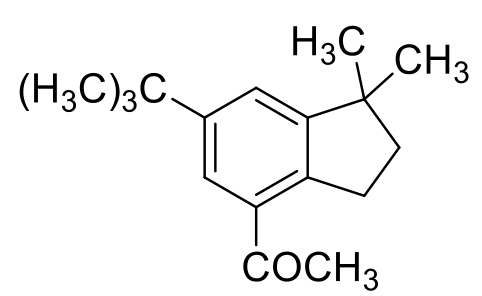 Correct
B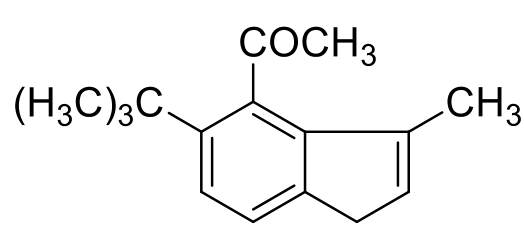
C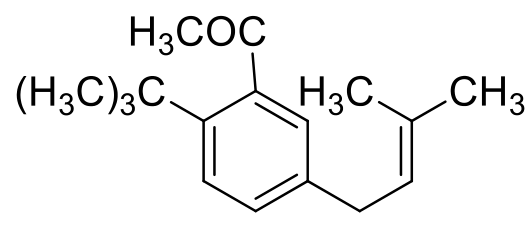
D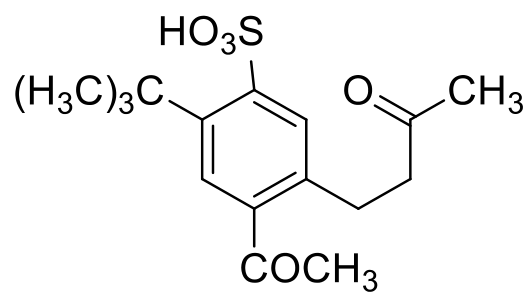
Step-by-Step Solution
To determine the structure of the final product S, let us trace the sequential chemical reactions step-by-step:
Step 1: Conversion of Compound P to Q (Grignard Reaction)
- Compound P is ethyl 3-(4-(tert-butyl)phenyl)propanoate, which contains an ester functional group ().
- Reaction with excess methylmagnesium bromide () followed by hydrolysis () results in nucleophilic addition of two methyl groups to the carbonyl carbon of the ester, yielding a tertiary alcohol.
- Thus, compound Q is 4-(4-(tert-butyl)phenyl)-2-methylbutan-2-ol:
Step 2: Conversion of Compound Q to R (Intramolecular Friedel-Crafts Alkylation)
- Treatment of tertiary alcohol Q with concentrated sulfuric acid () at results in the protonation of the hydroxyl group and elimination of a water molecule to generate a stable tertiary carbocation:
- This tertiary carbocation undergoes an intramolecular Friedel-Crafts alkylation attacking the benzene ring at the position ortho to the alkyl chain, giving a 5-membered fused ring system (an indane derivative).
- Thus, compound R is 6-(tert-butyl)-1,1-dimethylindane.
Step 3: Conversion of Compound R to S (Friedel-Crafts Acylation)
- Reaction of R with acetyl chloride () in the presence of anhydrous causes electrophilic aromatic substitution (Friedel-Crafts acylation).
- The aromatic ring has three open positions for electrophilic attack: C4, C5, and C7.
- Positions C5 and C7 are sterically hindered due to the adjacent bulky tert-butyl group at C6 and the quaternary carbon at C1.
- Position C4 is ortho to the less hindered carbon (C3) of the fused ring and meta to the tert-butyl group.
- Therefore, electrophilic substitution by the acetylium ion () occurs selectively at position C4 to minimize steric repulsion.
Hence, the correct structure corresponding to product S is given in Option A.
Correct Option: [A]