Identify Compounds Soluble in Aqueous Sodium Hydroxide Solution
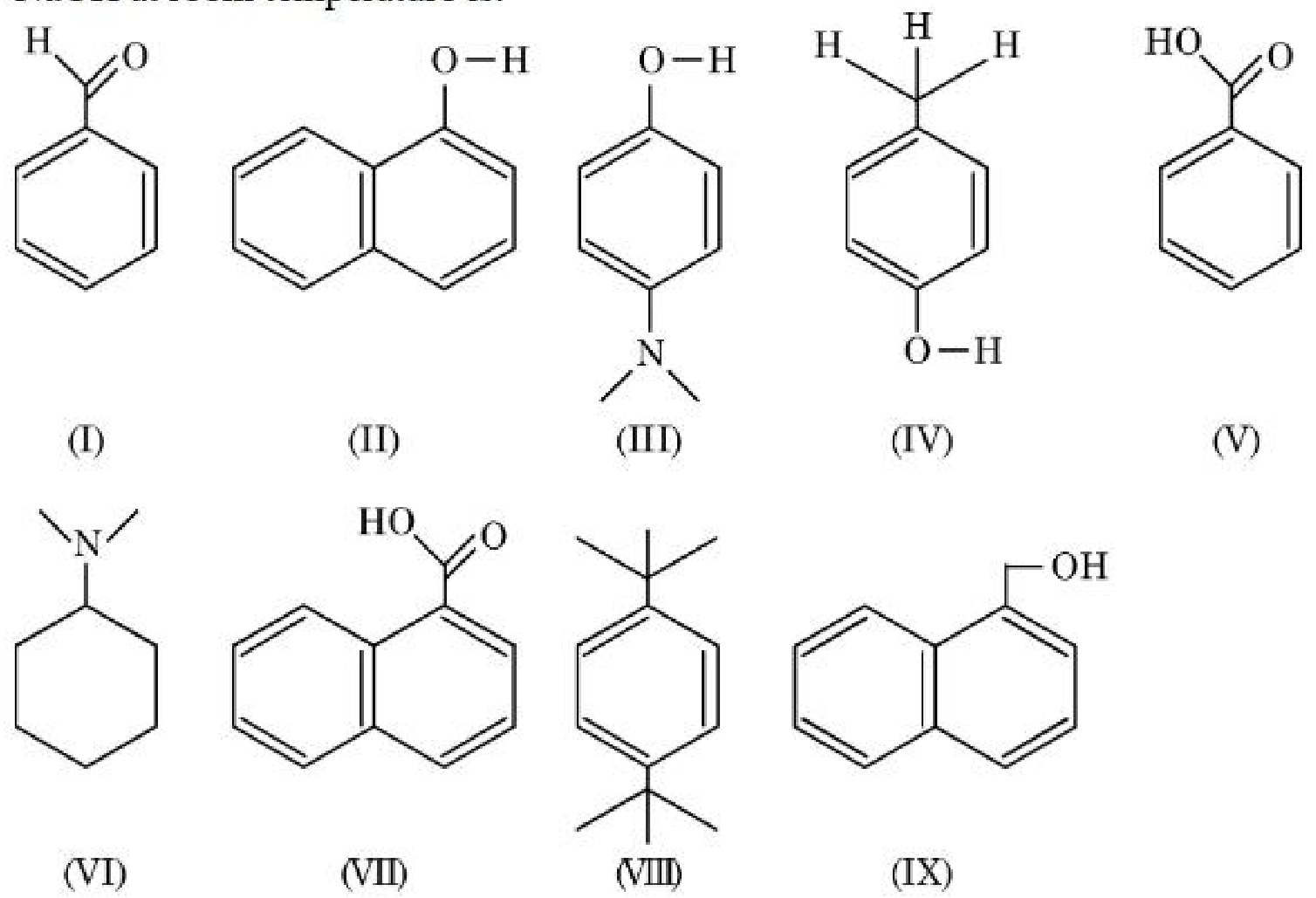
Amongst the following, the total number of compounds soluble in aqueous at room temperature is:
Options
5
4
6
3
Step-by-Step Solution
To determine the number of compounds soluble in aqueous at room temperature, we analyze the acidity and chemical nature of each compound given in the image.
Compounds that are acidic enough to react with aqueous (a strong base) will form water-soluble ionic salts (such as sodium carboxylates or sodium phenolates) and thus dissolve in the solution. These typically include:
- Carboxylic acids (), which have .
- Phenols (), which have .
Now, let's evaluate each of the 9 given compounds:
-
Compound (I) - Benzaldehyde (): It is a neutral carbonyl compound and does not react with aqueous to form a soluble salt. Insoluble
-
Compound (II) - 1-Naphthol (-naphthol): It contains a phenolic group (). It reacts with to form water-soluble sodium 1-naphtholate. Soluble
-
Compound (III) - 4-Hydroxypyridine / 4-Pyridone: This compound exists predominantly in its 4-pyridone keto-tautomeric form (amide-like structure) and is not classified as a standard acidic phenolic compound that forms a sodium salt soluble in aqueous . Insoluble
-
Compound (IV) - -Cresol (4-methylphenol): It contains a phenolic group (). It reacts with to form a soluble sodium salt. Soluble
-
Compound (V) - Benzoic acid (): It is a carboxylic acid (). It reacts readily with to form soluble sodium benzoate. Soluble
-
Compound (VI) - -Dimethylcyclohexylamine: It is a basic tertiary amine and does not react with bases like . Insoluble
-
Compound (VII) - 1-Naphthoic acid: It is an aromatic carboxylic acid. It reacts with to form a soluble sodium carboxylate salt. Soluble
-
Compound (VIII) - 1,4-Di-tert-butylbenzene: It is a non-polar hydrocarbon and is insoluble in aqueous solutions. Insoluble
-
Compound (IX) - 2-Naphthol (-naphthol): It contains a phenolic group (). It reacts with to form water-soluble sodium 2-naphtholate. Soluble
Conclusion:
The compounds that are soluble in aqueous are:
- (II) 1-Naphthol
- (IV) -Cresol
- (V) Benzoic acid
- (VII) 1-Naphthoic acid
- (IX) 2-Naphthol
Total number of soluble compounds = .
Thus, the correct option is A.