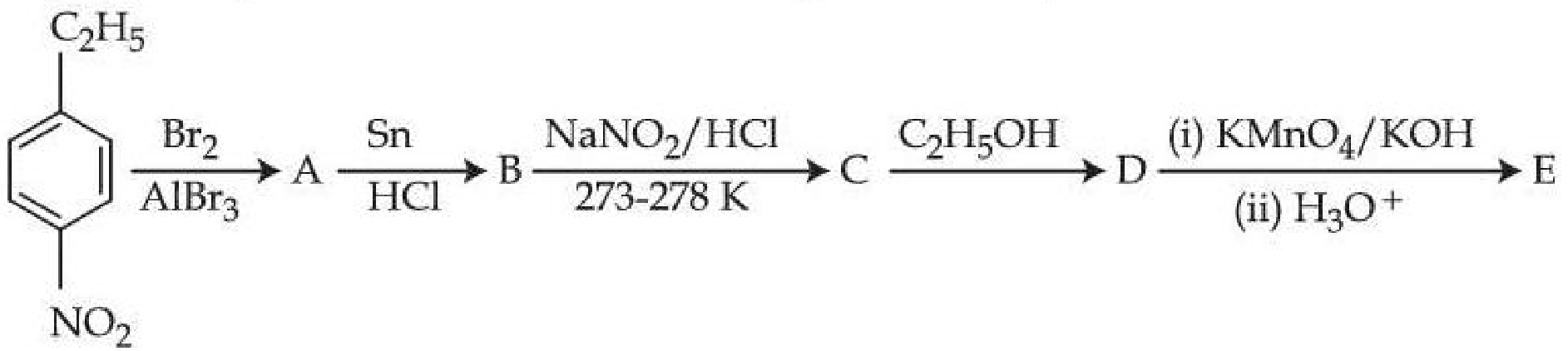
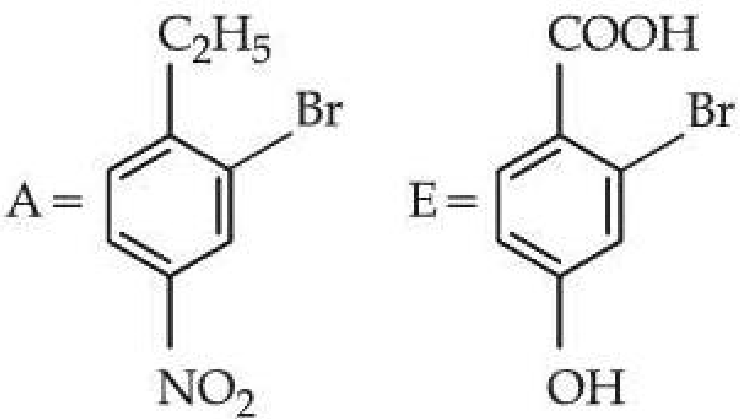
The ethyl group (−C2H5) is an activating and ortho/para-directing group via hyperconjugation and inductive effects (+I).
The nitro group (−NO2) is a strongly deactivating and meta-directing group via resonance (−R) and inductive effects (−I).
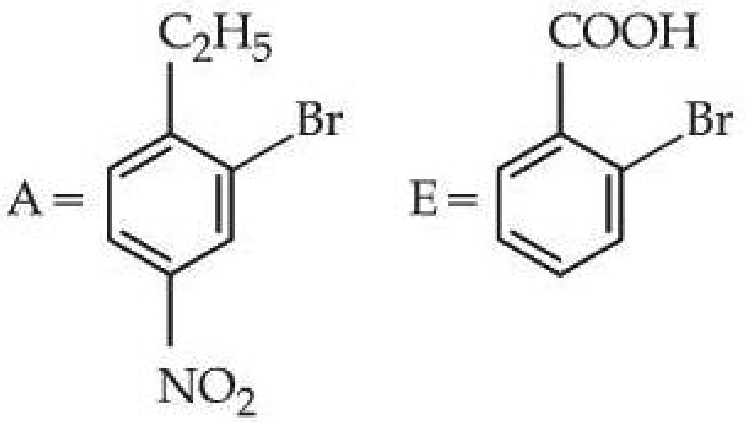
Since the orientation of electrophilic substitution is governed by the stronger activating group (−C2H5), and the para-position relative to −C2H5 is blocked by −NO2, the electrophile (Br+) attacks at the position ortho to −C2H5 (which is also meta to −NO2).
Ethanol acts as a mild reducing agent, replacing the diazonium group (−N2+Cl−) with a hydrogen atom (−H):
CC2H5OHD: 1-bromo-2-ethylbenzene
Step 5: Side-Chain Oxidation ((i) KMnO4/KOH, (ii) H3O+)
Alkaline potassium permanganate oxidizes the alkyl side chain (−C2H5) containing benzylic hydrogens into a carboxylate salt, which upon acidification yields the carboxylic acid group (−COOH):
D(i) KMnO4/KOH(ii) H3O+E: 2-bromobenzoic acid
Conclusion:
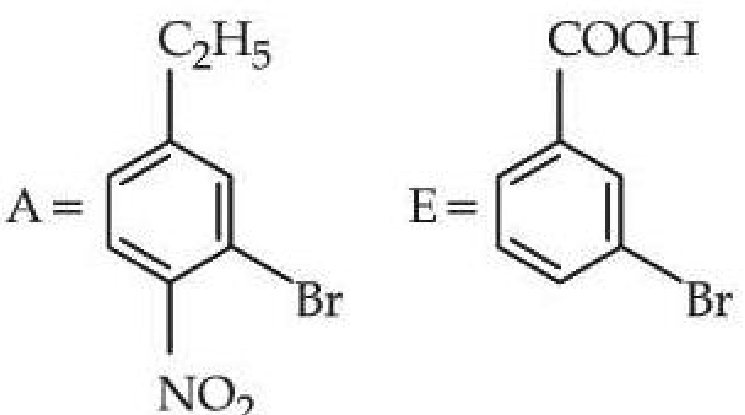
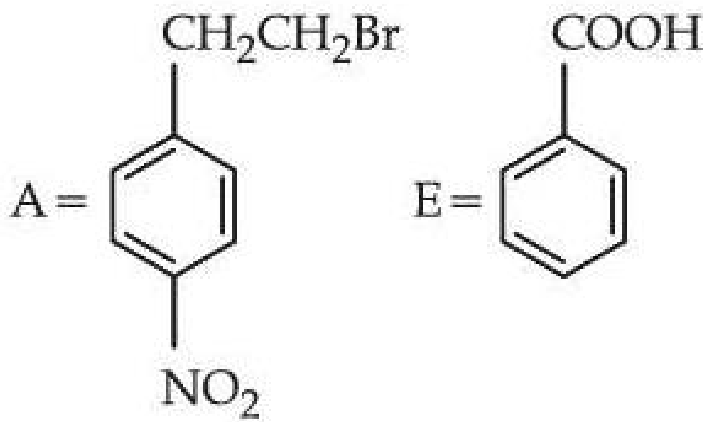
Compound A: 2-bromo-1-ethyl-4-nitrobenzene (with Brortho to C2H5)
Compound E: 2-bromobenzoic acid (with Brortho to COOH)
This corresponds to Option B.
Identify Compounds A and E in Reaction Sequence | Chemistry PYQ Solution - JEE Challenger