JEE Challenger
More from Aldehydes, Ketones and Carboxylic Acids

Identify Compound I in Perkin Reaction Sequence

Comprehension Passage

In the following reaction sequence, the compound J\mathbf{J} is an intermediate.

I→CH3COONa(CH3CO)2OJ→(iii) anhyd. AlCl3(i) H2,Pd/C, (ii) SOCl2K\mathbf{I} \xrightarrow[\text{CH}_3\text{COONa}]{\text{(CH}_3\text{CO)}_2\text{O}} \mathbf{J} \xrightarrow[\text{(iii) anhyd. AlCl}_3]{\text{(i) H}_2\text{,Pd/C, (ii) SOCl}_2} \mathbf{K}

J(C9H8O2)\mathbf{J} (\text{C}_9\text{H}_8\text{O}_2) gives effervescence on treatment with NaHCO3\text{NaHCO}_3 and a positive Baeyer's test.

The compound I\mathbf{I} is

Options

A
Option A
Correct
B
Option B
C
Option C
D
Option D

Step-by-Step Solution

To determine the structure of compound I\mathbf{I}, we analyze the given reaction conditions and chemical properties step-by-step:

  1. Identification of Reaction Type: The conversion of I\mathbf{I} to J\mathbf{J} using acetic anhydride (CH3CO)2O(\text{CH}_3\text{CO})_2\text{O} in the presence of sodium acetate (CH3COONa)(\text{CH}_3\text{COONa}) is the Perkin Reaction.

    In a standard Perkin reaction, an aromatic aldehyde (lacking α\alpha-hydrogens) reacts with an acid anhydride containing at least two α\alpha-hydrogens in the presence of the sodium salt of the acid to yield an α,β\alpha,\beta-unsaturated carboxylic acid.

  2. Properties and Structure of Compound J\mathbf{J}:

    • Reaction with NaHCO3\text{NaHCO}_3: Effervescence on treatment with sodium bicarbonate indicates the presence of a carboxylic acid group (−COOH-\text{COOH}).
    • Positive Baeyer's Test: Decolorization of cold, alkaline KMnO4\text{KMnO}_4 indicates the presence of carbon-carbon unsaturation (−CH=CH−-\text{CH}=\text{CH}-).
    • Molecular Formula: Compound J\mathbf{J} has the formula C9H8O2\text{C}_9\text{H}_8\text{O}_2.

    Given that compound J\mathbf{J} is formed via a Perkin reaction and has formula C9H8O2\text{C}_9\text{H}_8\text{O}_2, it is cinnamic acid: J=C6H5−CH=CH−COOH\mathbf{J} = \text{C}_6\text{H}_5-\text{CH}=\text{CH}-\text{COOH}

  3. Determination of Compound I\mathbf{I}: Since cinnamic acid (J\mathbf{J}) is synthesized by reacting an aromatic aldehyde with acetic anhydride: I+(CH3CO)2O→CH3COONaC6H5−CH=CH−COOH+CH3COOH\mathbf{I} + (\text{CH}_3\text{CO})_2\text{O} \xrightarrow{\text{CH}_3\text{COONa}} \text{C}_6\text{H}_5-\text{CH}=\text{CH}-\text{COOH} + \text{CH}_3\text{COOH}

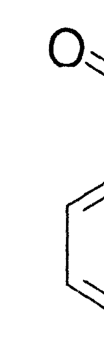
    The starting aldehyde I\mathbf{I} must be benzaldehyde (C6H5CHO\text{C}_6\text{H}_5\text{CHO}).

  4. Confirmation via Subsequent Steps (Formation of Compound K\mathbf{K}):

    • Hydrogenation (i): Reduction of J\mathbf{J} using H2/Pd-C\text{H}_2/\text{Pd-C} selectively reduces the double bond to form 3-phenylpropanoic acid: C6H5−CH=CH−COOH→H2/Pd-CC6H5−CH2−CH2−COOH\text{C}_6\text{H}_5-\text{CH}=\text{CH}-\text{COOH} \xrightarrow{\text{H}_2/\text{Pd-C}} \text{C}_6\text{H}_5-\text{CH}_2-\text{CH}_2-\text{COOH}
    • Chlorination (ii): Treatment with SOCl2\text{SOCl}_2 converts the acid into an acyl chloride: C6H5−CH2−CH2−COOH→SOCl2C6H5−CH2−CH2−COCl\text{C}_6\text{H}_5-\text{CH}_2-\text{CH}_2-\text{COOH} \xrightarrow{\text{SOCl}_2} \text{C}_6\text{H}_5-\text{CH}_2-\text{CH}_2-\text{COCl}
    • Intramolecular Friedel-Crafts Acylation (iii): Treatment with anhydrous AlCl3\text{AlCl}_3 leads to ring closure, yielding 1-indanone (K\mathbf{K}).

Thus, compound I\mathbf{I} is benzaldehyde (C6H5CHO\text{C}_6\text{H}_5\text{CHO}), which corresponds to option A.

Correct Answer: A