Identify Aromatic Compounds from Given Chemical Reactions
Out of the given species and , select the aromatic compound(s):
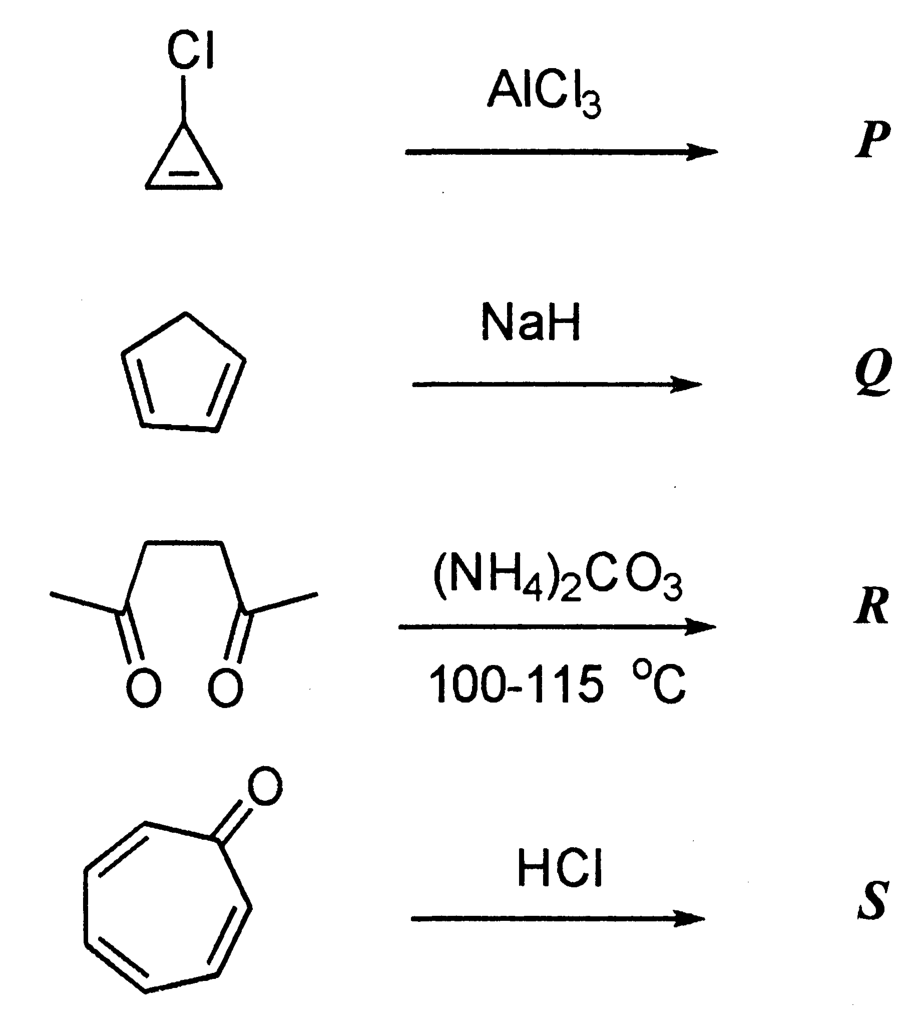
Options
A
Correct
B
Correct
C
Correct
D
Correct
Topics & Concepts
Step-by-Step Solution
To determine which of the given reaction products and are aromatic, we evaluate each chemical transformation and apply Hückel's Rule of Aromaticity ( electrons in a cyclic, planar, fully conjugated system):
1. Formation of Product
- Reaction: 3-Chlorocyclopropene is treated with the Lewis acid .
- Structure of : Cyclopropenyl cation ().
- Aromaticity Analysis:
- It is cyclic and planar with all carbon atoms being hybridized.
- Number of delocalized -electrons = .
- Satisfies Hückel's rule for : .
- Conclusion: is aromatic.
2. Formation of Product
- Reaction: Cyclopentadiene is treated with a strong base, sodium hydride ().
- Structure of : Cyclopentadienyl anion ().
- Aromaticity Analysis:
- The ring is cyclic, planar, and fully conjugated.
- Contains electrons from two double bonds and electrons from the lone pair on the carbanion, giving a total of electrons.
- Satisfies Hückel's rule for : .
- Conclusion: is aromatic.
3. Formation of Product
- Reaction: Hexane-2,5-dione (a -dicarbonyl compound) is heated with ammonium carbonate, (Paal-Knorr pyrrole synthesis).
- Structure of : 2,5-dimethylpyrrole.
- Aromaticity Analysis:
- The pyrrole ring is cyclic, planar, and completely conjugated.
- It contains electrons from two double bonds and electrons from the nitrogen lone pair delocalized into the ring, totaling electrons.
- Satisfies Hückel's rule for : .
- Conclusion: is aromatic.
4. Formation of Product
- Reaction: Cycloheptatrienone (tropone) is treated with hydrochloric acid ().
- Structure of : Hydroxytropylium cation.
- Aromaticity Analysis:
- Protonation at the oxygen atom leads to the formation of the hydroxytropylium ion, which has a positive charge delocalized over the seven-membered ring.
- The ring is cyclic, planar, and fully conjugated.
- Contains electrons from three double bonds.
- Satisfies Hückel's rule for : .
- Conclusion: is aromatic.
Final Answer
All species and are aromatic compounds.
- Correct Options: A, B, C, D