Identify Alkene Structure from Ozonolysis Products
An alkene (X) on ozonolysis followed by reduction gives following products. , ,
The alkene (X) is:
Options
A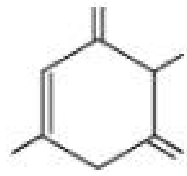
B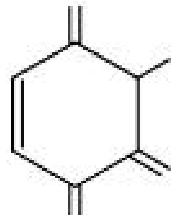
C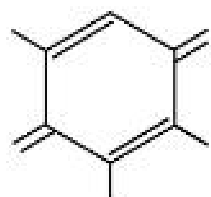
D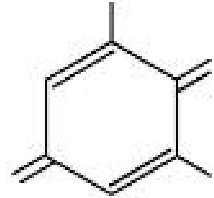 Correct
Step-by-Step Solution
To identify the structure of the alkene , we analyze the products obtained from its reductive ozonolysis by working backward and reconstructing the parent carbon skeleton.
1. Analysis of the Products
-
Formaldehyde (): Each mole of formaldehyde () is formed by the cleavage of an exocyclic terminal double bond (). Thus, the starting alkene contains two groups.
-
2-Oxopropanedial ():
- The two terminal aldehyde groups () arise from the cleavage of endocyclic double bonds () in the ring.
- The central carbonyl group () arises from a carbon atom that was originally attached to an exocyclic double bond (). Upon ozonolysis, this exocyclic double bond cleaves to yield a ketone carbonyl at this position and .
-
Butane-2,3-dione ():
- This fragment contains two acetyl groups () linked by a single carbon-carbon bond ().
- The two carbonyl carbons correspond to ring carbons that were each attached to a methyl group () and participated in double bonds.
2. Reconstructing the Alkene
To find the structure of alkene , we replace each carbonyl oxygen () in the products with a double bond () connecting the corresponding carbon atoms:
- Joining the two terminal aldehyde carbons of with the carbonyl carbons of re-establishes the six-membered ring.
- Restoring the exocyclic double bonds () at the central carbonyl carbon of the tri-carbonyl fragment and at the acetyl carbons accounts for all .
This connectivity corresponds precisely to the structure shown in Option D.
Conclusion
The correct option is D.