Identification of Reaction Sequence Producing Dicarboxylic Acid As Major Product
The correct reaction/reaction sequence that would produce a dicarboxylic acid as the major product is
Options
Step-by-Step Solution
To determine which reaction sequence yields a dicarboxylic acid as the major product, we analyze each option step-by-step:
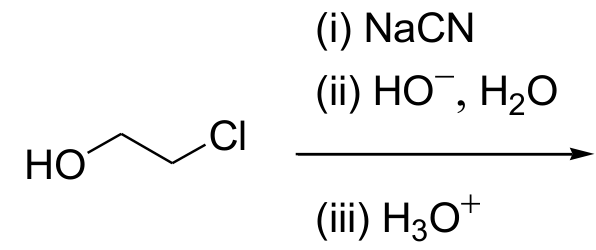
Option (A):
-
Nucleophilic Substitution: Reaction of 2-chloroethanol () with involves an displacement of the chloride ion by the cyanide nucleophile ():
-
Hydrolysis: Basic hydrolysis () followed by acid workup () hydrolyzes the nitrile group () into a carboxylic acid group ():
- Product: -hydroxypropanoic acid, which is a monocarboxylic acid.
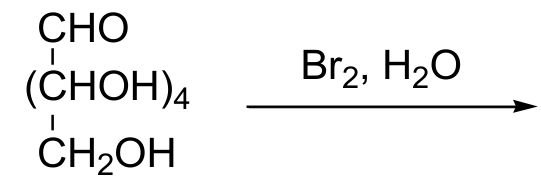
Option (B):
-
Mild Oxidation: Bromine water () is a mild oxidizing agent that selectively oxidizes the aldehyde group () of D-glucose to a carboxylic acid group (), leaving the primary alcohol group () intact:
-
Product: D-gluconic acid, which is a monocarboxylic acid. (Note: Oxidation to a dicarboxylic acid such as D-saccharic acid would require a stronger oxidant like concentrated ).
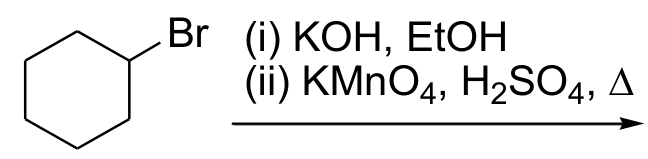
Option (C):
-
Dehydrohalogenation ( Elimination): Treatment of bromocyclohexane with alcoholic potassium hydroxide () undergoes elimination to form cyclohexene:
-
Oxidative Cleavage: Heating cyclohexene with acidic potassium permanganate () leads to the oxidative cleavage of the double bond. Each carbon of the alkene () is fully oxidized to a carboxylic acid group ():
- Product: Hexanedioic acid (Adipic acid), which contains two carboxylic acid groups and is a dicarboxylic acid.
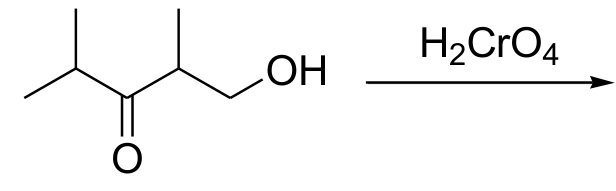
Option (D):
-
Jones Oxidation: Chromic acid () selectively oxidizes the primary alcohol group () to a carboxylic acid group (), while the ketone functional group remains unaffected:
-
Product: A keto-carboxylic acid, which is a monocarboxylic acid.
Conclusion:
The reaction sequence in Option (C) produces hexanedioic acid (adipic acid), a dicarboxylic acid, as the major product.
Correct Answer: (C)