Identification of Organic Compounds P and R via Ozonolysis Reactions
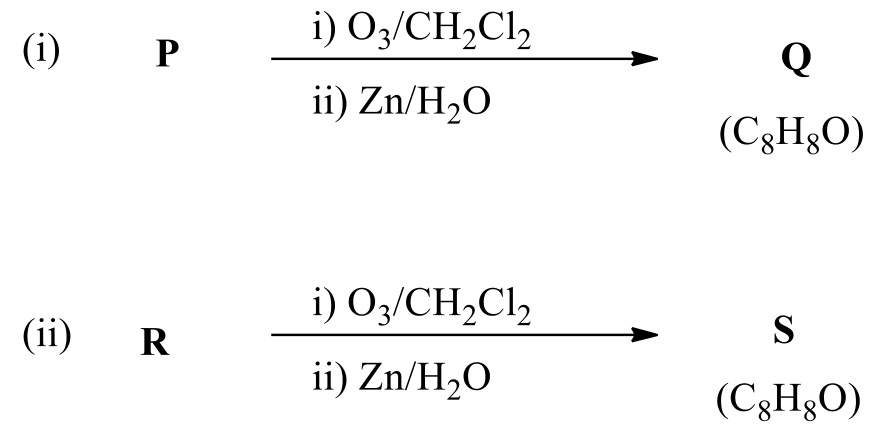
Ozonolysis of compounds P and R yields products Q and S, respectively. Both Q and S share the molecular formula C8H8O. Product Q gives a positive Cannizzaro reaction but does not undergo haloform reaction, while product S undergoes haloform reaction but fails to undergo Cannizzaro reaction.
(i) Pi) O3/CH2Cl2ii) Zn/H2OQ(C8H8O)
(ii) Ri) O3/CH2Cl2ii) Zn/H2OS(C8H8O)
Identify the suitable combination(s) for P and R, respectively, from the options given below.
To determine the suitable combination(s) for compounds P and R, let us analyze the chemical characteristics and requirements given for their ozonolysis products Q and S.
1. Analysis of Product Q
Molecular Formula:C8H8O
Cannizzaro Reaction: Product Q undergoes a positive Cannizzaro reaction, which implies that Q must be an aldehyde that lacks α-hydrogens (α-H=0).
Haloform Reaction: Product Q does not undergo a haloform reaction, which means it lacks the methyl ketone group (−C(=O)CH3) or the −CH(OH)CH3 unit.
Therefore, Q must be a methyl-substituted benzaldehyde isomer (such as 2-methylbenzaldehyde, 3-methylbenzaldehyde, or 4-methylbenzaldehyde), all of which have the molecular formula C8H8O and contain zero α-hydrogens.
2. Analysis of Product S
Molecular Formula:C8H8O
Haloform Reaction: Product S undergoes a haloform reaction, indicating the presence of a methyl ketone group (−C(=O)CH3).
Cannizzaro Reaction: Product S fails to undergo a Cannizzaro reaction.
Given the molecular formula C8H8O and the presence of a methyl ketone group, product S is uniquely identified as acetophenone (C6H5COCH3). Acetophenone contains 3α-hydrogens on its methyl group, enabling the haloform reaction and preventing the Cannizzaro reaction.
3. Evaluation of Options
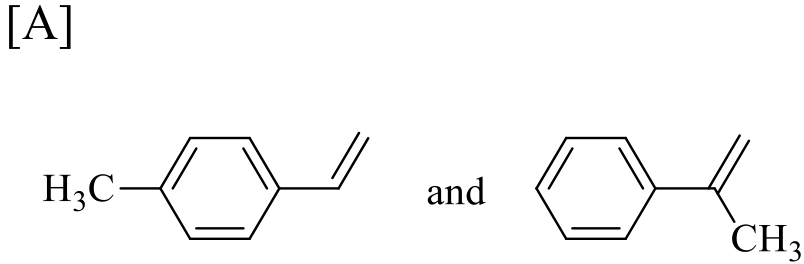
Option [A]:
Compound P (4-methylstyrene):H3C−C6H4−CH=CH2i) O3/CH2Cl2ii) Zn/H2OQ(C8H8O)H3C−C6H4−CHO+HCHO
Q=4-methylbenzaldehyde (C8H8O). It has no α-hydrogens (gives Cannizzaro) and no −COCH3 group (fails haloform). ✓
Compound R (2-phenylpropene):C6H5−C(CH3)=CH2i) O3/CH2Cl2ii) Zn/H2OS(C8H8O)C6H5−COCH3+HCHO
S=acetophenone (C8H8O). It undergoes haloform reaction and fails Cannizzaro reaction. ✓
Thus, Option [A] is correct.
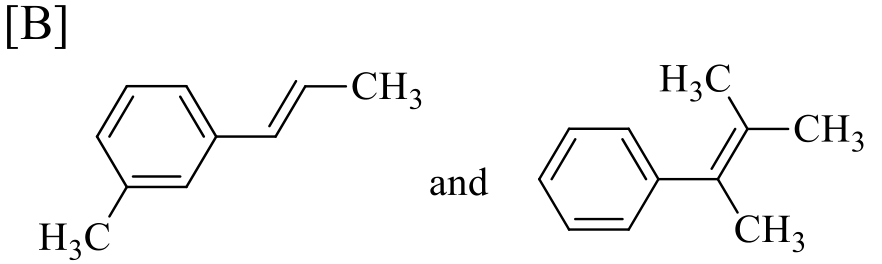
Option [B]:
Compound P (1-methyl-3-(prop-1-en-1-yl)benzene):m-CH3−C6H4−CH=CH−CH3i) O3/CH2Cl2ii) Zn/H2OQ(C8H8O)m-CH3−C6H4−CHO+CH3CHO
Q=3-methylbenzaldehyde (C8H8O). It gives Cannizzaro reaction and fails haloform reaction. ✓
Compound R ((3-methylbut-2-en-2-yl)benzene):C6H5−C(CH3)=C(CH3)2i) O3/CH2Cl2ii) Zn/H2OS(C8H8O)C6H5−COCH3+(CH3)2C=O
S=acetophenone (C8H8O). It undergoes haloform reaction and fails Cannizzaro reaction. ✓
Thus, Option [B] is correct.
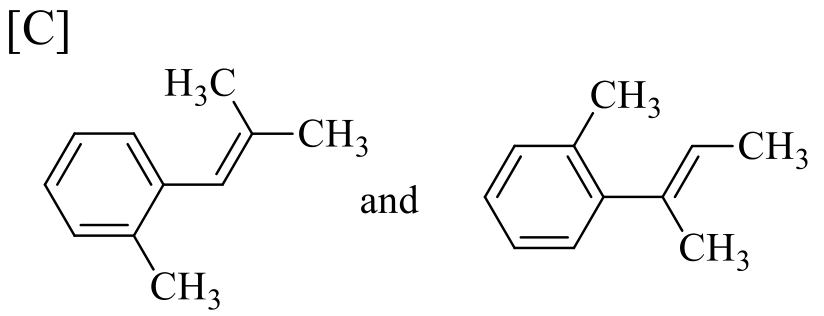
Option [C]:
Ozonolysis of compound R (1-methyl-2-(3-methylbut-2-en-2-yl)benzene) yields:
S=o-CH3−C6H4−COCH3(Molecular Formula: C9H10O)
Since the molecular formula of S is C9H10O instead of C8H8O, Option [C] is incorrect.
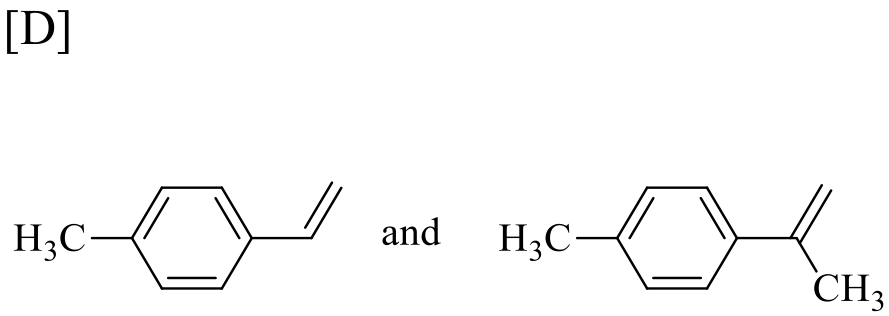
Option [D]:
Ozonolysis of compound R (1-methyl-4-(prop-1-en-2-yl)benzene) yields:
S=p-CH3−C6H4−COCH3(Molecular Formula: C9H10O)
Since the molecular formula of S is C9H10O instead of C8H8O, Option [D] is incorrect.
Conclusion
The suitable combinations for P and R are given by options A and B.